





Marquetry Captain Desk
A marquetry captain desk is a compact writing cabinet with intricate wood patterns, offering a neat workspace and hidden stationery compartments for a study.
Marquetry Captain Desk
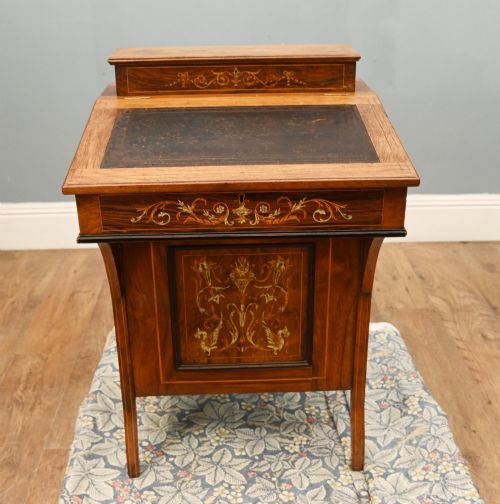
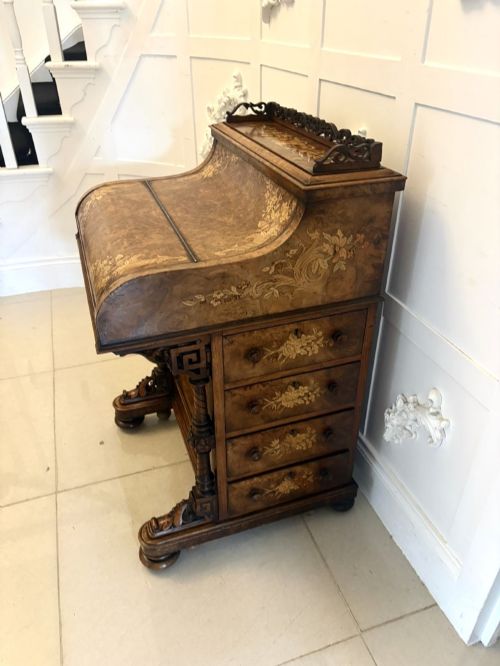
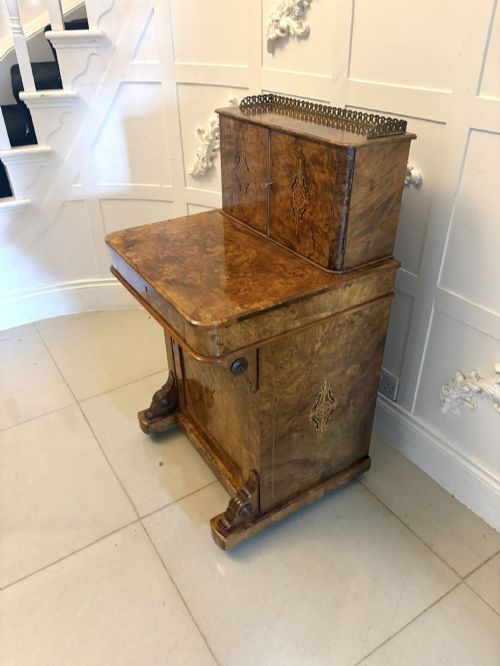
When you search for a marquetry captain desk, you are looking at compact writing cabinets, primarily Victorian Davenport desks and related writing furniture, that bring surface pattern into a working space. The version you are most likely to meet on this page is the Victorian walnut or burr walnut Davenport, frequently featuring inlaid marquetry and four side drawers.
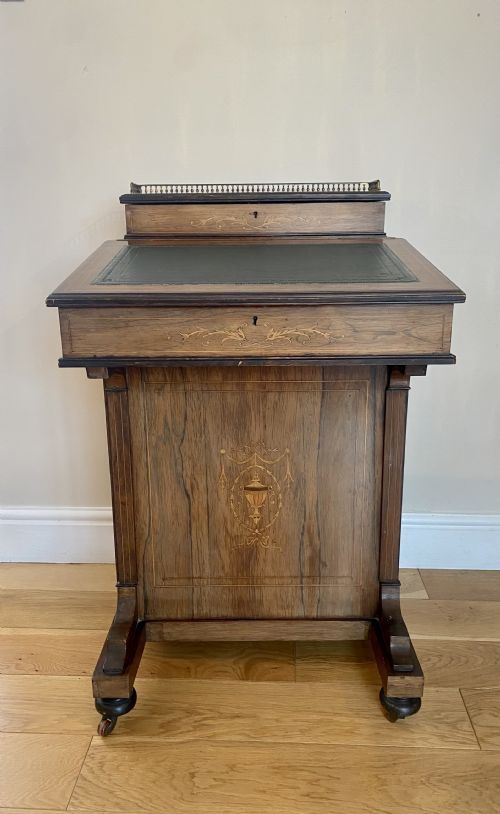
These pieces date predominantly from the nineteenth century, ranging from mid Victorian examples around eighteen fifty to Sheraton Revival interpretations toward nineteen hundred. Alongside traditional sloping desk forms, the selection includes related seating such as mahogany and rosewood desk chairs and swivel ships chairs designed to complement the writing cabinets.
Origins span standard domestic English cabinet making of the Victorian era alongside specific regional variations like Jerusalem olivewood work. The prevailing format combines a sloped, leather lined writing surface above a pedestal base, balancing decorative floral or geometric marquetry with practical daily utility.
How they were made
Cabinet makers built these pieces using solid and veneered timbers, relying heavily on burr walnut, plain walnut, rosewood, and mahogany as primary foundations. These woods provided stable, figured surfaces suited to intensive handling and decorative cutting.
Decoration relied on contrasting veneers set into the primary timber, employing marquetry inlay alongside boxwood and satinwood inlay to create floral scrolls and geometric borders. Working surfaces were traditionally inset with tooled leather to provide a durable writing plane.
Structural hardware combined brass handles, hinges, and operational mechanisms such as pop up stationery boxes or swivel joints on accompanying chairs. Joinery utilised traditional framing and drawer construction to support the heavy pedestal forms.
Marquetry Captain Desk Retail Price Guide 2026
Typical asking prices for marquetry captain desk among the pieces listed under this phrase on Sellingantiques today, from the lower quarter to the upper quarter. They describe what is for sale here now, not the wider market.
What varies in quality
The sophistication of the timber veneer and the precision of the marquetry inlay determine the initial visual tier of each piece. Finely figured burr walnut and complex floral marquetry represent more demanding craftsmanship than plain walnut or simpler linear stringing.
Construction details such as freestanding finished backs, secondary drawer linings, and original brass hardware distinguish superior workshop output from standard commercial production. The integration of mechanical elements like pop up compartments or sliding desk tops demonstrates higher ambition in cabinet making.
Proportion and the retention of matching seating elements, such as swivel desk chairs designed for the same period, elevate the coherence of the ensemble. Condition of the leather writing insert and the stability of the pedestal housing also mark the difference between heavily altered examples and well preserved survivals.
The Marquetry Captain Desk Glossary
- Marquetry inlay
- Decorative patterns formed by fitting together contrasting pieces of wood veneer onto a solid ground. This technique creates pictorial or geometric designs across the writing lid and body.
- Burr walnut
- Timber taken from the warted growths of walnut trees, yielding highly figured grain patterns with swirling knots. It was favoured by Victorian makers for its rich decorative impact.
- Davenport desk
- A small pedestal writing desk featuring a sloping, leather lined writing surface that often lifts to reveal storage compartments. Drawers typically open to one side rather than the front.
- Sheraton Revival
- A late nineteenth century design movement inspired by eighteenth century neoclassical furniture forms. Pieces from this revival often feature lighter timbers, satinwood inlay, and refined proportions.
- Pedestal base
- A supportive cabinet structure beneath the writing surface that houses banks of drawers. In these pieces, the pedestal supports the weight of the desk while offering secure internal storage.
Marquetry Captain Desk: Frequently Asked Questions
What is a Davenport desk?
A Davenport desk is a compact form of writing cabinet featuring a sloping lid above a pedestal of drawers. It was originally designed for use in small spaces or on shipboard.
The writing surface usually lifts to reveal a set of small interior drawers and pigeonholes for stationery storage.
How do you use the top compartment?
The upper section often houses a stationery box or a pop up mechanism that rises when released. It provides organised storage for pens, ink, and writing paper.
Some variants use a sliding or lifting lid to conceal these compartments when the desk is not in use.
Where were these desks placed?
These compact writing desks were typically positioned in drawing rooms, boudoirs, or studies where floor space was limited. Freestanding versions allowed placement in the centre of a room.
Their finished backs ensured they looked correct from every angle rather than pushed strictly against a wall.
How do I date a Victorian Davenport?
Dating relies on timber choice, inlay style, and mechanical fittings characteristic of the nineteenth century. Mid Victorian pieces from eighteen fifty to eighteen seventy often feature heavy burr walnut and rich marquetry.
Later Sheraton Revival examples from eighteen ninety onwards show lighter satinwood inlay and more slender proportions.