
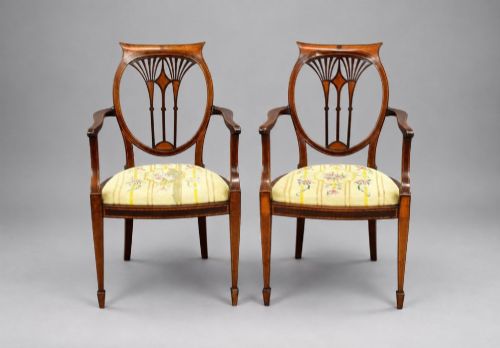
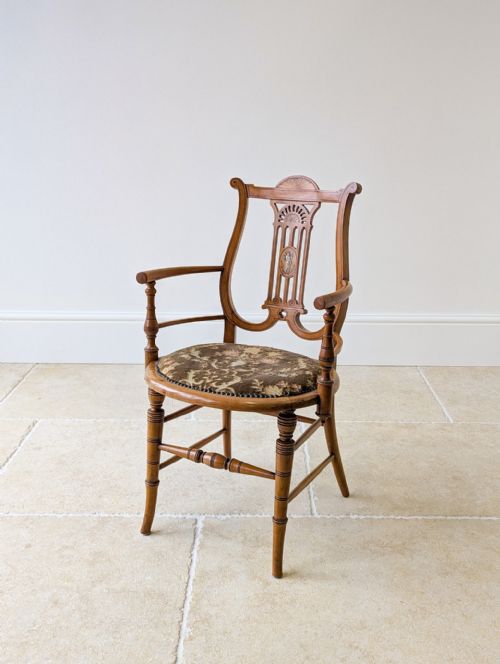
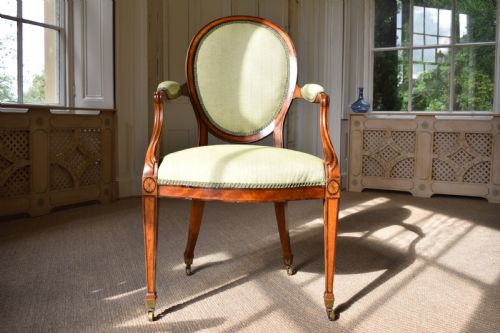
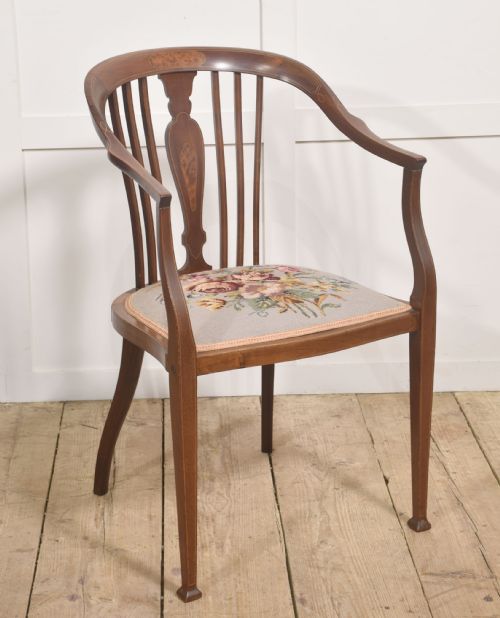


Marquetry Back Armchair
These marquetry back armchair examples combine timber framing with intricate wood inlay, offering both functional seating and decorative historic character.
Marquetry Back Armchair
A marquetry back armchair brings together structural seating timbers with detailed decorative wood inlay across the backrest. Buyers searching this phrase most frequently encounter Edwardian mahogany armchairs, salon chairs, and elbow chairs dating around nineteen hundred, alongside occasional Victorian pieces.
The selection ranges across several distinct forms, including corner chairs, rocking chairs, desk chairs, and high backed chairs. Styles span Edwardian revivalism, Art Nouveau, Sheraton Revival, Dutch Rococo, and Moorish Revival variations.
Earlier periods are represented by George III satinwood designs and late eighteenth century walnut high back armchairs with Dutch marquetry. These seating options served formal parlours, reception rooms, and studies.
Materials and construction
The primary framework relies on solid timbers such as mahogany, walnut, and satinwood, paired with contrasting wood inlay for the decorative motifs. Additional materials include brass details, alongside upholstered elements in fabric and velvet.
Makers integrated marquetry and wood inlay directly into the backrests and frames of the chairs. Construction methods united traditional cabinetmaking techniques with decorative surface ornamentation.
Materials recorded across current pieces include mahogany, satinwood, walnut, fabric, velvet, and brass.
Judging quality in inlay and timber
Quality rests upon the precision of the wood inlay and the selection of the primary timber body. Finer examples display crisp botanical or geometric marquetry set smoothly into mahogany, walnut, or satinwood.
Structural integrity of the joints and the crispness of carved details distinguish superior specimens from standard production. The harmony between the inlaid backrest and the overall proportion of the armchair dictates the standing of the piece.
James Shoolbred
The Marquetry Back Armchair Glossary
- Marquetry
- Decorative patterns formed by fitting together thin veneers of wood and other materials onto a structural surface. This technique creates pictorial or geometric designs across the backrest.
- Satinwood
- A pale, durable tropical timber prized for its lustrous sheen and golden colour. It frequently serves as the primary wood or contrasting veneer in Sheraton Revival furniture.
- Sheraton Revival
- A late nineteenth and early twentieth century design movement replicating the neoclassical furniture forms of George Sheraton. These pieces utilise delicate mahogany framing and satinwood inlay.
- Elbow chair
- A seating form featuring short arms designed to support the elbows rather than full length armrests. They appear frequently in Edwardian parlour and salon settings.
Marquetry Back Armchair: Frequently Asked Questions
What is a marquetry back armchair?
A marquetry back armchair is a wooden seat featuring decorative wood veneer inlay specifically integrated into the backrest design. These chairs date predominantly from the Victorian and Edwardian eras, incorporating styles like Sheraton Revival and Art Nouveau.
Such seating served as decorative yet functional furniture for parlours, salons, and studies, utilising rich timbers like mahogany and walnut.
How do I date an inlaid armchair?
Dating relies on examining the timber species, construction methods, and stylistic cues present in the woodwork. Edwardian examples often feature satinwood inlay on light mahogany frames, whilst Victorian and George III pieces display heavier proportions.
Stylistic influences such as Art Nouveau sweeping lines or Dutch Rococo shaping also help establish the manufacturing period.
Where were these armchairs used?
These armchairs were designed for formal reception rooms, drawing rooms, and studies within period homes. Parlour suites and salon settings utilised matching arm chairs and elbow chairs for entertaining guests.
Desk chairs and rocking chairs served functional roles in private studies and bedrooms.
What woods are used in these chairs?
Makers constructed the primary frames using hardwoods such as mahogany, walnut, and satinwood. Contrasting wood inlay provides the decorative patterns across the backrests.
Upholstery elements incorporate materials like velvet and fabric alongside brass hardware.