


Marble Top Half Moon
These marble top half moon tables bring distinctive neoclassical grace to hallways and drawing rooms through curved stone and timber.
Marble Top Half Moon
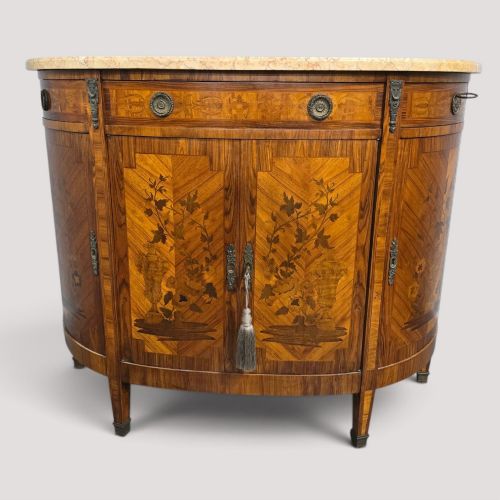
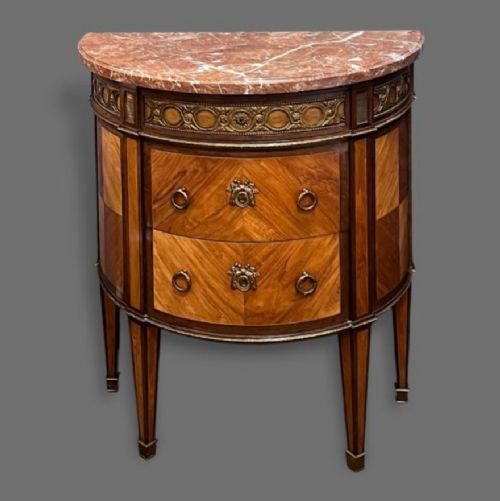
A marble top half moon table provides a distinctive semi-circular silhouette designed to sit flush against a wall in hallways and principal reception rooms. These pieces appear in forms ranging from console tables and cabinets to washstands, side tables, and chests of drawers.
The pieces on this page span several distinct eras, originating from the eighteenth century through to the Edwardian period and nineteen-twenty. French influences are particularly prominent, alongside Georgian style, English pieces, and occasional items from the Black Forest or Qing Dynasty.
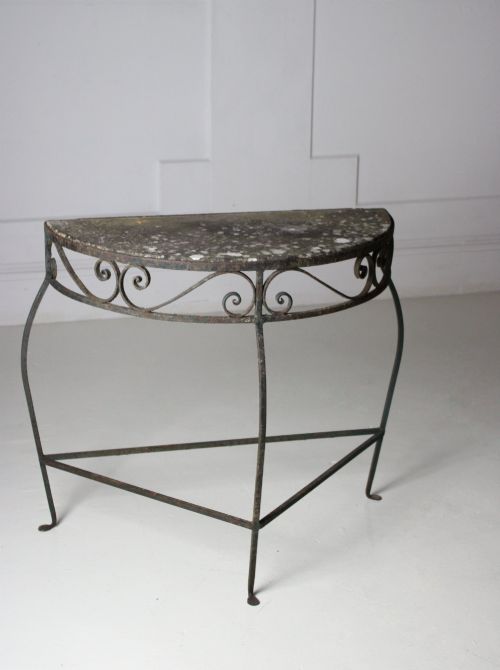
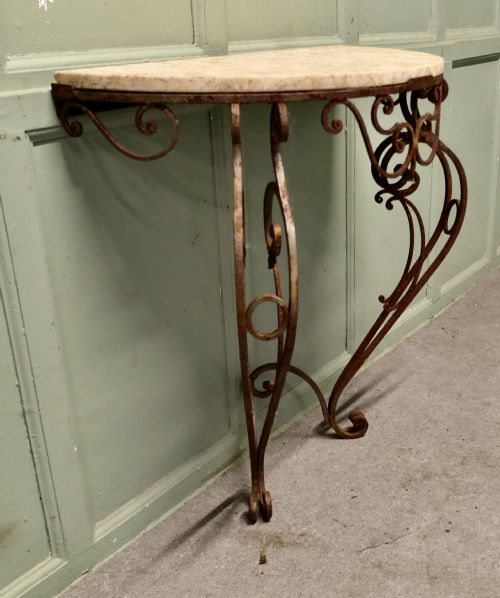
Console tables and demilune cabinets dominate the selection, frequently supported by wrought iron, walnut, mahogany, or painted woods. Buyers meet these items in various regional interpretations, from rustic French country designs to formal neoclassical compositions.
Materials and construction
The construction relies heavily on contrasting solid and veneered timbers such as walnut and mahogany, often enhanced by marquetry inlay or paintwork. Artisans shaped these woods into curved semi-circular frames to support heavy stone surfaces.
Slabs of marble, including distinctive varieties like rouge marble, form the functional and decorative tops of these tables and cabinets. Wrought iron and gilded bronze or ormolu provide structural support and ornamental detail on specific console and cabinet examples.
Materials across these listings include marble, walnut, wrought iron, wood, ormolu, mahogany, gilt, and paint.
Markers of quality
Quality reveals itself in the precision of the curved woodwork and the finesse of any marquetry inlay or carved detail. Superior pieces exhibit crisp joinery and well-balanced proportions that respect the classical demilune geometry.
The selection of the marble top and the integration of metalwork, such as wrought iron or ormolu mounts, distinguish standard utility items from more ambitious decorative furniture. Finer examples display meticulous surface finishes, whether polished timber grain or accomplished paintwork.
The Marble Top Half Moon Glossary
- Demi-lune
- A French term meaning half-moon, describing furniture with a semi-circular footprint designed to stand against a wall.
- Console table
- A wall-mounted or freestanding table supported by brackets or legs, historically placed in formal reception rooms.
- Marquetry
- The art of applying pieces of veneer to a structure to form decorative patterns, frequently utilised on cabinet doors and tabletops.
- Ormolu
- Gilded bronze used for decorative mounts and ornamentation on fine furniture.
- Neoclassical
- A style reviving classical architectural and decorative motifs, prominent in eighteenth and nineteenth-century design.
Marble Top Half Moon: Frequently Asked Questions
Where should I place a half moon table?
These pieces suit entrance halls, narrow corridors, and drawing rooms because their flat back sits securely against the wall without protruding too far into the floor space.
Their curved front softens the geometry of a room while providing a useful surface for lamps, mirrors, or decorative objects.
How do I care for the marble top?
Marble requires gentle cleaning with a damp cloth and mild soap, avoiding acidic substances like lemon or vinegar that can etch the polished stone surface.
Using coasters and mats helps prevent staining and scratching on antique marble.
Are these tables sturdy enough for daily use?
The heavy stone tops provide considerable weight that keeps the tables stable against the wall, though console tables often benefit from being secured to the wall for absolute safety.
Cabinets and chests offer enclosed storage alongside their surface utility, combining practicality with decorative presence.
How can I tell the period of the wood?
Examining the secondary timbers, construction joints, and finishing techniques helps indicate the age of the piece, alongside stylistic markers from eras like the Georgian or Edwardian periods.
French marquetry and painted finishes also carry distinct characteristics unique to their century of origin.