
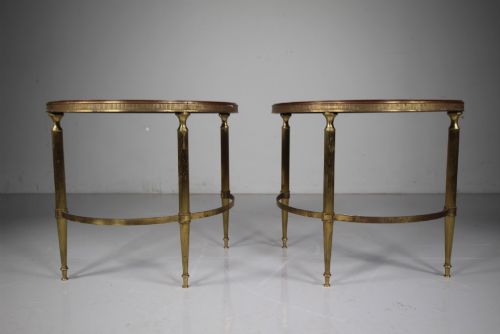
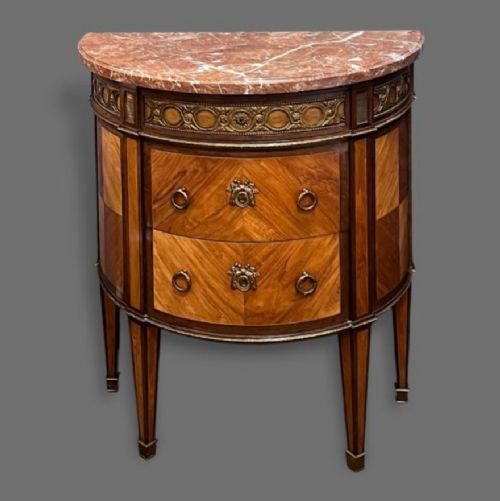


French Style Demi Lune
French style demi lune tables and cabinets are half-moon shaped statement pieces bringing classical elegance and practical surface space to hallways and drawing rooms.
French Style Demi Lune
When you search for french style demi lune, you encounter half-moon console tables, chests of drawers, games tables, and bedside cabinets. These pieces trace their origins to periods including the nineteenth century, the Edwardian era, and the nineteen-thirties.
Console tables form the core of what you will most likely meet on this page, frequently featuring marble tops and decorative wood finishes. Alongside these are games tables and commodes that echo classical European designs.
The aesthetic draws heavily on French Louis XVI, Louis XV Revival, and Grand Regency styles, alongside Georgian interpretations and Art Deco expressions. Makers occasionally referenced cabinetmakers such as Joseph-Emmanuel Zwiener in their work.
Construction and Materials
These items utilise a foundation of wood, incorporating cabinet timbers such as mahogany, walnut, kingwood, and satinwood. Many surfaces display intricate marquetry and painted details.
Marble tops, including rouge varieties, sit atop many of the console tables and cabinets, secured by wooden framing. Metal elements such as brass and ormolu provide mounts, handles, and gallery rails.
Several tables here feature hinged tops that fold out, reminding us that nineteenth-century card games demanded a sturdy half-moon surface.
Evaluating Quality
Quality reveals itself in the selection and arrangement of cabinet timbers and veneers, where thoughtful grain matching elevates a piece. The crispness of marquetry work and hand-painted decoration also separates standard examples from finer ones.
The weight and finish of applied brass or ormolu mounts indicate the standard of production. Similarly, the integration of heavy stone, such as a fitted marble top, demonstrates the precision of the underlying joinery.
Joseph Emmanuel Zwiener
The French Style Demi Lune Glossary
- Demi lune
- A half-moon shape used for tables, commodes, and cabinets designed to stand flush against a wall. This profile saves floor space while offering a display surface.
- Ormolu
- Gilt bronze mounted onto furniture as decorative feet, handles, and mounts. This technique was widely employed in fine cabinetmaking.
- Marquetry
- The art of applying pieces of veneer to a structure to form decorative patterns and pictures. It utilises various coloured woods to achieve tonal depth.
- Commode
- A low chest of drawers or cabinet standing on legs, originating in France. They often feature stone tops and elaborate veneer work.
- Console table
- A table supported by wall brackets or front legs, intended to stand against a wall. They frequently carry marble slabs.
French Style Demi Lune: Frequently Asked Questions
Where should I place a demi lune table?
These half-moon pieces suit narrow hallways, entryways, and landings where a standard rectangular table would obstruct foot traffic. They also function well against drawing room walls beneath mirrors or artwork.
Because they sit flat against the vertical surface, they occupy minimal depth while providing a useful ledge for lamps, vases, and correspondence.
Are marble tops original to these tables?
Many nineteenth-century and early twentieth-century examples incorporate fitted marble slabs, which served as durable, heat-resistant surfaces. These stones were typically selected to complement the wood beneath, such as kingwood or mahogany.
While replacements do occur over time, stone tops formed a standard specification for many console tables and commodes of this aesthetic.
How do I distinguish between periods?
Nineteenth-century items often display heavier timber usage, detailed marquetry, and classical ormolu mounts reflecting Louis XVI revivals. Pieces from the nineteen-thirties and Edwardian years sometimes lean towards simpler painted finishes or cleaner lines.
Examining the construction methods, secondary woods, and hardware helps determine whether an item dates to the eighteen-eighties or a later revival phase.
What is the difference between a console and a commode?
A console table is an open piece primarily designed for display and support against a wall, sometimes featuring a single drawer or a decorative frieze. A commode functions as a closed storage unit with drawers or cabinet doors.
Both formats utilise the half-moon demi lune footprint, but their internal structure and storage capabilities differ entirely.