
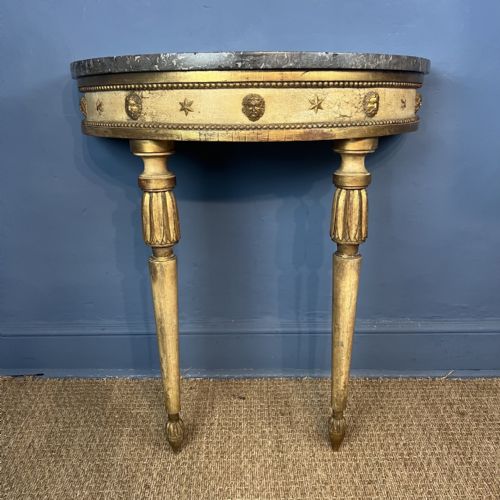


Marble Top Demilune
Marble top demilune pieces are semicircular tables and cabinets topped with stone, offering elegant surface space for hallways and principal rooms.
Marble Top Demilune
A marble top demilune takes the form of a half moon, designed to sit flush against a wall in a hallway or principal room. Console tables and side cabinets dominate the selection, bringing architectural presence without protruding far into the floor space.
The evidence spans the 18th century through to the early 20th century, including periods such as Regency, Victorian, and Edwardian. French and Italian influences appear frequently alongside English examples.
Makers and workshops across Europe produced these half moon forms in diverse styles, ranging from Neoclassical and Louis XVI to rustic French country and painted finishes.
Materials and construction
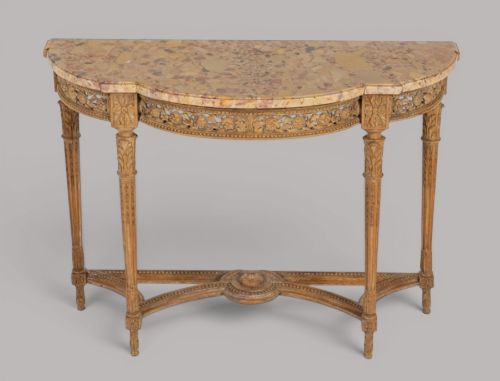
Craftsmen shaped dense hardwoods like mahogany, walnut, kingwood, and burr elm for the carcasses and frames, often applying intricate marquetry, parquetry, or giltwood details. Painted and parcel gilt finishes also feature across various continental pieces.
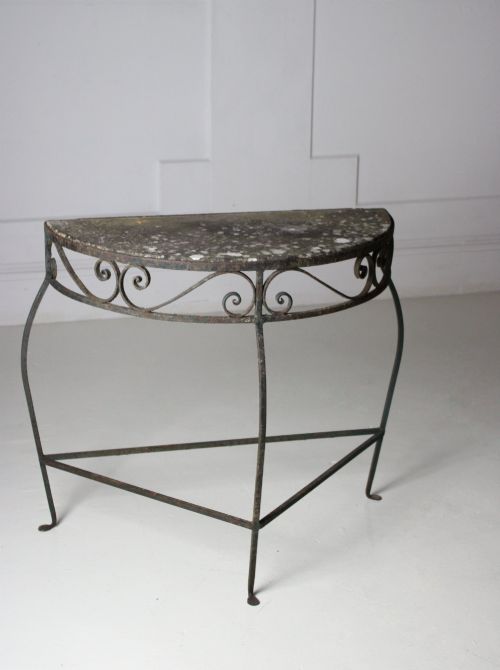
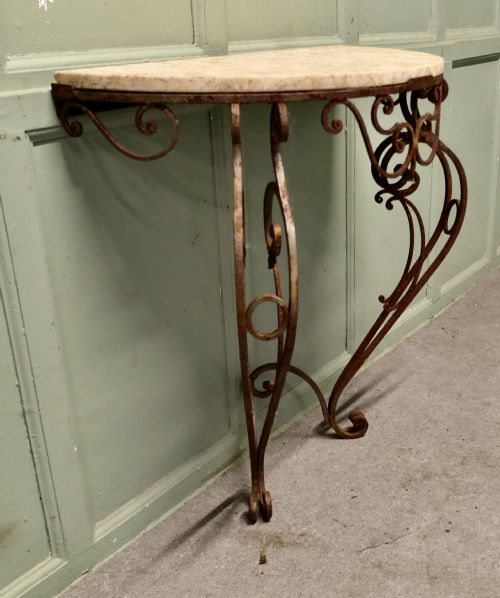
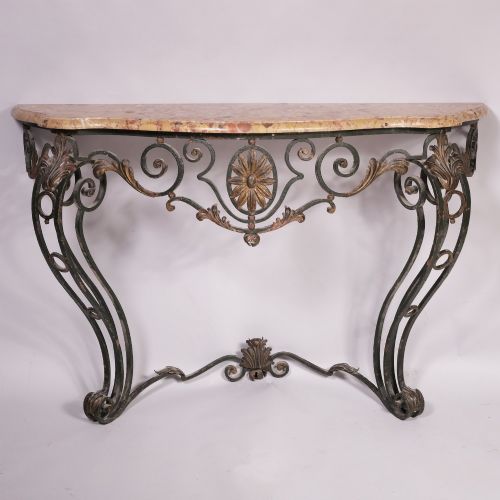
Wrought iron appears in structural frames for sturdier hall and console tables, contrasting with the smooth, heavy stone slabs fitted to the top. Gesso and ormolu add surface ornamentation and gilded highlights to the woodwork.
The stone tops themselves are cut to the exact half moon contour of the timber frame, resting flush to provide a durable and cool surface.
Among the hall furniture, a pair of late 19th-century Black Forest side tables takes the literal form of seated hounds.
Assessing quality
The sophistication of the carved woodwork and the choice of timber veneer dictate the grade of the piece, with finely figured walnut or kingwood marquetry marking out superior examples. Painted and gilded surfaces depend on the preservation of the original hand-applied layers.
The integration between the heavy stone slab and the wooden or wrought iron base reveals the maker's precision, as a superior top fits the semicircular contour exactly without shifting. Heavier framing timbers and substantial ironwork provide structural integrity that lighter utility pieces lack.
The Marble Top Demilune Glossary
- Demilune
- A half moon shape used for tables and cabinets designed to stand against a wall. This profile allows furniture to occupy narrow hallways or tight spaces while maintaining a decorative surface.
- Console table
- A table supported by wall brackets or console legs, typically placed against a wall. These pieces often feature ornamental carving and heavy stone tops.
- Marquetry
- The art of applying pieces of veneer to a structure to form decorative patterns and pictures. Craftsmen utilise various coloured woods to create intricate floral or geometric designs.
- Ormolu
- Gilded bronze ornamentation applied to furniture and decorative objects. This technique was widely utilised in French cabinetmaking during the 18th and 19th centuries.
- Washstand
- A piece of furniture designed to hold a basin and washing equipment, frequently fitted with a stone top to resist water damage. They appear in mahogany and satinwood across the Victorian and Edwardian periods.
Marble Top Demilune: Frequently Asked Questions
Where should I place a demilune table?
These semicircular tables suit entrance halls, narrow landings, and reception rooms where floor space is limited. Their flat back sits securely against the wall while projecting outward just enough to display lamps or decorative objects.
Because they do not jut far into a room, they maintain clear walkways while introducing period character to transitional spaces.
How do I care for the stone surface?
Stone tops require simple dusting with a soft cloth and immediate blotting of any liquid spills to prevent staining. Acidic substances like citrus juice or wine can etch the polish if left unattended.
Routine maintenance involves mild soap and water followed by thorough drying, avoiding harsh chemical cleaners that strip the natural finish.
Are these pieces strictly decorative?
While console variants serve primarily as display ledges, demilune side cabinets, commodes, and washstands offer functional enclosed storage behind doors or drawers. Their internal compartments hold household items while the flat top provides surface utility.
Selection depends on whether you require open display or concealed storage within a hallway or living space.
How do I identify the period of a piece?
Dating relies on observing the combination of timber species, construction methods, and decorative styles such as Neoclassical carving or Edwardian satinwood inlay. Regional characteristics also point toward specific origins, like French painted finishes or Italian gilding.
Examining the underside and drawer construction reveals hand-cut elements consistent with 18th and 19th-century workshop practices.