
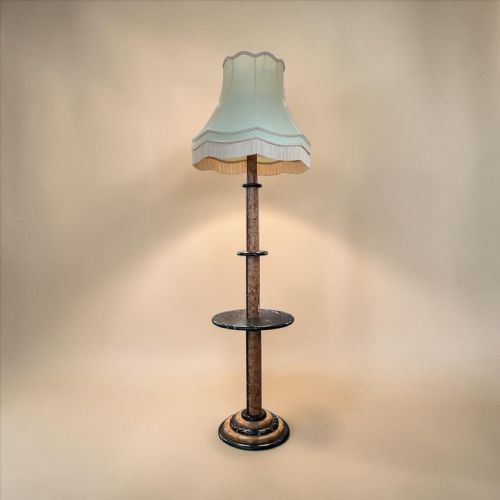
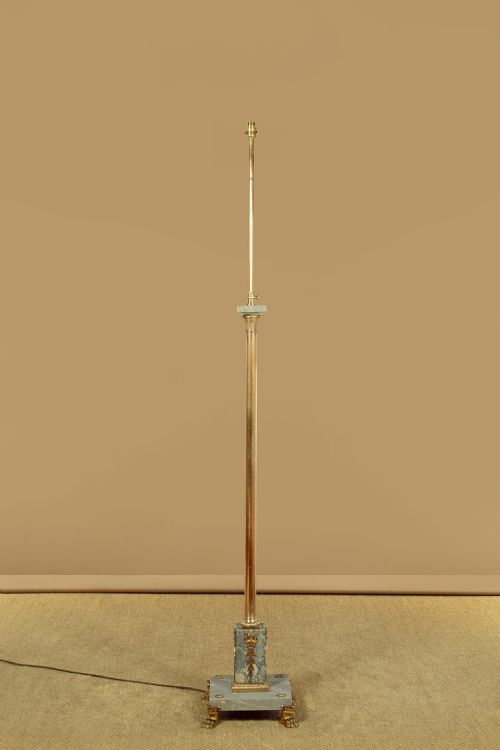


Marble Standard Lamp
These marble standard lamp pieces combine solid stone columns with brass fittings, bringing substantial weight and period elegance to an interior.
Marble Standard Lamp
A marble standard lamp provides vertical illumination through a tall column supported by a weighted stone base or platform. When searching for a marble standard lamp, buyers encounter floor-standing lighting fixtures dating from the nineteenth century through the mid-twentieth century.
Makers and designers drew upon Neoclassical Revival, Art Nouveau, Art Deco, and French Empire styles. These pieces range from simple fluted columns to elaborate figural compositions incorporating cast brass and ormolu.
How they were made
Construction relies upon turning and carving dense natural materials such as marble, onyx, and alabaster to form the central pillars and bases. These stone elements provide the necessary heft to balance extended heights and heavy fabric shades.
Metal components utilise cast brass, gilded ormolu, and bronze, often secured through threaded rods running through the core of the stone shaft. Many examples incorporate adjustable mechanisms allowing the height of the standard lamp to be altered.
Steamer oil lamps were adapted to stand beside cabin chairs, proving that Victorian readers took their illumination very seriously indeed.
What varies in quality
Quality rests in the grade and figuring of the natural stone and the crispness of the metal castings. Solid marble shafts display distinct veining and polish, whereas lesser examples use simpler finishes or composite materials.
The refinement of the brass and ormolu mounts distinguishes standard production from finer workshop pieces. Heavier gauge metalwork and sophisticated adjustment mechanisms indicate superior construction.
The Marble Standard Lamp Glossary
- Ormolu
- Gilded bronze or brass mounts applied to furniture and lighting fixtures. This technique creates a rich decorative contrast against stone and wood.
- Alabaster
- A fine-grained translucent stone used for carved columns and lamp bodies. It allows light to diffuse softly through the material.
- Standard lamp
- A British term for a floor lamp designed to stand independently in a room. These fixtures typically support a large fabric shade at eye level.
Marble Standard Lamp: Frequently Asked Questions
How do I date a marble standard lamp?
Dating relies upon examining the manufacturing techniques, wiring methods, and stylistic cues present in the brass fittings and stone turnings. Victorian and nineteenth-century examples often feature heavy cast components and hand-cut threads.
Later pieces from the 1920s and 1930s frequently adopt Art Deco or streamlined classical geometries. Comparing the decorative motifs, such as Art Nouveau floral lines or French Empire mounts, helps place the lamp within its specific period.
Are these lamps heavy to move?
These lamps are exceptionally heavy due to the solid marble, onyx, and alabaster used in their columns and bases. This weight was engineered intentionally to provide a stable centre of gravity for tall floor lighting.
When repositioning the lamp, it is best to lift from the lower section rather than the upper brass stem to avoid stressing internal rods.
Can modern bulbs be used in them?
Most antique standard lamps have been rewired for modern electrical standards while retaining their original brass lamp holders or switches. Standard screw or bayonet bulbs fit these adapted fittings.
It is advisable to check the internal wiring and consult a qualified electrician if the lamp retains vintage cloth-covered cord or older brass sockets.
What is the difference between onyx and marble?
Onyx is a translucent form of quartz with distinct parallel banding, while marble is a metamorphic rock formed from recrystallised carbonate minerals with cloudy veining. Both materials were utilised interchangeably by makers for their decorative properties.
Onyx components often appear in late Victorian and Edwardian standard lamps where translucency and colour variation were prized.