


Marble and Gilt Clock
A marble and gilt clock brings together cool stone and shining metal to anchor a room with heavy, decorative presence.
Marble and Gilt Clock
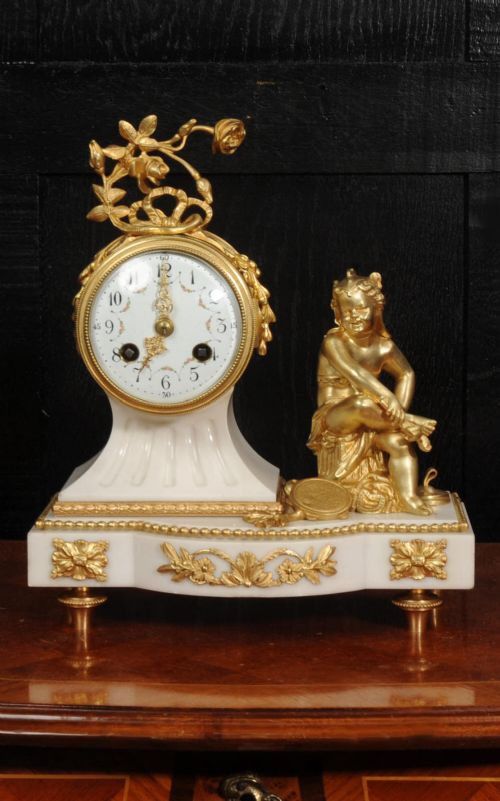
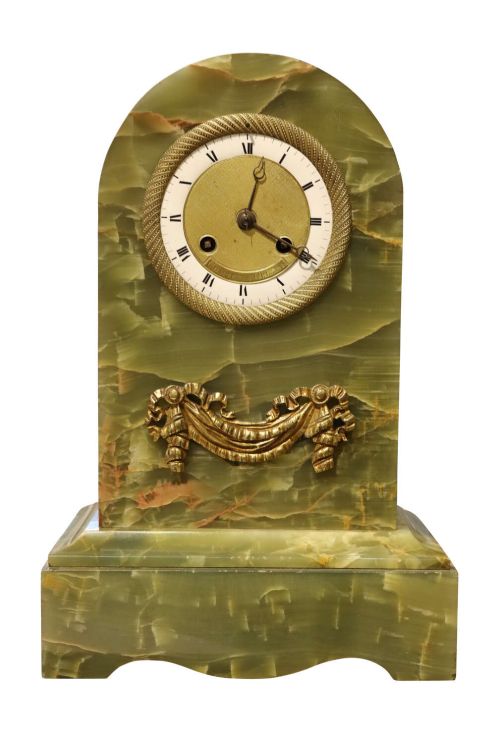
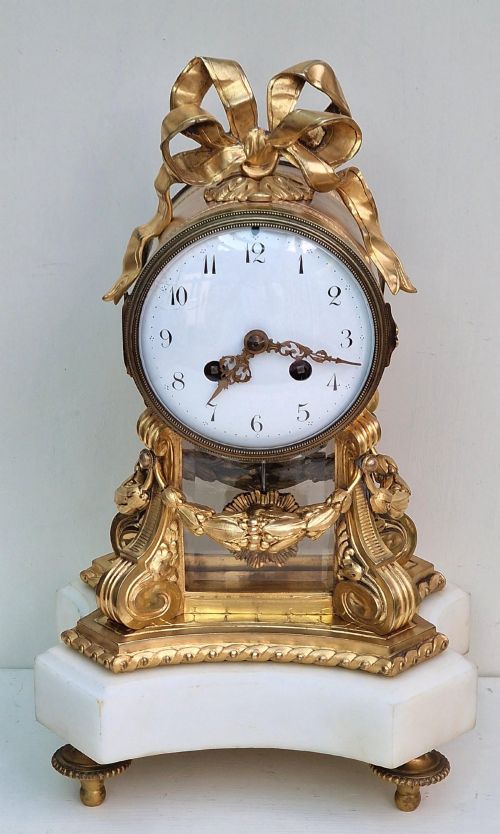
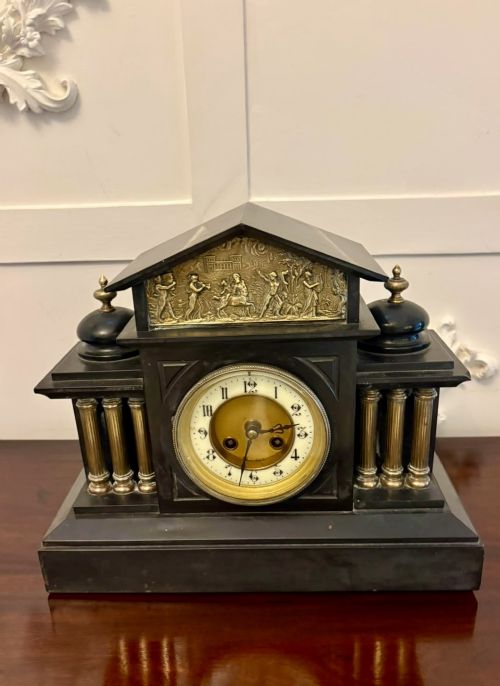
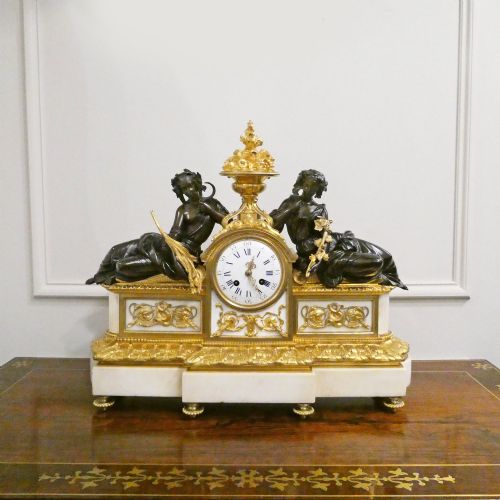
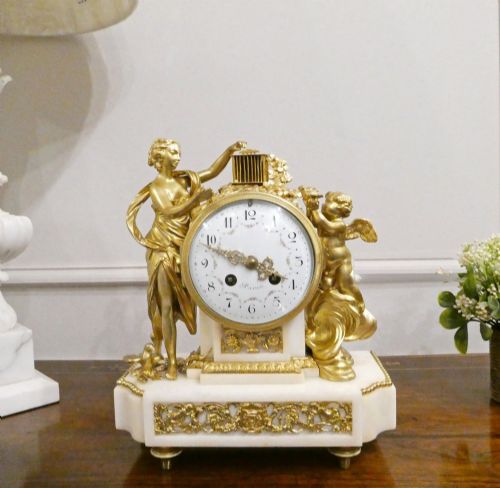
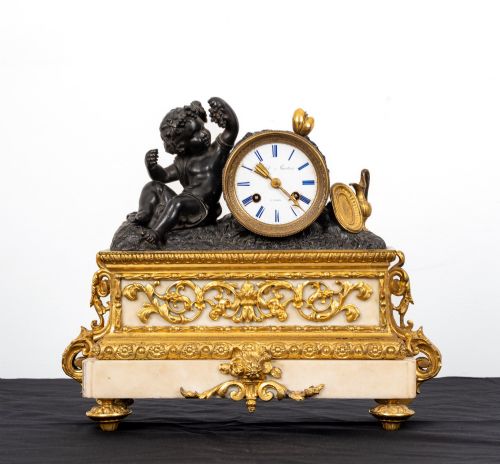
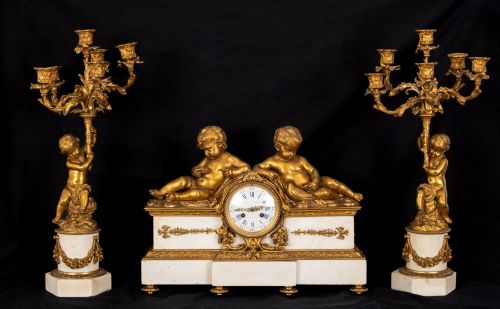
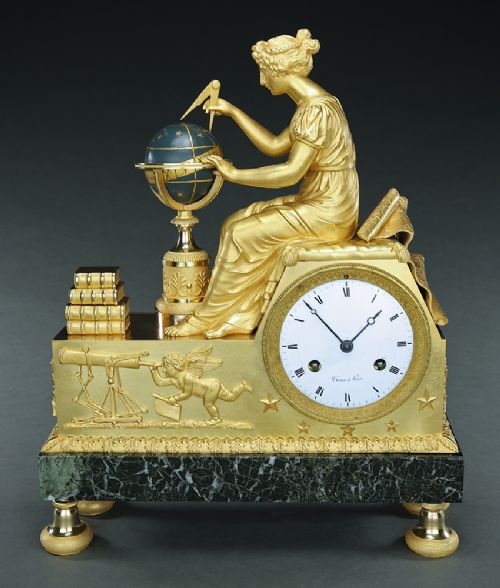
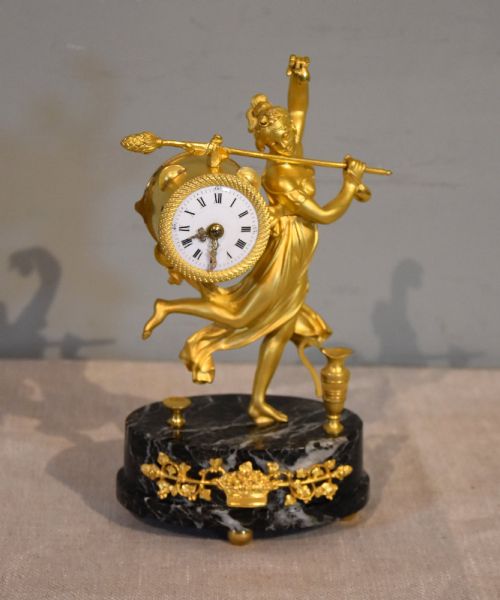
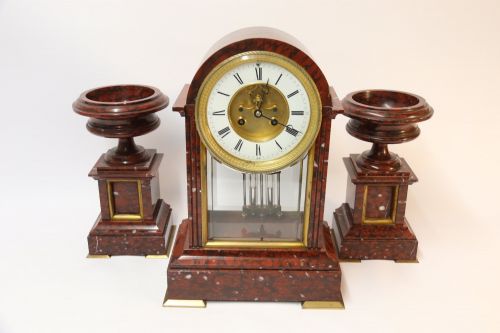
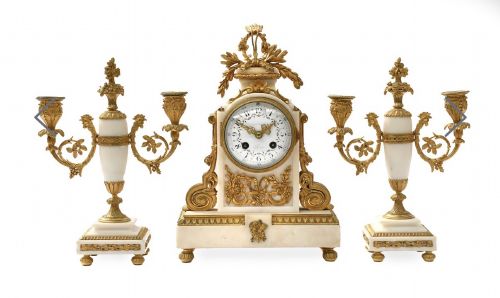
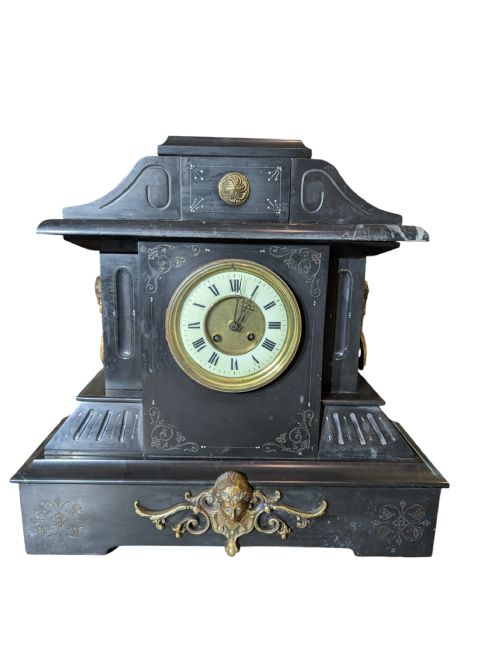
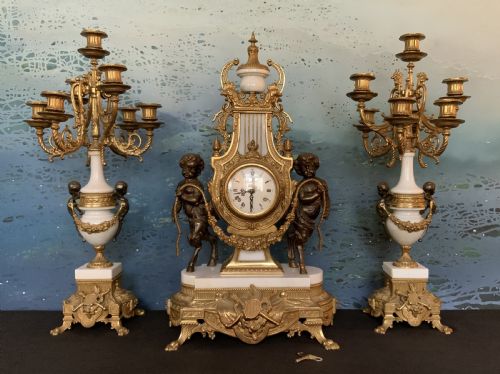
A marble and gilt clock combines the solid weight of carved stone with the bright gleam of cast metal mounts, most frequently appearing in nineteenth-century French designs. These pieces range from simple architectural mantel timepieces to elaborate three-piece garniture sets complete with matching candelabra. Buyers encounter black, white, green, and red marble varieties, often paired with ormolu, gilt bronze, or brass details.
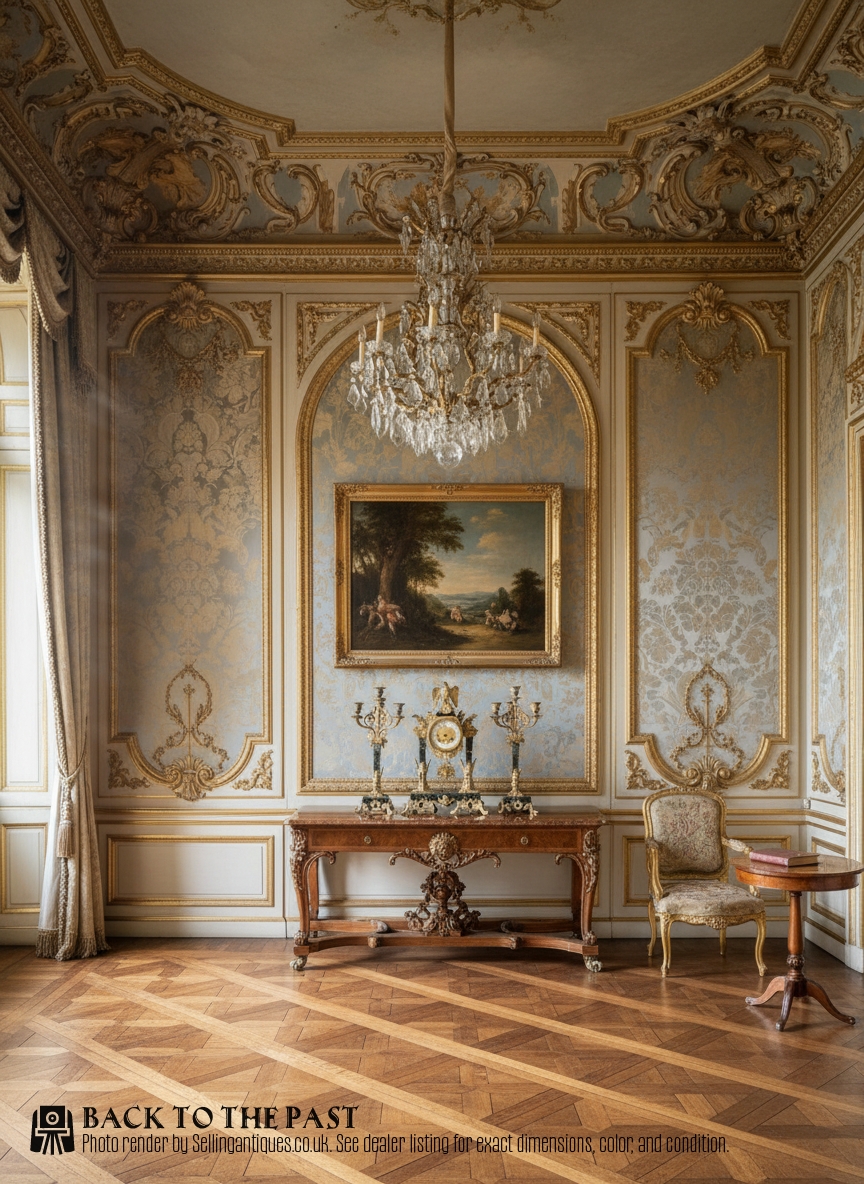
The aesthetic leans heavily towards classical revival movements, particularly Louis XVI and French Empire styles, alongside Victorian interpretations. The incorporation of enamel dials, cherubs, urns, and columns demonstrates the formal ambition of these domestic timekeepers. Many examples survive as part of larger matching sets designed to sit symmetrically on a mantelpiece.
Originating largely from continental workshops, these items served both practical timekeeping and high-status interior decoration. The physical structure relies on substantial stone bodies that house mechanical movements, supported by feet and decorative friezes cast in gilt metals.
How They Were Made
The construction brings together masonry and metalfounding, where blocks of natural marble are sawn, turned, and polished to form the architectural case. Stonemasons shaped black, white, red, and sienna varieties into porticos, urns, and block forms to house the internal mechanics.
Metal components utilise bronze, brass, and copper cast via traditional methods, then finished with mercury gilding or modern electroplating to create ormolu and gilt surfaces. These mounts are chased by hand to sharpen details like acanthus leaves, ribbons, and figural motifs before being pinned or screwed directly into the stone body.
Listings feature nineteen-century periods alongside eighteenth-century examples, utilising marble, gilt bronze, ormolu, and enamel.
What Varies in Quality
The refinement of the casting and chiselling separates standard production from exceptional work, visible in the crispness of the gilt bronze mounts and the depth of hand-chased surface detail. Lesser examples rely on simplified brass stampings and machine finishes, whereas superior pieces feature articulated figures, heavy fire-gilt bronze, and finely figured marble.
The integration of the movement dictates mechanical merit, where signed plates from established makers and complex striking trains indicate higher manufacturing investment. The harmony between the stonemason's geometric precision and the bronzeworker's decorative output determines the overall visual balance.
Japy Freres·Charles a Orleans·Vincenti·Siffel and Cartier·Samuel Marti·Philippes Paris·Berger Paris·Louis Goret·Sacre·Remond·Le Roy et Fils·Vincenti et Cie
The Marble and Gilt Clock Glossary
- Ormolu
- Gilt bronze produced by applying a mercury and gold amalgam to a bronze casting and heating it until the mercury vaporised. This technique creates a rich, matte golden surface characteristic of fine French horology.
- Garniture
- A set of matching decorative objects designed for display together, typically comprising a central clock flanked by two matching candelabras or urns. They became popular centrepieces for nineteenth-century mantelpieces.
- Portico clock
- A distinct architectural clock style featuring a platform supported by four or more columns framing a suspended pendulum. The design reflects neoclassical enthusiasm for ancient Greek and Roman temple architecture.
- Enamel dial
- A clock face made by fusing powdered glass onto a metal base at high temperatures, usually featuring painted Roman or Arabic numerals. This method provided a durable, glossy, and easily cleaned surface.
- Movement
- The mechanical heart of the clock, comprising gears, springs, escapements, and striking mechanisms. These components dictate how long the clock runs between winds and whether it strikes the hours.
Marble and Gilt Clock: Frequently Asked Questions
How do I wind the clock?
Most mechanical versions require a matching key inserted into specific winding holes on the enamel dial to tension the mainsprings. Care must be taken not to overwind the mechanism.
Striking models often have separate arbours for the time train and the strike train, both of which need attention to keep the clock running and chiming correctly.
What is a clock garniture?
A clock garniture is a matched set consisting of a central mantel clock accompanied by two side pieces, such as candelabras or decorative urns. These sets were designed to create a symmetrical display across a fireplace mantel.
The materials and decorative motifs on the side pieces directly mirror those on the main clock case.
How do I clean marble and gilt?
Stone surfaces respond best to gentle dusting with a dry microfibre cloth, avoiding harsh chemical cleaners that can dull the polished finish. Water should be kept away from any exposed mechanical parts.
Gilt metal mounts require minimal intervention, using only a soft brush to lift dust from recessed chased details without rubbing the gold surface.
Are these clocks heavy?
These pieces possess substantial weight due to the dense blocks of natural marble and cast bronze used in their construction. Lifting them requires supporting both the stone base and the internal frame simultaneously.
The heavy mass provides a stable foundation for the mechanical movement housed inside.