
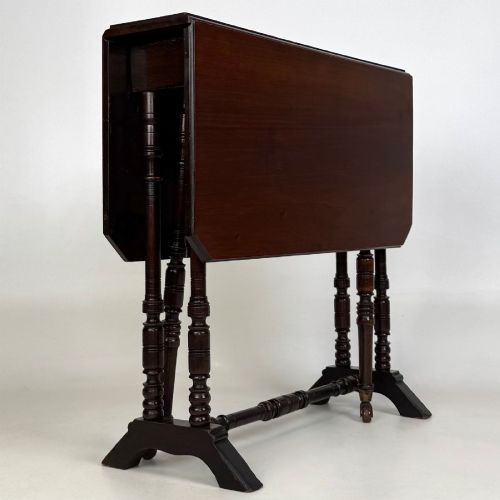
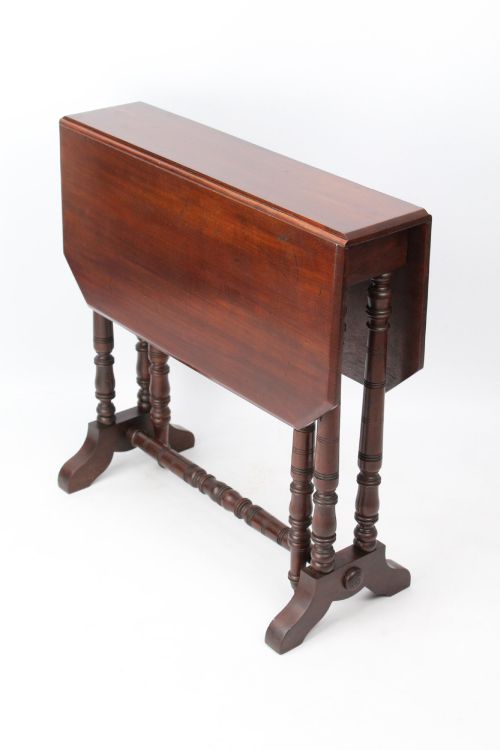
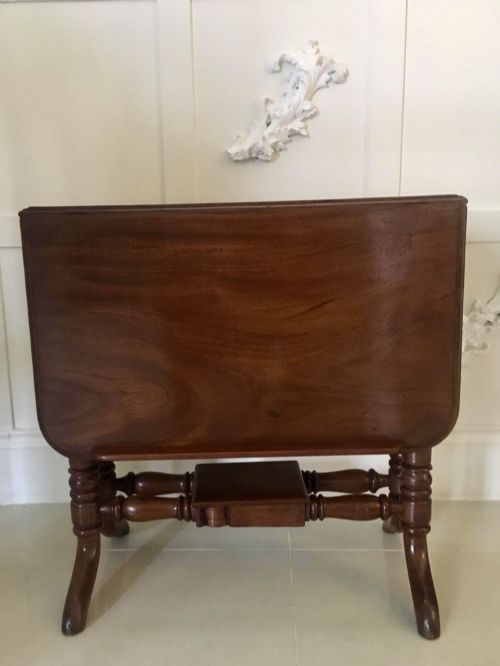
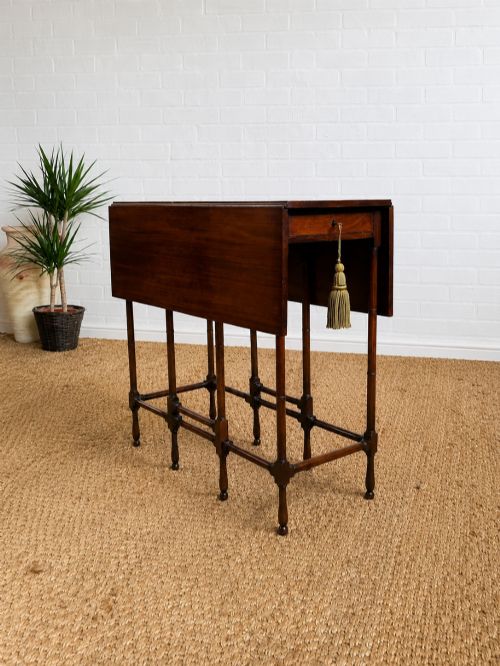

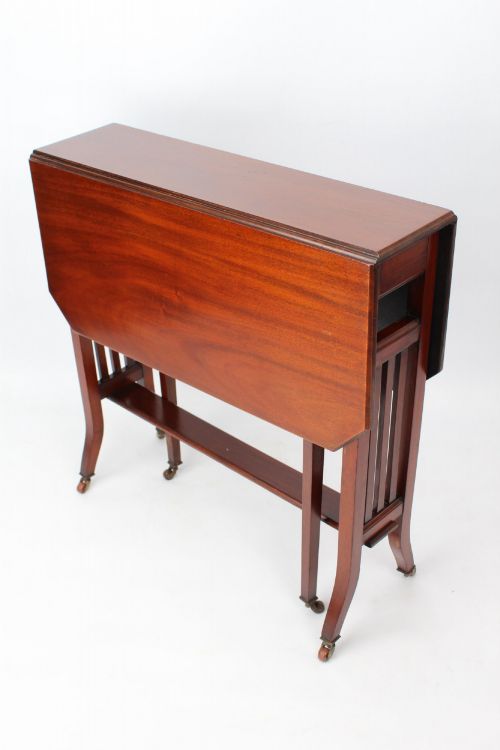
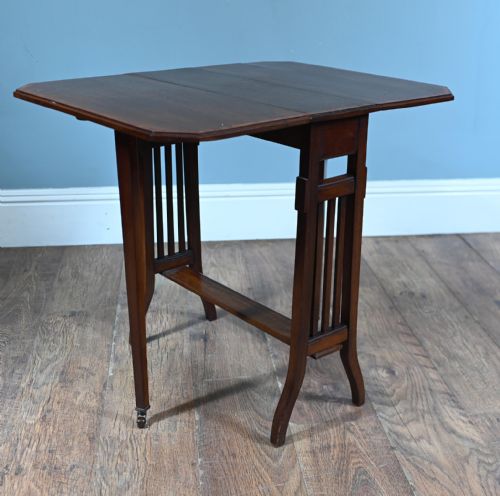


Mahogany Sutherland Side Table
A mahogany sutherland side table folds flat when not in use yet opens swiftly to hold books or tea, making it a clever space-saving choice for any room.
Mahogany Sutherland Side Table
When you search for a mahogany sutherland side table, you are looking at a specific form of drop-leaf table that rests on narrow gate legs. These pieces appear across Victorian, Edwardian, and Georgian periods, serving as versatile occasional tables in domestic spaces.
The version you are most likely to meet on this page dates from the Edwardian era or the late nineteenth century. These examples often feature slender oval leaves and compact frames suited for smaller rooms.
Makers designed these tables to stand against a wall until needed, at which point the hinged leaves lift to create a stable surface. The evidence shows forms ranging from standard occasional tables to specialised reading tables and low coffee tables.
Materials and construction
Cabinetmakers built these tables primarily from solid or veneered mahogany, sometimes employing ebonised finishes for a dark, uniform appearance. Contrasting timbers such as satinwood, boxwood, and brass hardware appear in decorative inlays and structural hinges.
The defining mechanical feature is the gate leg action, where hinged supports swing outward to hold the drooping leaves level. Turners shaped the supporting legs in various styles, including bamboo-turning, to balance lightness with the strength needed to carry the drop leaves.
Some Edwardian tables feature bamboo-turned legs, bringing a touch of botanical mimicry to standard mahogany furniture.
Judging quality in a sutherland table
Quality rests heavily on the crispness of the timber and the subtlety of any inlay work. Finer pieces incorporate decorative satinwood banding or boxwood stringing set cleanly into the mahogany ground.
The stability of the gate action and the neatness of the hinged joints separate standard production from superior examples. A well-made table operates smoothly without looseness in the pivoting legs when the leaves are raised.
The Mahogany Sutherland Side Table Glossary
- Sutherland table
- A narrow drop-leaf table with exceptionally slim gate legs that support wide leaves. This form allows the table to fold into a very shallow footprint.
- Drop leaf
- A hinged section of a table top that folds down when not in use. It requires additional supports underneath to remain horizontal.
- Gate leg
- A leg hinged to a swing-out frame that supports a drop leaf. This design provides structural support across a wide area when open.
- Satinwood inlay
- A contrasting light yellowish timber inserted into the darker mahogany surface for decoration. It is frequently seen on Edwardian examples.
- Ebonised
- Wood treated with a finish to imitate ebony. This dark staining appears on specific Victorian and Edwardian pieces.
Mahogany Sutherland Side Table: Frequently Asked Questions
How do you open a sutherland table?
You lift one drop leaf upward until it sits level. Then you swing the hinged gate leg outward from beneath the frame to lock that leaf in position.
Repeat the same motion on the opposite side to open the full surface. To close the table, swing each leg back inward and let the leaves drop down against the central well.
What rooms suit a sutherland table?
These tables fit easily beside a sofa or chair as a convenient spot for books and drinks. Because they fold nearly flat, they work well in compact spaces where furniture needs to move or adapt.
In larger rooms, they function as occasional lamp tables or decorative display surfaces against an empty wall.
How can you tell an Edwardian piece from a Victorian one?
Edwardian examples often display lighter proportions, satinwood inlay, and sometimes bamboo-turned legs. They frequently reflect the Sheraton Revival style popular around nineteen hundred.
Victorian versions tend to have darker, heavier timber and simpler turnings without complex contrasting inlays. They generally date from the mid to late nineteenth century.
Are these tables sturdy enough for daily use?
Solid mahogany and well-fitted gate mechanisms provide surprising strength for everyday tasks like holding tea sets or reading material. The narrow legs distribute weight effectively when the leaves are fully supported.
Care should be taken not to lean heavy weight directly onto the outer edges of the raised leaves, as the strain falls entirely on the folding hinges.