


Mahogany Serpentine Side Cabinets
Mahogany serpentine side cabinets are curved timber storage pieces that bring elegance and movement to a room.
Mahogany Serpentine Side Cabinets
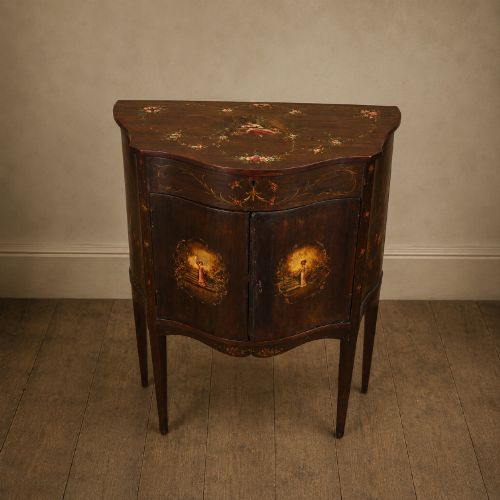
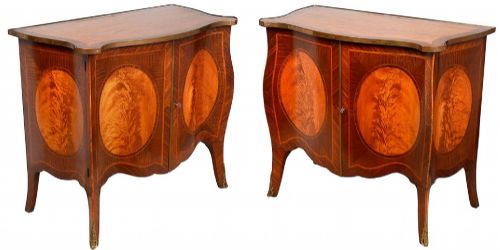
Mahogany serpentine side cabinets offer curved fronts that bring visual movement to a room, appearing in forms such as bedside cupboards, commodes, and credenzas. These items emerge from various periods, including the Georgian eighteenth century, the Victorian era, and later revivals around nineteen twenty.
The selection includes specific regional interpretations, such as Scandinavian nineteenth century cupboards alongside traditional English pieces. Buyers frequently encounter revival styles that echo earlier eighteenth century cabinetmaking traditions.
Makers utilised diverse formats ranging from compact side cabinets to larger display cabinets with glass doors. Each piece serves primarily as functional storage while providing a decorative surface for display.
How they were made
Cabinetmakers worked primarily with mahogany timbers, often incorporating contrasting details in satinwood and rosewood. Construction methods required careful shaping of the timber to achieve the characteristic undulating front curve.
Surfaces frequently display decorative techniques including hand painting, inlay, and ormolu mounts. Glass panels appear in display variants, whilst velvet linings feature in certain interior compartments.
Joinery techniques united solid woods and veneers to create stable carcasses capable of holding curved drawer fronts and doors. Brass hardware and mirrors completed the construction of the more decorative examples.
Some nineteenth century cabinets were designed to be freestanding in the middle of a room, finished with curved timber on all four sides.
What varies in quality
Quality rests upon the precision of the curved timber work and the harmony of the proportions. Superior examples display smooth undulating lines without distortion in the grain.
The refinement of decorative elements, such as hand painted details or quality brass mounts, distinguishes finer pieces from simpler utility furniture. The choice of timber figures prominently, with rich mahogany grain adding depth to the surface.
The Mahogany Serpentine Side Cabinets Glossary
- Serpentine
- A curved shape featuring a convex centre flanked by concave sides, creating an undulating front line. This contour demands advanced woodworking skill to execute properly.
- Commode
- A low cabinet or chest of drawers, often standing on legs, used originally for storage in bedrooms or reception rooms. The term frequently applies to decorative French and English side pieces.
- Credenza
- A sideboard or buffet cabinet used for storing and displaying serving items. Victorian examples often incorporate glass doors and mirrored backs.
- Ormolu
- Gilt bronze mounts applied to furniture for decoration, popular in French revival pieces. The metal adds metallic contrast to the timber surface.
- Inlay
- A technique where pieces of contrasting wood or other materials are inserted into the primary surface to form decorative patterns. Satinwood frequently provides the lighter contrast against dark mahogany.
Mahogany Serpentine Side Cabinets: Frequently Asked Questions
What is a serpentine front?
A serpentine front curves outward in the middle and inward at the sides, forming a gentle wave shape. This design creates a sense of movement across the face of the furniture.
Crafting this shape required precise timber cutting and joinery, making it a hallmark of finer cabinetmaking.
Where should I place a side cabinet?
These cabinets suit dining rooms, hallways, or living spaces where they provide useful surface area and enclosed storage. Their decorative fronts mean they work well against plain walls.
Smaller versions function effectively as bedside cupboards or accent pieces in reception rooms.
How do I care for mahogany?
Keep mahogany furniture away from direct sunlight and heat sources to prevent the wood from drying out and the finish from fading. Regular dusting with a soft, dry cloth preserves the sheen.
Avoid using silicone polishes, choosing instead traditional beeswax applied sparingly.
How can I tell the period?
Dating relies on examining construction methods, timber choice, and decorative styles such as Georgian restraint or Victorian elaboration. Revival pieces often combine earlier stylistic motifs with later manufacturing techniques.
Hardware, drawer construction, and secondary woods offer further clues to the decade of manufacture.