
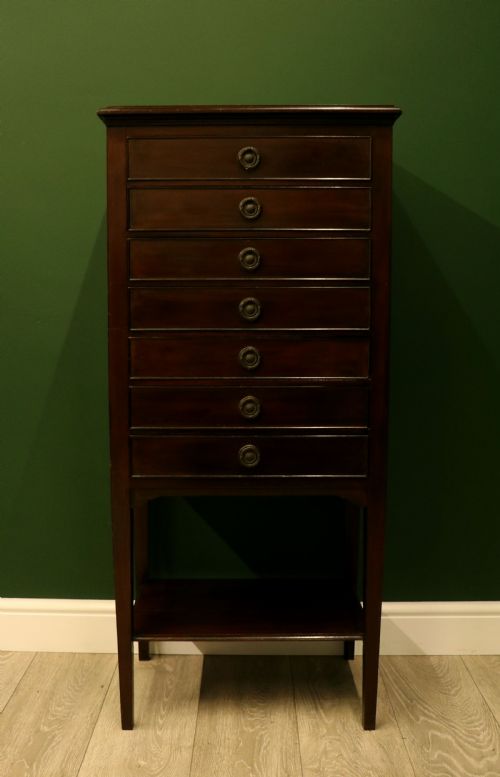


Mahogany Music Cabinet Drawers
Mahogany music cabinet drawers provide compact storage for sheet music, manuscripts, and papers while anchoring a room in rich timber tones.
Mahogany Music Cabinet Drawers
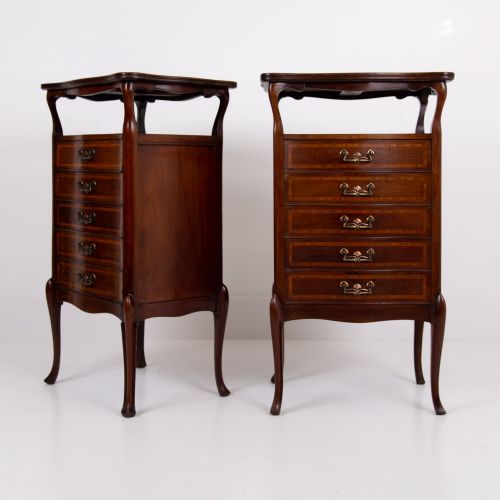
When you search for mahogany music cabinet drawers, you look at upright storage furniture designed specifically to organise sheet music, manuscripts, and periodicals. The selections span periods from the eighteenth century through the Victorian era into the Edwardian period and the early twentieth century. Most pieces met on this page date from the Edwardian era and the late Victorian period, taking forms such as music cabinets, canterburys, and piano stools.
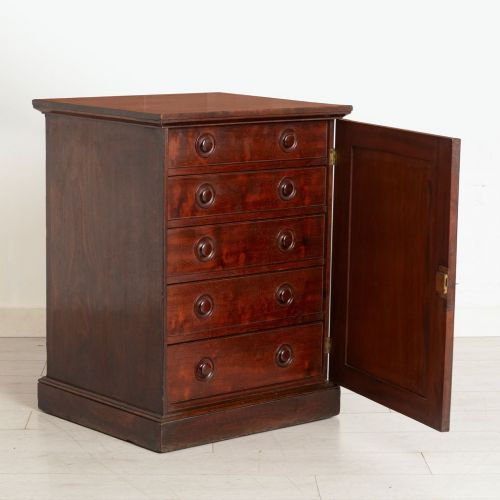
These pieces appear in various configurations, including slim upright cabinets with drop-front drawers, multi-drawer chests, and specialised filing furniture. Styles range through Victorian, Edwardian, Art Nouveau, Arts and Crafts, Regency, and William IV designs. Many incorporate open racks or partitioned interiors alongside enclosed drawer banks to separate different sizes of paper.
The dominant material throughout these listings is mahogany, often paired with contrasting timbers and decorative hardware. Buyers frequently encounter examples featuring satinwood inlay, brass fittings, and glass elements. Whether configured as a tall five-drawer chest or a low bedside piece, each item reflects the domestic musical culture of its period.
Materials and construction
Cabinetmakers utilised solid mahogany and mahogany veneers over secondary timbers to construct the main bodies and drawer frames. Timber selection focused on grain figure and depth of colour, frequently enhanced through careful polishing. Structural joints relied on traditional cabinetmaking techniques to ensure durability under daily use.
Inlay work added decorative detail to drawer fronts and top panels, most commonly employing satinwood and boxwood. Metal elements such as brass handles, hinges, and occasional rack dividers provided both functional support and visual contrast. Glass panels appeared on display variations, while internal divisions used lightweight timber to separate sheet music without adding excessive weight.
Victorian musicians evidently owned an enormous amount of paper, requiring ingenious drop-front drawers to stop their sheet music sliding everywhere.
Craftsmanship and distinction
Quality in these pieces rests upon the precision of the drawer construction and the integration of secondary timbers. Better examples exhibit tight joinery, smooth drawer action across drop-front or standard pulls, and clean internal dividers. Finer cabinets show careful matching of mahogany veneers and crisp execution of satinwood inlay rather than printed or superficial decoration.
The sophistication of the hardware and stylistic detailing also separates standard production from superior work. Pieces incorporating bespoke brass fittings, refined Art Nouveau or Arts and Crafts motifs, and well-balanced proportions stand apart from simpler utility items. The integrity of the original polish and the preservation of internal manuscript shelving further distinguish the better surviving examples.
The Mahogany Music Cabinet Drawers Glossary
- Canterbury
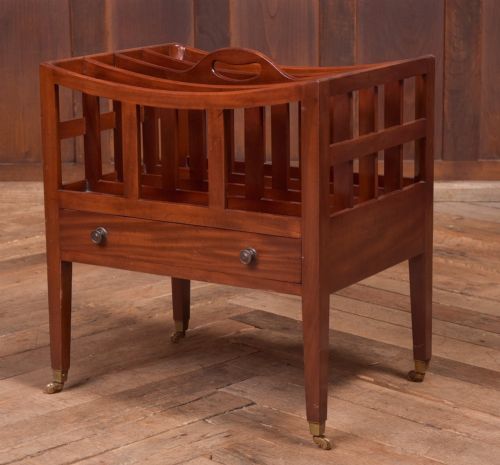
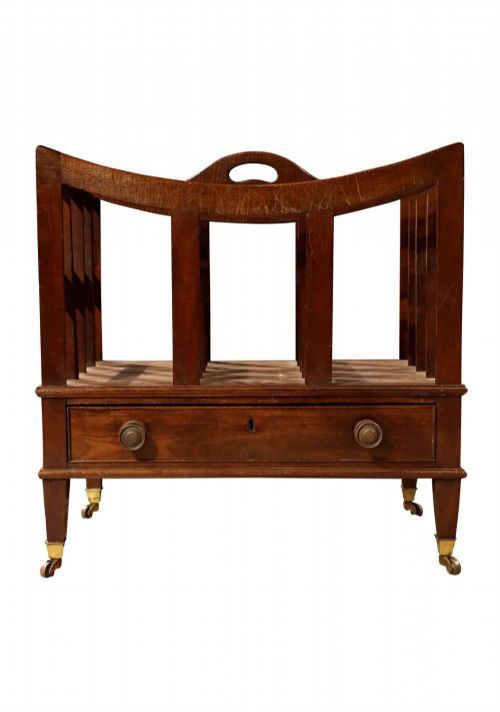
- A low stand with vertical partitions designed for holding sheet music, magazines, or newspapers. Originating in the late eighteenth century, these pieces often incorporate a single lower drawer.
- Drop-front drawer
- A drawer featuring a hinged front that folds downward when pulled open, allowing easier access to flat stacks of paper inside. This mechanism appears frequently in sheet music cabinets.
- Satinwood inlay
- A decorative technique using contrasting light-coloured satinwood veneers embedded into the darker mahogany surface. It creates geometric or floral borders across panels and drawer fronts.
- Sheet music cabinet
- An upright piece of furniture fitted with shallow drawers or vertical compartments built to store bound scores and loose manuscript sheets. They became essential household items during the Victorian and Edwardian periods.
Mahogany Music Cabinet Drawers: Frequently Asked Questions
What were music cabinets used for?
Music cabinets provided dedicated storage for the large quantities of sheet music, songbooks, and manuscript paper kept in Victorian and Edwardian homes. Their shallow drawers and internal divisions kept paper flat and sorted by instrument or composer.
Beyond musical storage, many households repurposed these compartmentalised pieces for holding documents, letters, or collection specimens. The specialised drawer depths prevented delicate paper from curling or sliding.
How do I identify an Edwardian music cabinet?
Edwardian music cabinets typically date between 1901 and 1910, often showing lighter mahogany tones and delicate satinwood inlay work. They frequently feature multiple drop-front drawers designed specifically for sheet music storage.
These pieces often reflect the influence of Sheraton revival styles or subtle Arts and Crafts design principles. Their hardware tends to be dainty, using brass handles that complement the lighter timber finishes characteristic of the period.
Are music cabinets suitable for modern homes?
Music cabinets fit easily into modern living spaces due to their narrow, upright footprints and versatile storage capacity. They serve effectively as bedside tables, hallway chests, or desktop organizers.
The shallow drawers accommodate modern stationery, art supplies, or small accessories while adding period character to a room. Their enclosed designs help maintain a tidy appearance in smaller contemporary interiors.
What is the difference between a Canterbury and a music cabinet?
A Canterbury is generally a low, open rack structure with vertical partitions intended for quick access to daily newspapers, magazines, or current music books. Many versions include a single enclosed drawer beneath the open sections.
In contrast, a music cabinet is an enclosed, taller chest featuring multiple stacked drawers designed for long-term archiving of bound scores. While both serve musical storage, the cabinet offers complete protection behind closed doors.