


Mahogany Marble Top Cupboard
A mahogany marble top cupboard brings together dense timber and cool stone for bedside storage.
Mahogany Marble Top Cupboard
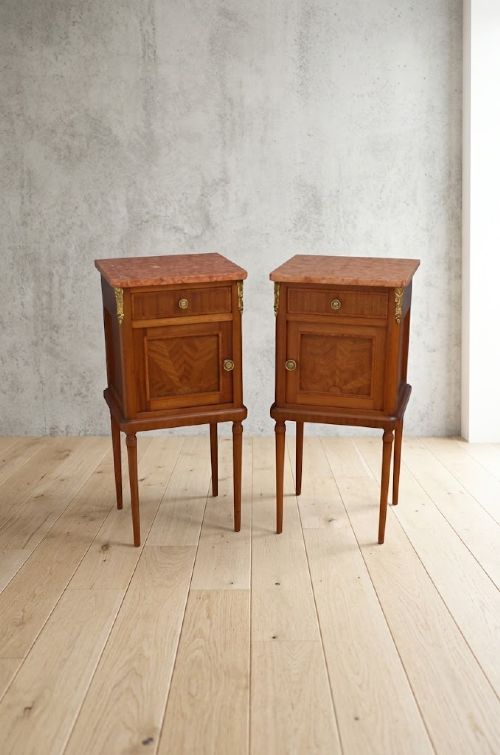
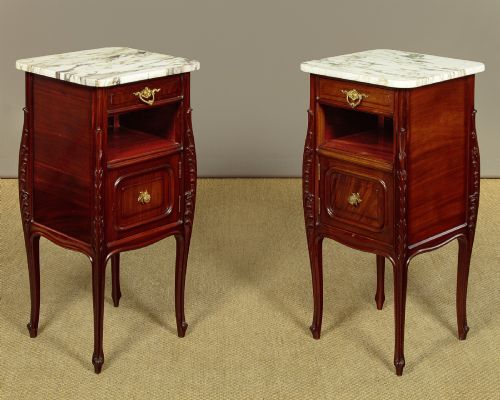
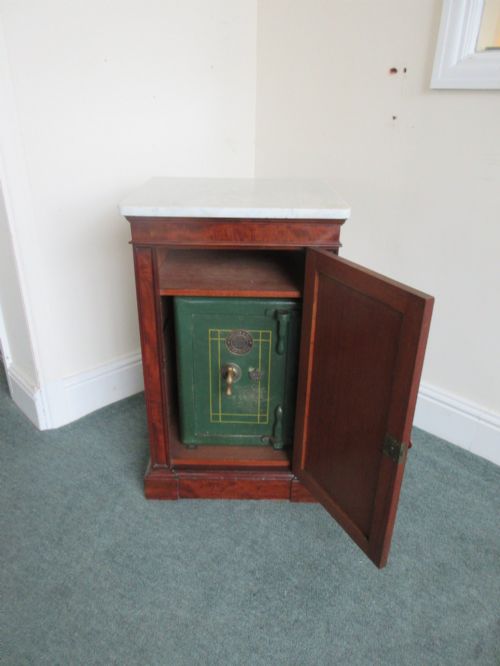
A mahogany marble top cupboard combines a solid timber carcase with a fitted stone slab, serving primarily as bedside storage or a small side cabinet. These pieces appear frequently as cylindrical pedestals or rectilinear bedside chests from the nineteenth and early twentieth centuries.
Makers across France, England, and Italy adapted the form into nightstands, washstands, and pot cupboards with enclosed shelving. The combination offered a durable, water-resistant surface above enclosed space for domestic chambers.
Materials and construction
Cabinet makers utilised dense mahogany and flame mahogany veneers over secondary timbers, occasionally incorporating marquetry inlay, brass mounts, or ormolu details. The stone slabs consist largely of fitted marble, sometimes featuring a raised brass gallery or shaped edge.
Cylindrical pieces required steam-bent staves or coopered construction to achieve a rounded carcase, while rectilinear forms relied on traditional frame-and-panel joinery. Turning was employed for columns, tapering legs, and pedestal bases.
Some nineteenth-century cylindrical bedside companions secretly doubled as ventilated housing for the nocturnal ceramic.
Distinctions in quality
Quality rests upon the selection of timber figures, the precision of veneer matching, and the integration of the stone top. Finer examples display continuous grain patterns, hand-cut joinery, and heavy, well-veined marble slabs fitted flush to the timber.
Secondary details such as cast brass mounts, tambour doors, and original hardware elevate a piece beyond standard utilitarian production. The weight of the marble and the stability of the cylindrical or panelled carcase define the standard of manufacture.
Collinson & Lock London·Edwards & Roberts·Shoolbred
The Mahogany Marble Top Cupboard Glossary
- Pot cupboard
- A small bedside cabinet originally designed to house a chamber pot behind a single door or cylindrical shutter. These compact units typically feature the characteristic stone top for easy cleaning.
- Vernis Martin
- A simulated Japanese lacquer technique developed in France, found on decorated panels of select side cabinets. It involves multiple layers of resin varnish applied over painted surfaces.
- Tambour
- A flexible sliding shutter formed from narrow strips of wood glued to a canvas backing, allowing access to curved cabinet interiors. This technique appears on nineteenth-century cylindrical pedestals.
- Ormolu
- Gilded bronze mounts applied as decorative accents on French Empire and revival furniture. The metal is cast, chased, and fire-gilded to create bright golden highlights against dark mahogany.
- Carrara marble
- A type of white or blue-grey marble quarried in Italy, frequently chosen for the top surfaces of continental and English washstands and bedside cabinets.
Mahogany Marble Top Cupboard: Frequently Asked Questions
What was a marble top cupboard used for?
These cabinets served primarily as bedside storage in nineteenth-century bedchambers, holding personal items and washware. The stone surface provided a durable, stain-resistant station for pitchers, glasses, and lamps.
Over time, variations evolved to include washstands, nightstands, and small commodes. Their enclosed lower compartments kept domestic items out of sight while maintaining a clean profile.
How do I identify French versus English pieces?
French examples often display distinct stylistic revivals such as Louis Philippe or French Empire, frequently utilising cylindrical forms, tambour doors, and rich ormolu mounts. English pieces tend towards rectilinear Victorian proportions, sometimes featuring column corners or panelled doors.
Continental marble slabs also differ in thickness and edge profiling compared to their British counterparts. Regional construction methods in the carcase interior further separate London workshops from continental cabinet makers.
Are marble tops removable?
Most marble slabs rest loose upon the wooden carcase, held in place simply by their own substantial weight. This design allowed for easy lifting during transport and cleaning.
On certain washstands and fitted cabinets, the stone may be secured with plaster or integrated into a raised gallery frame. Care must be taken when moving these pieces to lift the stone separately from the timber base.