
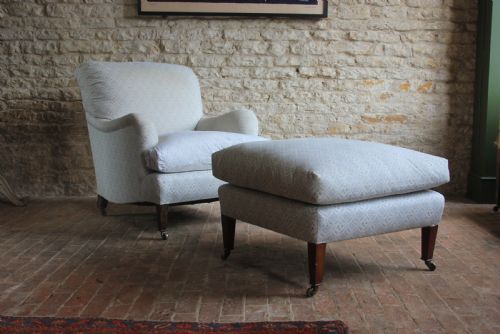


Mahogany Foot Stool
A mahogany foot stool brings solid timber frames and traditional upholstery together in forms ranging from compact Victorian footstools to grand Regency ottomans.
Mahogany Foot Stool
A mahogany foot stool is a low timber support designed for resting feet or sitting, frequently found in forms such as square footstools, long footstools, piano stools, and ottomans. The examples span several centuries, with nineteenth-century Victorian and Regency pieces appearing alongside eighteenth-century Georgian items and later revivals.
The assortment on this page includes standard low foot rests, swivel-top adjustable music stools, and larger upholstered ottomans with internal storage or carved cabriole legs. Buyers encounter both simple vernacular pieces and elaborate designs referencing Chippendale or Queen Anne styles.
Materials and construction
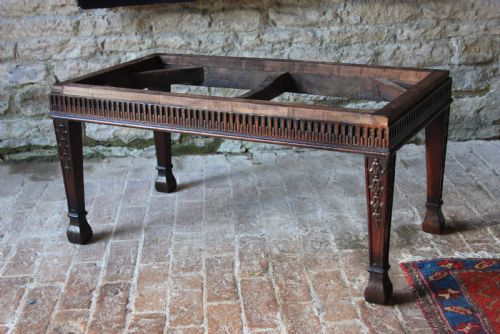
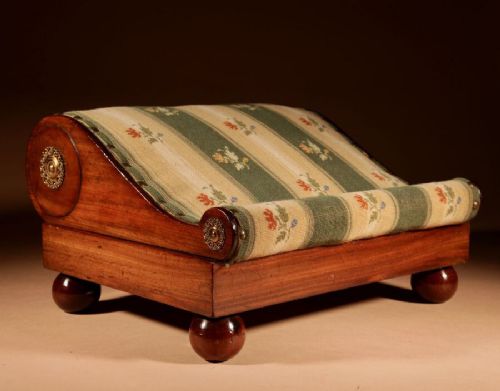
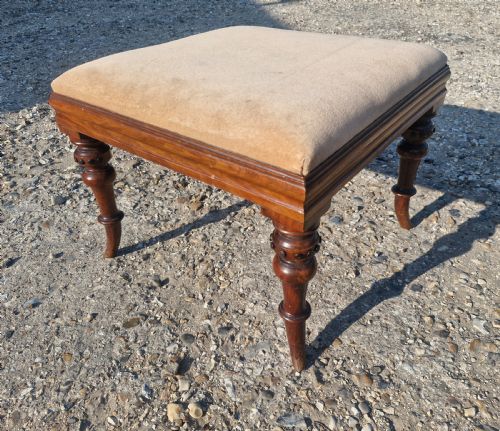
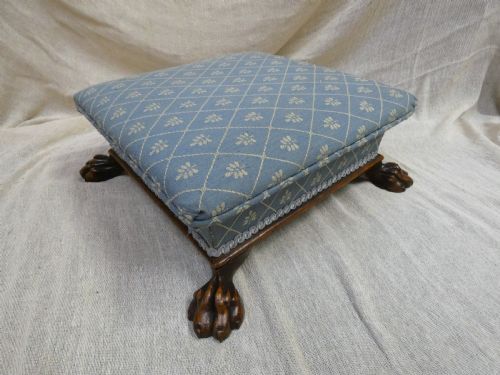
Makers utilised dense mahogany timber for the structural frames, often shaping the wood into turned legs, scroll tops, sabre legs, or carved cabriole supports with ball and claw feet. Some examples incorporate brass details, ormolu mounts, and ebonised highlights to enrich the timber framework.
The upper surfaces rely on traditional textiles, featuring antique needlepoint, tapestry, crewel work, wool, velvet, leather, and damask upholstery. Padding techniques vary from simple stuffing to deep buttoning and tight horsehair foundations secured with brass tacks.
Listings feature mahogany frames paired with diverse textiles, including wool tapestry, velvet, leather, and original nineteenth-century needlepoint.
Judging quality in construction and upholstery
Quality rests in the crispness of the timber carving and the structural integrity of the joints, where hand-cut joinery outperforms later mass-produced alternatives. Superior pieces display carefully selected mahogany grain and substantial weight in the frame.
The standard of the upholstery work and the preservation of original textiles, such as hand-worked needlepoint or early leather, separate high-grade examples from later re-covered pieces. Proportion and balance between the timber base and the upholstered top further distinguish better workshops.
Howard And Sons·Mathew Gregson·Gillows Of Lancaster·Whytock And Reid
The Mahogany Foot Stool Glossary
- Cabriole leg
- A furniture leg that curves outward at the knee and tapers inward toward the foot, frequently ending in a pad or claw shape.
- Needlepoint
- A type of counted thread embroidery stitched onto canvas, commonly used for historical footstool covers.
- Ottoman
- A low, upholstered seat or footstool without a back or arms, sometimes fitted with internal storage space.
- Ormolu
- Gilded bronze ornamentation applied to furniture frames during the eighteenth and nineteenth centuries.
- Sabre leg
- A concave, outwardly curving furniture leg that tapers toward the base, typical of Regency design.
Mahogany Foot Stool: Frequently Asked Questions
What is the difference between an ottoman and a footstool?
An ottoman typically offers a larger surface area and sometimes incorporates internal storage beneath the upholstered lid. Footstools are generally smaller, dedicated supports designed specifically for resting the feet.
Both forms utilise timber frames and similar upholstery styles, but their scale and intended placement within a room differ.
How do I date a mahogany foot stool?
Dating relies on stylistic clues such as leg shape, carving techniques, and assembly methods. Regency pieces often feature sabre legs or scroll tops, while Victorian examples frequently show heavier turned supports or deep buttoned leather.
Secondary woods and the type of fixings used inside the frame provide further evidence for determining the period of manufacture.
Were these stools used only for resting feet?
Many examples served multiple functions, operating as piano stools, dressing table seats, or hearth stools alongside their primary role as foot rests. Adjustable swivel mechanisms and storage compartments show that makers adapted the basic form for musicians and dressing rooms.
Their sturdy timber construction allowed them to double as occasional seats when needed in domestic spaces.
How should I care for antique upholstery?
Protect antique textiles and leather by keeping the stool away from direct sunlight and maintaining stable room humidity. Gentle surface cleaning with appropriate soft attachments prevents dust accumulation without disturbing historic fibres.
Original needlepoint and antique leather require careful handling to preserve their structural integrity over time.