


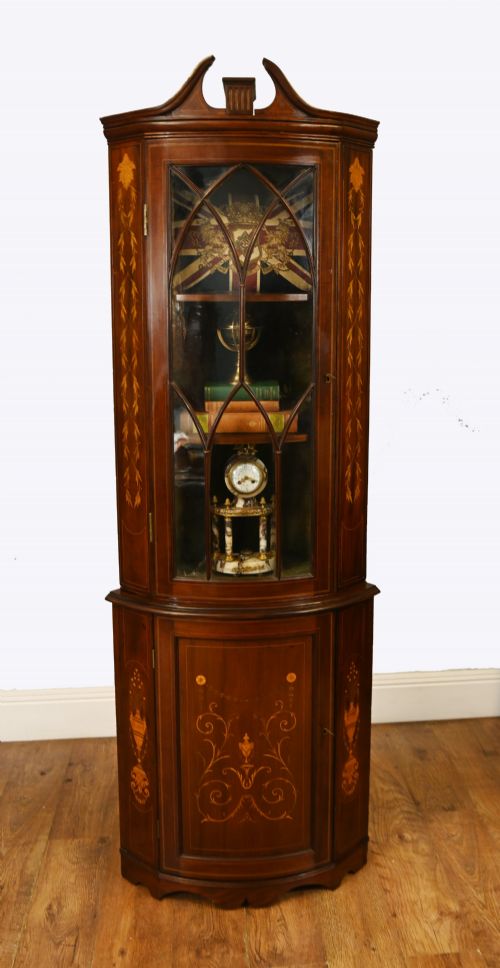


Mahogany Corner China Cabinet
These mahogany corner china cabinet pieces turn awkward angles into display space with glazed doors and warm timber.
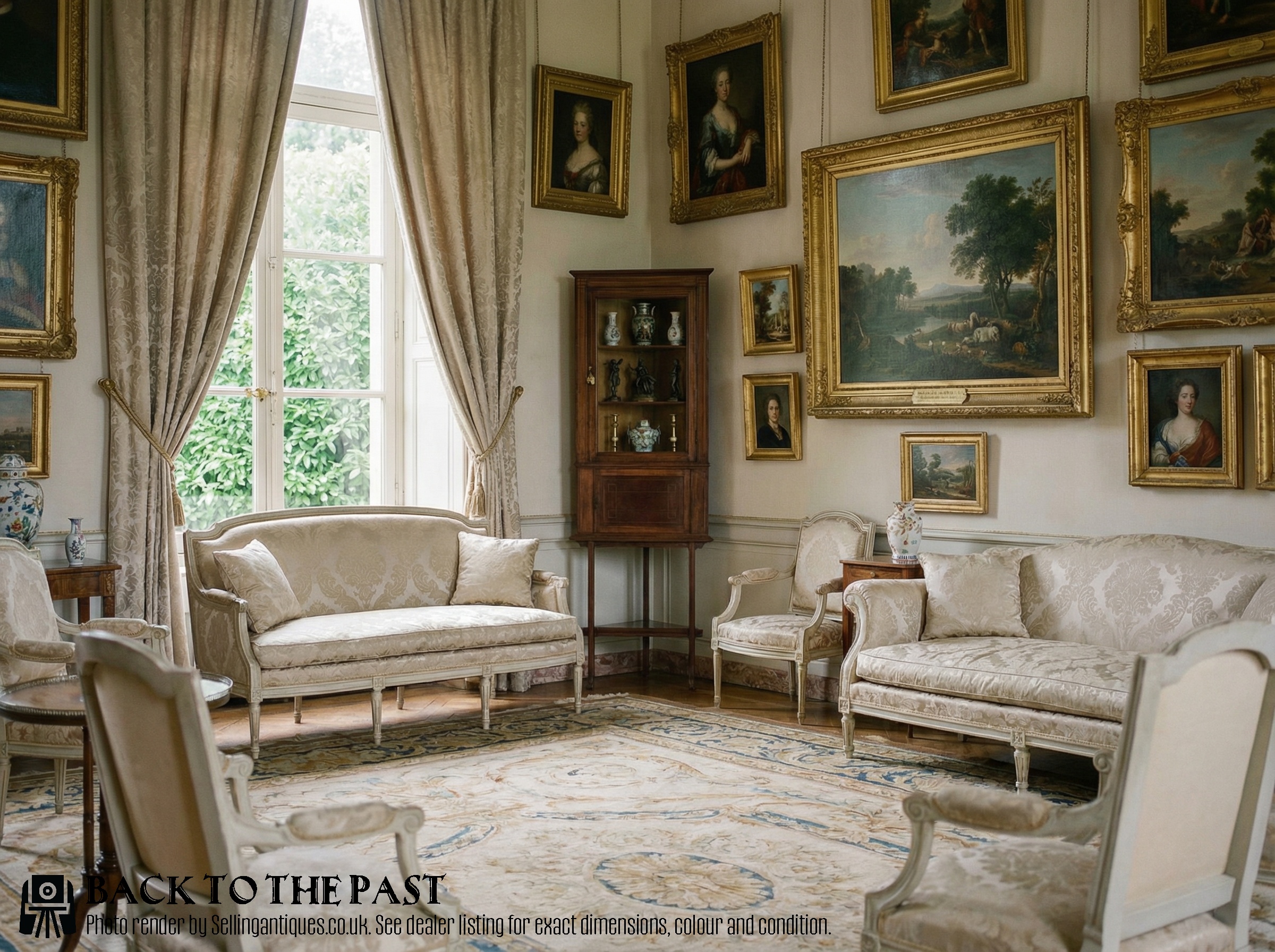
Mahogany Corner China Cabinet
A mahogany corner china cabinet occupies the junction of two walls, using depth rather than width to hold porcelain and glassware. Buyers seek these out to fit tight domestic angles without losing floor space.
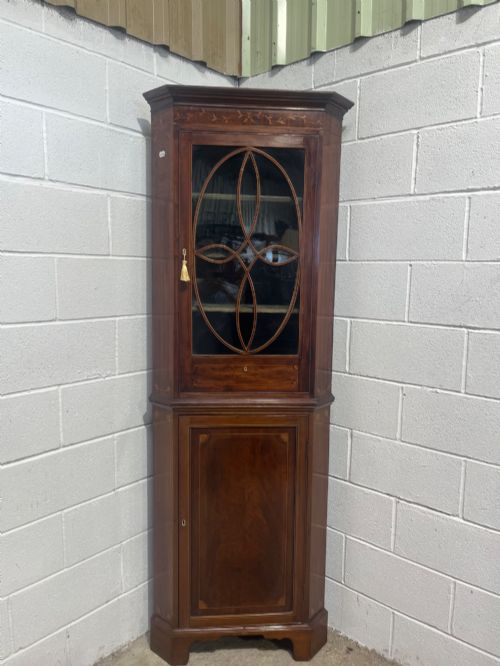
Most examples appearing here belong to the Edwardian era and the twentieth century, alongside older Georgian and Victorian forms. They span single-door wall-hung units, floor-standing cupboards, and two-piece standing double-height variations.
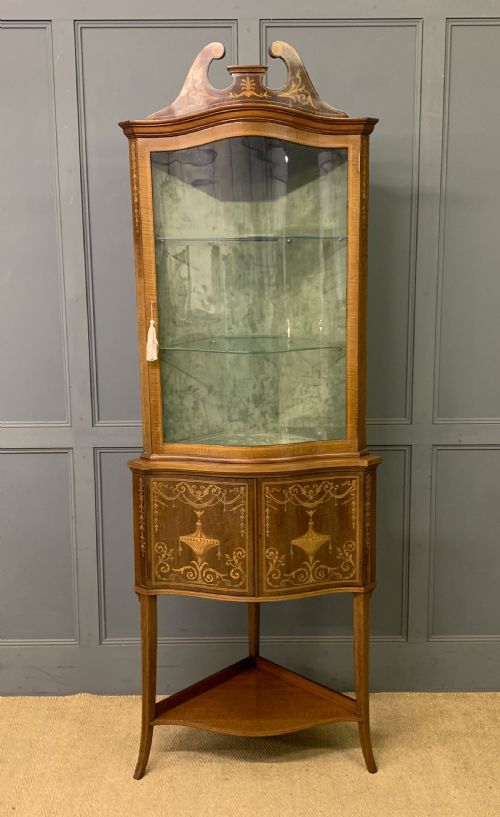
Makers shaped these from solid timber and veneers, incorporating glazed doors with astragal bars to show off contents. Some versions stand on dedicated bases or legs, while others run straight down to a plinth.
Materials and construction
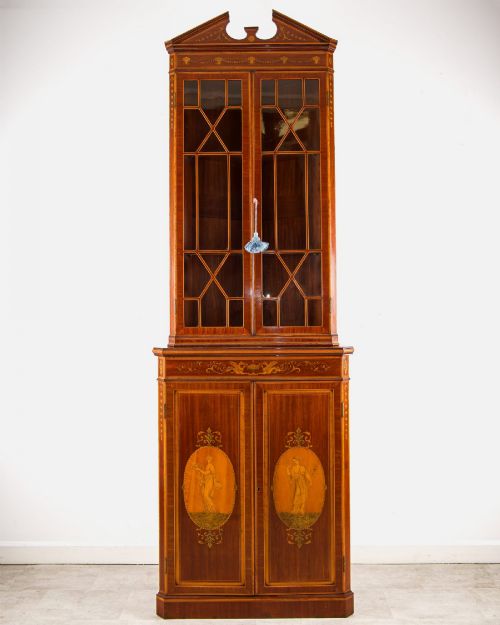
Makers built these cabinets primarily using mahogany, often enriched with contrasting satinwood and boxwood inlay. Glass forms the primary door panels, supported by timber frames and sometimes backed by mirror glass inside.
Marquetry and stringing provide surface decoration on Edwardian and revival pieces, while earlier Georgian examples rely on proportion and timber grain. Brass hardware secures the doors, and fabric occasionally lines the interior shelves.
Several tall cupboards arrive in two separate pieces, proving that even eighteenth-century designers knew corners are tricky to negotiate upstairs.
Distinctions in quality
Quality rests on the crispness of the inlay work and the selection of the mahogany veneer. Finer cabinets show precise boxwood and satinwood stringing that follows the angles of the frame without gaps or filler.
Construction methods also set pieces apart, visible in the joinery of the door frames and the thickness of the glass panes. Better examples maintain rigidity in the tall standing frames and keep doors true on their hinges.
The Mahogany Corner China Cabinet Glossary
- Astragal glazing
- Timber bars dividing glass panes into smaller lights within a door. This method creates the classic grid pattern seen on many display doors.
- Bow front
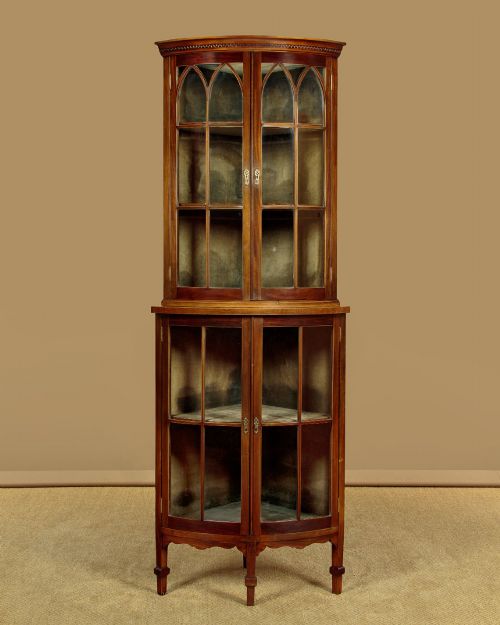
- A convex curved front facade that projects outward from the corner angles. This shape softens the profile of the cabinet in a room.
- Marquetry
- Decorative patterns formed by fitted pieces of veneer applied to a wood foundation. Craftsmen use various woods to create floral or geometric motifs.
- Double corner cabinet
- A two-part standing cupboard featuring an upper and lower section. These tall pieces provide substantial storage capacity across both levels.
Mahogany Corner China Cabinet: Frequently Asked Questions
How do I secure a corner cabinet?
Most standing versions balance securely on their bases due to their heavy timber construction and contents. Wall-hung models require proper fixings screwed directly into solid wall studs to support the weight safely.
Because these cabinets sit tightly into room angles, they naturally resist tipping once positioned correctly on level floors.
What is astragal glazing?
Astragal glazing refers to the narrow wooden mouldings that divide a glass door into multiple smaller panes. This technique frames the contents while providing structural rigidity to the door.
Cabinetmakers used this method extensively on Edwardian and Georgian display pieces to enhance the visual lightness of the timber.
Are these cabinets difficult to move?
Single-piece cabinets are manageable for two people, though tall standing and double-height models require careful handling. Two-piece versions separate into upper and lower sections to simplify transport.
Removing glass shelves and doors before moving prevents accidental damage to the delicate internal structure.
How do I date an Edwardian piece?
Edwardian cabinets often feature bright mahogany finishes combined with satinwood and boxwood inlay in Sheraton Revival styles. Machine-sawn timber and lighter internal construction distinguish them from heavier nineteenth century pieces.
Makers working in this period frequently produced these items to satisfy a domestic demand for revival furniture.
Can I adjust the internal shelves?
Many traditional cabinets feature fixed wooden or glass shelves held in stationary grooves. Altering them requires professional woodworking knowledge to avoid weakening the frame.
Buyers should check shelf depth before purchase to ensure taller porcelain items fit comfortably inside.