
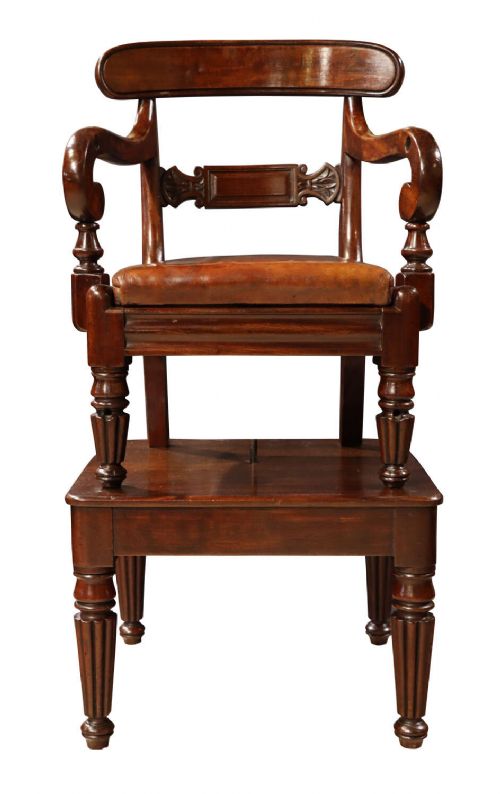


Mahogany Childs Seat
These mahogany childs seat pieces are miniature domestic seats designed for young children, offering sturdy timber construction and period craftsmanship.
Mahogany Childs Seat
A mahogany childs seat encompasses small-scale high chairs, armchairs, rocking chairs, and chairs on stands found across the Georgian, Regency, and Victorian periods. Buyers meet various forms, ranging from standard side chairs to complex metamorphic high chairs that convert for multiple uses.
Many examples date from the nineteenth century, with specific pieces displaying regional cabinet-making traits and period styles like William IV, George III, and Edwardian. The selection includes simple occasional seating alongside elaborate designs featuring caned seats and integrated tables.
Materials and construction
Cabinet-makers built these chairs primarily using solid mahogany, often pairing the dense timber with cane panels, leather upholstery, fabric, textile, or tapestry. Brass elements frequently appear as structural hardware or decorative accents on high chairs and armchairs.
Joinery techniques matched those of adult furniture from the same eras, incorporating turned wooden supports, curved armrests, and framed backrests. Inlaid details and woven caned bergere inserts demonstrate the detailed handwork applied to domestic seating for children.
Factors of quality
Quality in a mahogany childs seat depends upon the precision of the timber joinery, the integrity of the secondary materials like cane or leather, and the overall proportions. Finer pieces retain original structural elements and sophisticated turning, whereas simpler versions rely on plain uprights and basic panel construction.
The sophistication of the design, such as a metamorphic mechanism or an accompanying stand, elevates the piece above standard domestic examples. Richness of grain and subtlety of inlay further distinguish superior workshop production from standard utility seating.
The Mahogany Childs Seat Glossary
- Metamorphic chair
- A convertible piece of furniture designed to shift between a high chair and a low chair or play table. This ingenious mechanism allowed growing children to utilise the same seat in multiple settings.
- Bergere
- A closed-upholstered armchair with a wooden frame where the back and sides consist of woven cane. This technique provides a light yet supportive surface.
- Chair on stand
- A removable seating unit fitted securely to a separate wooden base or table frame. This configuration elevated the child to dining table height.
- Tub highchair
- A high chair featuring a rounded, enclosed backrest that curves continuously into the arms. This shape offers secure enclosure for younger children.
Mahogany Childs Seat: Frequently Asked Questions
How were high chairs used?
These elevated seats kept infants secure and at table height during family meals in dining rooms.
Many designs incorporated trays or stood upon dedicated wooden bases to lift the child safely above floor level.
What periods do these chairs represent?
The available pieces span from Georgian and Regency eras through to the Victorian and Edwardian periods.
Stylistic markers such as George III framing or Art Nouveau inlay help distinguish the exact era of manufacture.
Are cane seats original?
Caned panels frequently appear on Georgian and Victorian chairs to provide lightweight seating support.
Many surviving examples retain their period weaving, though expert re-caning is common in pieces showing heavy daily use.
How do I care for mahogany?
Maintain the timber by keeping the chair away from direct heat sources and sudden humidity changes.
Regular dusting with a dry cloth preserves the polished surface without the need for heavy chemical waxes.