




Mahogany Cased Barometer
These mahogany cased barometers combine domestic utility with scientific precision, bringing practical meteorology into the home through handsome cabinetry.
Mahogany Cased Barometer
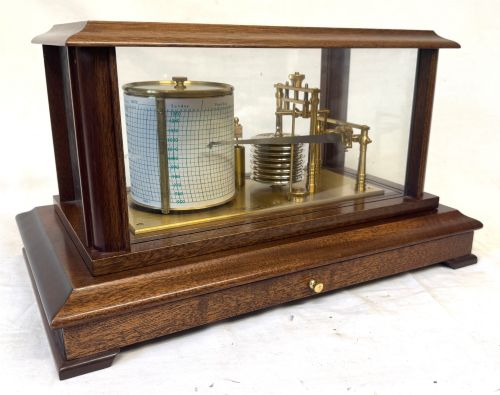
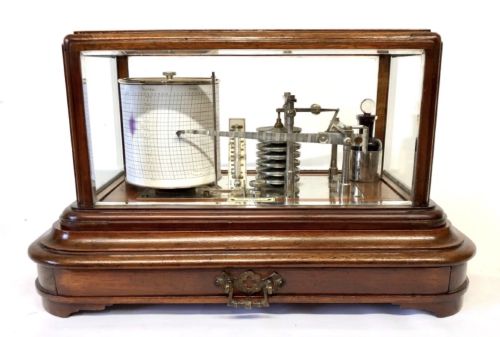
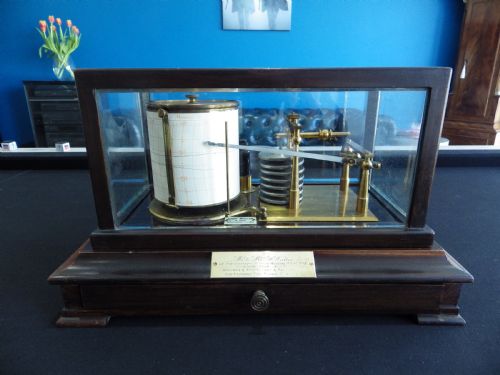
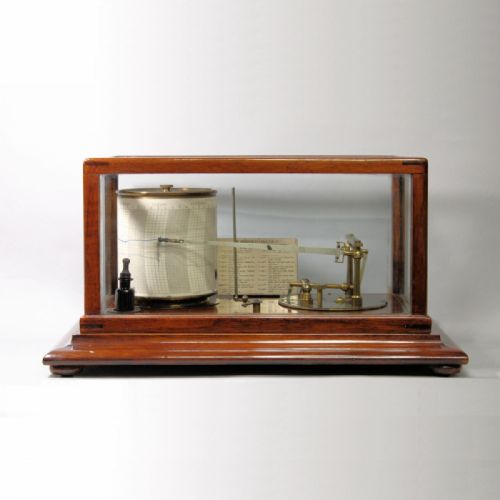
A mahogany cased barometer is a weather-measuring instrument housed in a wooden enclosure, most frequently seen here as recording barographs and traditional wall-hanging dials. The selection spans domestic examples from the Victorian, Edwardian and interwar periods alongside specialised scientific apparatus.
The dominant form on this page is the five-glass mahogany cased barograph, often fitted with a chart drawer below the mechanism. Wheel barometers and stick barometers also appear, representing both British provincial makers and London retailers.
How they were made
Cases rely on mahogany timber, selected for stability and figure, joined to brass fittings and bevelled glass panels that protect the internal mechanics. Dials utilise silvered metal, paper charts, and engraved scales alongside steel components.
Makers integrated delicate meteorological movements, including aneroid stacks and mercury tubes, into custom cabinetry that often incorporated storage drawers for recording paper or thermometers.
The listings on this site span materials including mahogany, brass, glass, steel, paper, silvered metal, and bone.
What varies in quality
Quality rests in the crispness of the timber cabinetwork, the legibility of the engraved silvered metal dials, and the reputation of the maker inscribed on the movement. Finer examples retain original paper charts, intact glass covers, and specialised thermometers or hydrometers.
The distinction between standard commercial items and superior pieces lies in the complexity of the movement, such as the inclusion of multiple vacuum chambers or specialised marine and railway recording mechanisms.
Negretti & Zambra·Short & Mason Limited·Alexander Wright·R Fuess·Richard Freres·Harrods of London·Robson of Newcastle·W.E. Pain of Cambridge
The Mahogany Cased Barometer Glossary
- Barograph
- A self-recording aneroid barometer that plots atmospheric pressure onto a rotating paper chart. These instruments sit inside glass and mahogany cases.
- Stick Barometer
- A tall, vertical barometer containing a column of mercury that measures atmospheric pressure directly against a scale. These often feature exposed cistern covers at the base.
- Wheel Barometer
- A wall-mounted instrument featuring a circular dial where a float mechanism turns a pointer. The case often terminates in an onion top or pediment.
- Aneroid Barometer
- A barometer that measures pressure using a flexible metal box without liquid. This design allowed instruments to be built into portable wooden cases.
- Fortin Stick Barometer
- A precision mercury barometer with an adjustable cistern base for exact readings. These scientific instruments demand careful handling during relocation.
Mahogany Cased Barometer: Frequently Asked Questions
How do I operate a barograph?
Place the instrument on a stable surface away from direct heat and drafts. Lift the glass cover to wind the clockwork drum and secure a fresh paper chart.
Set the pen arm lightly against the paper using the adjustment screw. The mechanism will record pressure fluctuations over the course of a week.
Where should I hang a barometer?
Select an interior wall that experiences minimal temperature variation. Avoid positioning the instrument near radiators, fireplaces, or direct sunlight.
Ensure the hanging bracket or screw fixes securely into solid timber or masonry. Wall-hanging barometers require a plumb vertical position for accurate mechanical response.
How do I identify the period of a barometer?
Examine the timber finish, cabinet proportions, and dial typography. Victorian models often feature heavy carving, whilst Edwardian pieces lean toward cleaner lines and simpler inlay.
Maker signatures and patent dates stamped on the movement or paper charts provide a precise manufacturing window. The presence of a chart drawer typically points to late nineteenth or early twentieth-century production.