
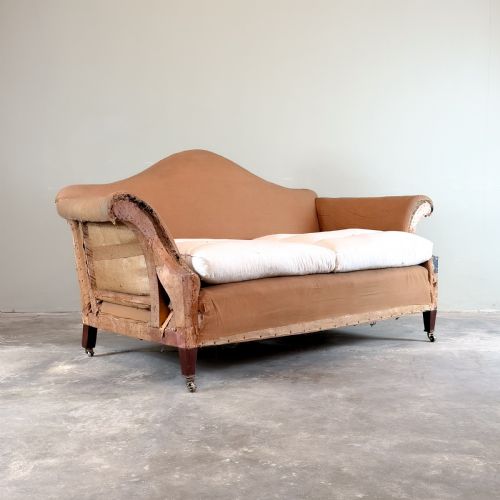


Mahogany Camel Back Sofa
A mahogany camel back sofa brings classic serpentine lines and sturdy timber frames into a room, offering both traditional seating and enduring style.
Mahogany Camel Back Sofa
A mahogany camel back sofa is a traditional seating form characterised by its undulating, curved top rail that resembles a camel's hump. You will encounter pieces spanning from the eighteenth century through to the Edwardian era and later revivals.
The selection ranges from genuine eighteenth-century examples to nineteenth-century interpretations and later revivals in the Georgian, Hepplewhite, and Chippendale styles. These seating options often feature serpentine fronts and varying leg configurations.
Most examples you will meet on this page date from the nineteenth and early twentieth centuries, constructed in the enduring styles of earlier periods. They serve as primary seating in formal rooms, combining timber frames with upholstered surfaces.
How they were made
Makers built the structural frames using solid mahogany, shaping the distinctive camel-shaped back rails and front rails to follow flowing serpentine contours. Joinery relied on traditional techniques to ensure the frame could support extensive upholstery without shifting.
Internal construction utilised natural support materials including jute webbing, cotton stuffing, and various fabric layers beneath the final surface cover. Upholstery fabrics such as damask, velvet, and patterned textiles completed the exterior finish over traditional padding.
Undercarriage stability often involved straight or carved mahogany legs, sometimes connected by understretchers depending on the specific period and stylistic influence.
Some robust frames required up to eight legs to support their generous three-seater proportions.
What varies in quality
The refinement of the timber carving on the legs and frame separates standard production pieces from finer examples. Sharp, clean lines along the serpentine back rail demonstrate superior woodworking skill during construction.
Proportions dictate the overall elegance of the silhouette, with well-balanced arm heights and graceful curves defining the upper tier of craftsmanship. The integrity of the underlying frame structure ensures lasting stability through decades of use.
The Mahogany Camel Back Sofa Glossary
- Camel back
- A furniture back design featuring a continuous convex curve along the top rail, resembling the hump of a camel. This profile became prominent in eighteenth-century seating design.
- Serpentine front
- A furniture front configuration that curves outward in the centre and inward toward the sides in a gentle 'S' shape. It adds visual movement to the base of the sofa.
- Hepplewhite style
- A lightweight, elegant furniture style named after the cabinetmaker George Hepplewhite, characterised by tapered legs and shield or camel back designs. Revival pieces often emulate these eighteenth-century proportions.
- Chippendale style
- A decorative style inspired by Thomas Chippendale, featuring rich mahogany timber, elaborate carving, and robust structural forms. These pieces often incorporate sturdy legs and stretcher bases.
- Understretchers
- Horizontal wooden braces connecting the legs of a piece of furniture near the floor to provide additional structural support. They are frequently found on earlier or revival seating forms.
Mahogany Camel Back Sofa: Frequently Asked Questions
What is a camel back sofa?
A camel back sofa is a traditional seating form defined by its distinctive curved, undulating top rail. The profile rises and falls in smooth arcs resembling the back of a camel.
These pieces typically feature upholstered backrests and seats supported by exposed mahogany frames and legs.
How do I identify a Georgian style sofa?
Georgian style sofas are identified by their classical proportions, mahogany construction, and adherence to eighteenth-century design principles. Look for serpentine fronts and disciplined curving lines.
Many later nineteenth-century and twentieth-century pieces successfully replicated these earlier Georgian characteristics.
What fabrics are used on these sofas?
Upholstery materials on these sofas historically include damask, velvet, cotton, and various woven upholstery fabrics. Traditional stuffing methods often utilised jute webbing and cotton layers.
Many surviving pieces have been re-covered over the years to suit contemporary interiors while retaining their original frames.
Where should I place a camel back sofa?
A camel back sofa works well as a focal point in a traditional living room, drawing the eye with its sculptural silhouette. Its refined back profile allows it to sit comfortably away from walls.
These sofas pair effectively with period armchairs and wooden coffee tables in classic interior schemes.