
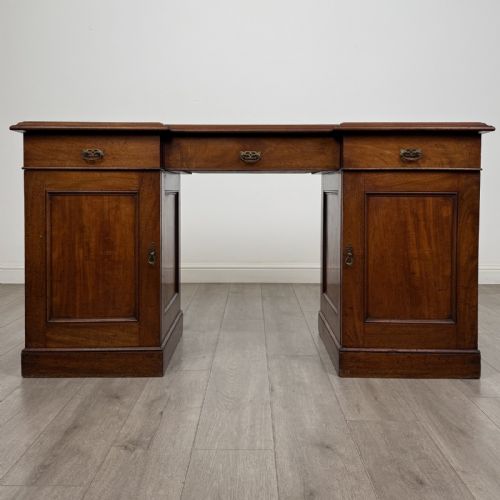
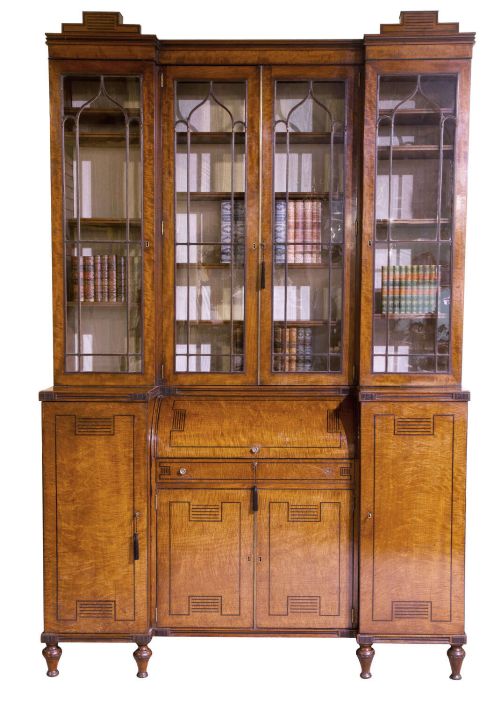
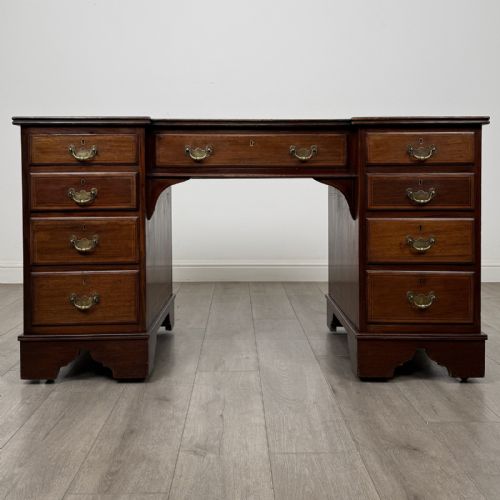


Mahogany Breakfront Desk
A mahogany breakfront desk brings architectural presence and ample workspace to a study, offering the serious writer a commanding centrepiece with deep character.
Mahogany Breakfront Desk
A mahogany breakfront desk is a substantial writing furniture piece defined by its projecting central section, creating a stepped facade that breaks the linear flow of the wall. These pieces combine the utility of a desk with the grand scale of a library bookcase or pedestal base, designed for stately rooms.
The versions most commonly met on this page span the Georgian, Regency, William IV, and Victorian periods, often incorporating secretaire drawers or glazed upper cabinets. They range from pedestal forms to towering secretary bookcases that reach towards high ceilings.
Makers utilised rich timber grains to enhance the visual impact of the breakfront profile, ensuring the central section catches the eye. The form serves both practical storage and grand display, holding books and writing materials within fitted interiors.
How they were made
Cabinet makers constructed these pieces using solid and veneered mahogany, often embellished with contrasting satinwood and ebony inlay to accentuate the breakfront lines. Glass doors feature in the bookcase variants, while writing surfaces frequently incorporate inset leather tops.
Brass hardware, including escutcheons and handles, provides functional and decorative accents that complement the dark timber tones. Joinery techniques from the eighteenth and nineteenth centuries ensure the structural integrity of these large pedestal and bookcase combinations.
Listings span the Georgian, Regency, William IV, and Victorian eras, showcasing mahogany, satinwood, and ebony.
What varies in quality
Quality in a mahogany breakfront desk rests on the selection and matching of timber veneers across the projecting facade. Finer examples display carefully figured grain patterns that create a harmonious visual rhythm from the central section to the wings.
The sophistication of the internal fittings, such as secret drawers within secretaire sections and delicate stringing details, separates standard utility pieces from high workshop productions. The proportion of the breakfront projection relative to the overall carcass dictates the elegance of the silhouette.
Gillow & Co.
The Mahogany Breakfront Desk Glossary
- Breakfront
- An architectural furniture facade where the central section projects forward from the flanking wings. This creates depth and visual hierarchy in large desks and bookcases.
- Secretaire
- A desk or drawer featuring a drop-front writing flap that conceals a fitted interior of small drawers and pigeonholes. It allows a tall bookcase to function as a writing desk.
- Pedestal desk
- A heavy freestanding desk supported by two pedestals of drawers or cupboards flanking a central kneehole. It provides substantial storage beneath the writing surface.
- Stringing
- Narrow inlaid lines of contrasting wood, such as satinwood or ebony, used to outline panels and drawers. It highlights the geometric precision of the cabinet work.
- Glazed
- Fitted with glass panes, typically held in timber frame tracery, to protect books while keeping them visible. This is a common feature on the upper bookcase sections.
Mahogany Breakfront Desk: Frequently Asked Questions
What is a breakfront desk?
A breakfront desk is a large form where the central section projects forward from the sides. It combines workspace with architectural presence.
These pieces often include pedestals or large bookcase tops, making them dominant fixtures in traditional libraries.
How do I date a mahogany desk?
Dating relies on observing period characteristics such as Georgian proportions, Regency brass inlay, or Victorian proportions. Timber choice and construction methods also indicate the era.
Comparing the secondary woods and hardware styles helps confirm whether a piece belongs to the eighteenth or nineteenth century.
Where should I place a pedestal desk?
A pedestal desk requires a generous room layout because of its substantial depth and dual-pedestal footprint. It often sits freestanding in the middle of a study or against a principal wall.
Ensure adequate clearance around the kneehole and drawers for comfortable daily use.