
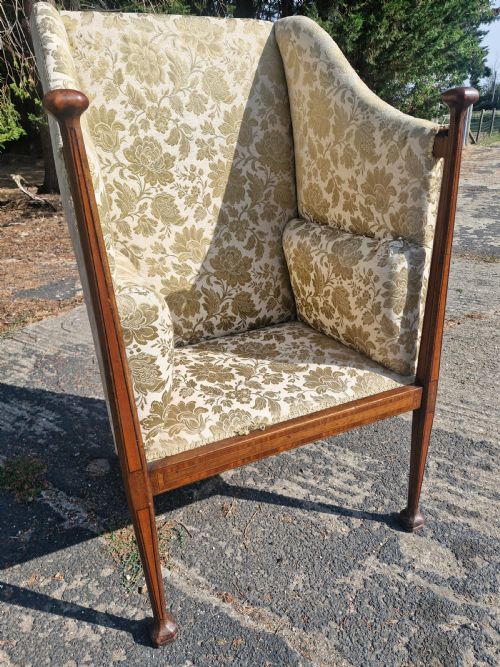
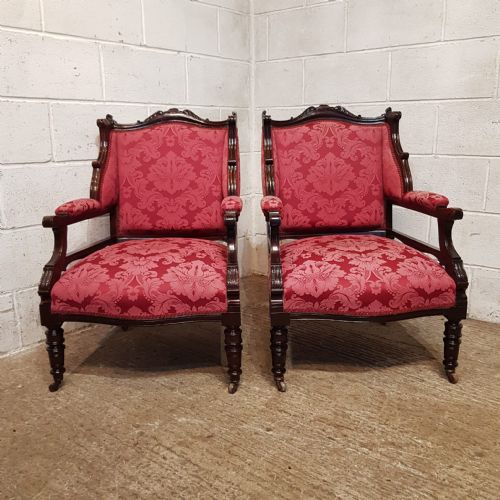


Mahogany Art Nouveau Armchair
A mahogany art nouveau armchair combines flowing naturalistic line with rich timber, offering a distinctive seat that anchors a room with organic elegance.

Mahogany Art Nouveau Armchair
A mahogany art nouveau armchair brings together the sinuous aesthetic of the movement and the solid timber frame of late Victorian, Edwardian, and nineteen-hundreds cabinet work. You will frequently encounter salon chairs, high-backed hall armchairs, and occasional seating shaped from mahogany.
The evidence shows forms ranging from low salon nursing chairs to substantial tub chairs and corner chairs. These pieces were designed for the parlour and drawing room, where curving woodwork and inlaid details caught the eye.
How they were made
Frames are built predominantly from mahogany, often enhanced with contrasting wood inlay, satinwood, and delicate marquetry. These decorative elements trace the organic motifs characteristic of the style along splats, crest rails, and arm supports.
Upholstery forms an integral part of the construction, utilising damask fabric and damask upholstery secured to sprung or padded seats. Brass accents occasionally appear as structural or decorative fixings on specific chair frames.
Listings feature mahogany frames paired with satinwood, brass, and damask upholstery across pieces dated from eighteen ninety to nineteen hundred and ten.
What varies in quality
Quality rests in the crispness of the inlay work and the fluidity with which the mahogany is shaped into characteristic curves. Finer examples display precise wood inlay and marquetry that integrate seamlessly into the structural lines of the chair.
The ambition of the form also dictates distinction, moving from simple side chairs to elaborate high-backed armchairs, tub chairs, and complete parlour suites. The depth of the carving and the integrity of the original upholstery scheme further separate standard production from superior pieces.
Louis Majorelle
The Mahogany Art Nouveau Armchair Glossary
- Marquetry Inlay
- Decorative patterns formed by fitting small pieces of veneer into a prepared mahogany surface. This technique allows for complex floral and curving motifs.
- Damask Upholstery
- A reversible figured fabric traditionally used to cover salon and parlour seating. It provides a textured pattern that complements polished wood frames.
- Corner Chair
- A seat designed to fit into the corner of a room, typically featuring a curved backrest supported by multiple spindles or posts.
- Satinwood
- A pale, lustrous timber frequently utilised for contrasting inlay work against darker mahogany backgrounds. It highlights fine linear details on back splats.
- Tub Chair
- An upholstered armchair with a continuous curved back and sides forming a barrel shape. This form offers an enclosed and supportive seat.
Mahogany Art Nouveau Armchair: Frequently Asked Questions
How do I identify a mahogany art nouveau armchair?
Look for characteristic curving lines inspired by natural forms, combined with mahogany frames and occasional marquetry or wood inlay. These pieces typically date from the late Victorian period, the Edwardian era, or around nineteen hundred.
Examine the backrest and arm supports for whiplash curves and floral motifs. The presence of original damask upholstery or satinwood detailing often confirms the period aesthetic.
Where were these chairs used originally?
These armchairs served primarily in formal spaces such as drawing rooms, parlours, and salons. They were chosen for entertaining guests and adding decorative flair to domestic interiors.
Different forms suited different corners of the room, from high-backed hall chairs to low nursing chairs and corner seats. Their decorative nature meant they were displayed as much for their design as for sitting.
How do I care for the mahogany and upholstery?
Maintain the mahogany frame with appropriate furniture wax applied sparingly to preserve the sheen of the timber. Avoid placing the chair in direct sunlight to protect the wood and any inlaid elements.
Brush damask upholstery gently to remove dust, and consult a specialist for professional cleaning if needed. Protecting the fabric from sustained friction helps retain its texture and pattern.
Can these armchairs be used daily?
Many examples remain sturdy enough for regular use, provided the frame and joints are stable. Lighter salon chairs and nursing chairs are better suited to occasional seating rather than heavy daily lounging.
Check the structural integrity of the joints and the condition of the internal webbing or upholstery stuffing. Careful daily use preserves both the antique timber and the decorative fabric.