



Art Nouveau Armchair
An art nouveau armchair brings flowing organic lines and fine woodwork into a room, offering both decorative presence and comfortable seating.
Defining the art nouveau armchair
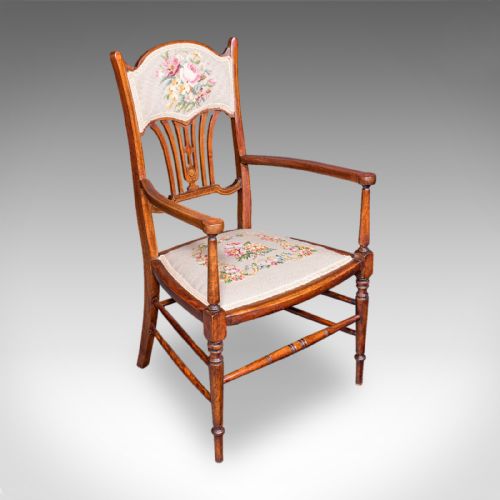
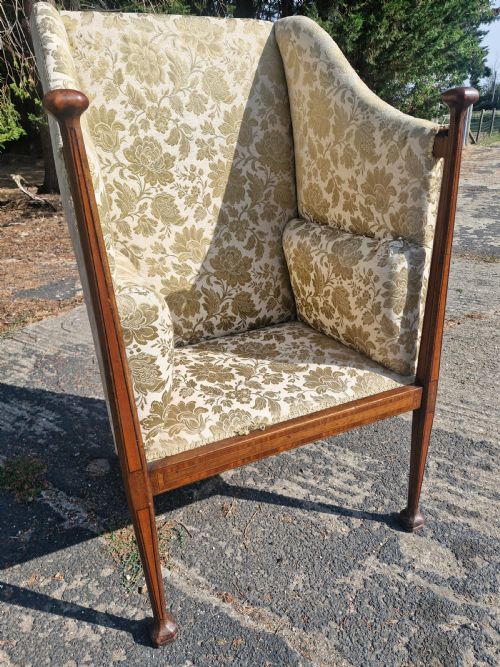
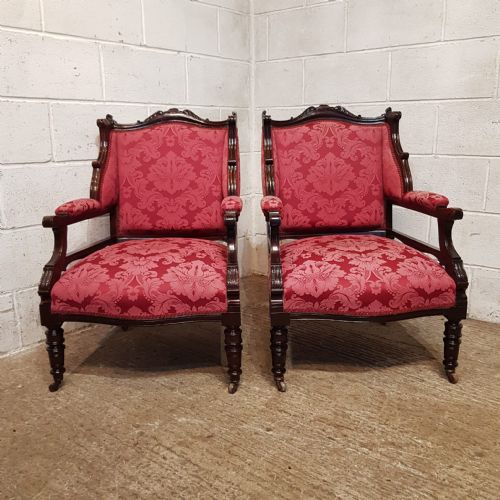
An art nouveau armchair represents a distinct shift toward natural motifs and fluid structural forms during the late Victorian and Edwardian eras. Buyers searching for an art nouveau armchair will encounter everything from simple corner chairs and elbow seats to substantial upholstered fireside models.
The pieces documented here span from the 1890s through to 1910, reflecting the movement's peak popularity. Common formats include salon chairs, carvers, and high-back designs originating around the turn of the twentieth century.

Materials and construction
Makers constructed these frames predominantly in mahogany, oak, walnut, and beech, frequently integrating marquetry inlay to enhance the timber surfaces. Structural work often combined traditional joinery with curved wooden components characteristic of the style.
Upholstery completed the pieces, utilising fabrics, leather, tapestry, and braid trim. Textures and textiles were selected to complement the polished wood and support the organic design ethos.
Retail Price Guide 2026
Typical UK retail prices for art nouveau armchair, calculated from the Sellingantiques database of over a million retail prices indexed since 2003. This retail price guide relies exclusively on Sellingantiques data; no external sources or auction records are used, so the figures do not describe the wider market.
Recorded materials span mahogany, oak, walnut, and beech, complemented by marquetry inlay, tapestry, leather, and braid trim.
Distinctions in quality
Quality rests upon the execution of the woodwork and the complexity of the inlaid motifs. Superior examples display refined carving, precise marquetry, and substantial timber frames rather than purely superficial decoration.
The integrity of the structural joinery and the authenticity of the original or period-appropriate upholstery further separate standard utilitarian seating from finer salon and fireside pieces.
Shapland and Petter·J S Henry
The Art Nouveau Armchair Glossary
- Marquetry Inlay
- Decorative woodwork where small pieces of different coloured veneers are fitted into a solid background to form patterns. This technique frequently depicts the floral and whiplash lines typical of the period.
- Carver
- An armchair, often with open arms, designed to sit at the head of a table or serve as a substantial parlor seat. These frames usually match a set of smaller dining chairs.
- Elbow Chair
- A traditional term for an armchair with low armrests designed to support the elbows. They appear frequently in Victorian and Edwardian domestic settings.
- Corner Chair
- A seat designed to fit into the corner of a room, featuring a diagonal orientation and a wrap-around back rail. They offer a compact alternative to standard armchairs.
Frequently Asked Questions
How do I identify an art nouveau armchair?
Look for characteristic design elements such as whiplash curves, stylized floral marquetry inlay, and organic motifs integrated into the wooden frame.
These visual markers separate the aesthetic from heavier Victorian styles or later twentieth-century modernism.
What woods were used for these chairs?
Makers relied heavily on mahogany, oak, walnut, and beech to build the structural frames of these seats.
Mahogany and inlaid veneers appear most frequently among finer salon pieces, while oak is common in sturdier carver models.
Were these chairs used in the dining room?
While many served as salon or fireside seats, larger carver chairs were often made as part of a suite for dining or hall use.
Upholstered wing and fireside versions were specifically intended for comfortable lounging in morning rooms and sitting rooms.
How should I care for the upholstery?
Protect the fabric, tapestry, or leather components by avoiding direct sunlight and utilising gentle, material-appropriate cleaning methods.
Regular dusting of the wooden frame and careful vacuuming of the textile surfaces will preserve the condition of the piece.