
Mahogany and Satinwood Desk
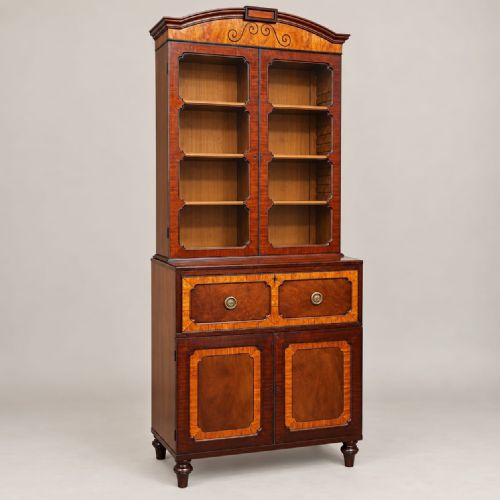
A mahogany and satinwood desk brings together rich timber and pale contrast inlay to anchor a study with Georgian elegance or Edwardian lightness.
Mahogany and Satinwood Desk
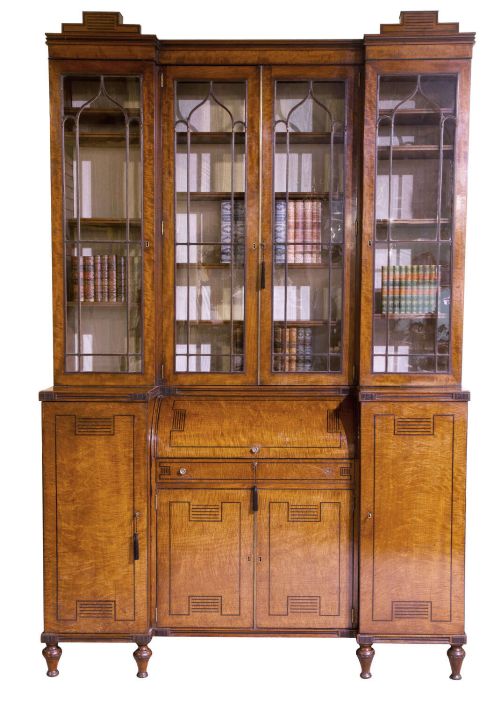
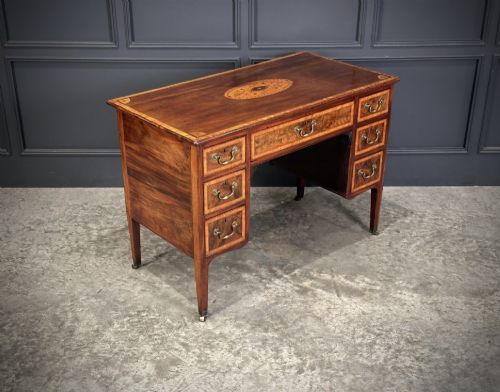
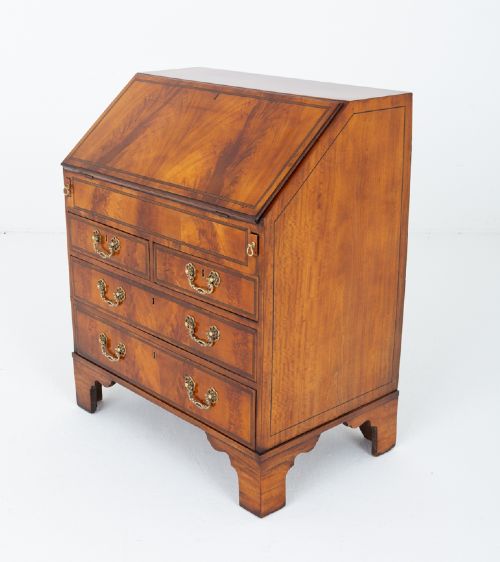
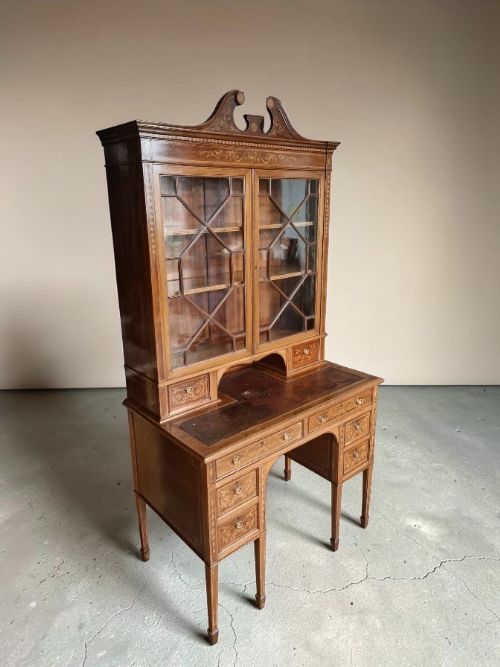
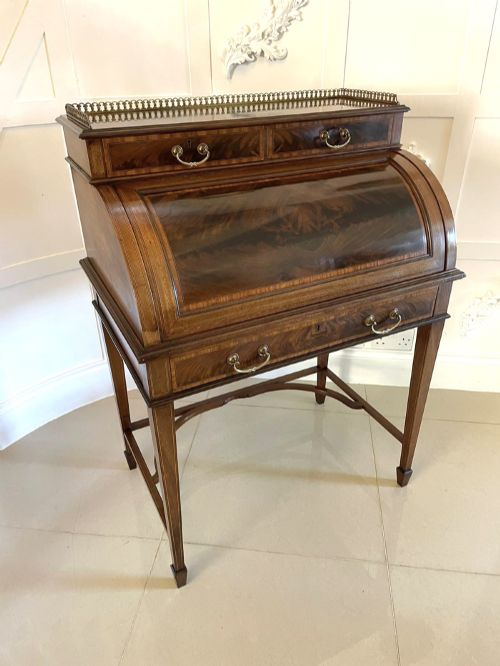
A mahogany and satinwood desk encompasses writing tables, bureau bookcases, cylinder desks, and kidney shapes spanning from the eighteenth century into the Edwardian period. Buyers searching for a mahogany and satinwood desk encounter freestanding writing tables alongside elaborate Carlton House desks and smaller ladies writing surfaces.
The Edwardian Sheraton Revival pieces dominate numerically, often featuring delicate banding, serpentine fronts, and fitted interiors with small drawers and pigeonholes. Earlier Georgian and Regency examples demonstrate simpler structural lines set off by precise marquetry and crossbanding in lighter woods.
Materials and construction
Cabinetmakers built these pieces using solid and veneered mahogany as the primary carcase timber, accented with contrasting satinwood inlay, ebony stringing, and brass hardware. Leather inserts frequently form the writing surfaces of tables and kneehole desks.
Marquetry and painted decoration appear across Edwardian and Sheraton Revival pieces, while eighteenth-century items rely on figured grain patterns and geometric stringing to create visual depth.
Listings span from the eighteenth century to the Edwardian era, incorporating mahogany, satinwood, brass, and leather.
Markers of execution
Quality rests in the crispness of the satinwood inlay, the tightness of the mitre joints, and the selection of figured mahogany veneers for primary surfaces. Superior examples retain original brass handles, fitted interior compartments, and supple leather writing inserts.
Maker attribution separates standard production from exceptional pieces, with workshops such as Edwards and Roberts or Maple and Co. demonstrating finer hand-cut marquetry and more robust internal drawer construction.
Edwards and Roberts·Maple and Co.
The Mahogany and Satinwood Desk Glossary
- Carlton House desk
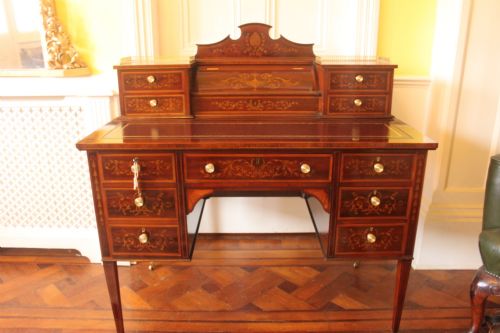
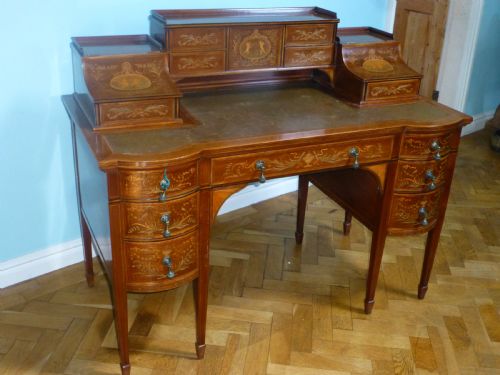
- A form of writing table featuring a curved superstructure of small drawers and pigeonholes enclosing the writing surface. This layout appeared in the late eighteenth century and saw renewed popularity during the Edwardian Sheraton Revival.
- Satinwood inlay
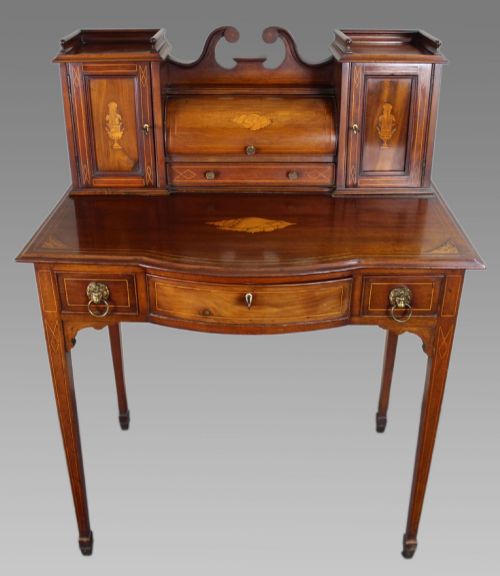
- The practice of recessing pale satinwood into contrasting darker mahogany to form geometric borders or floral motifs. It defines the visual character of many Georgian and Edwardian pieces.
- Cylinder desk
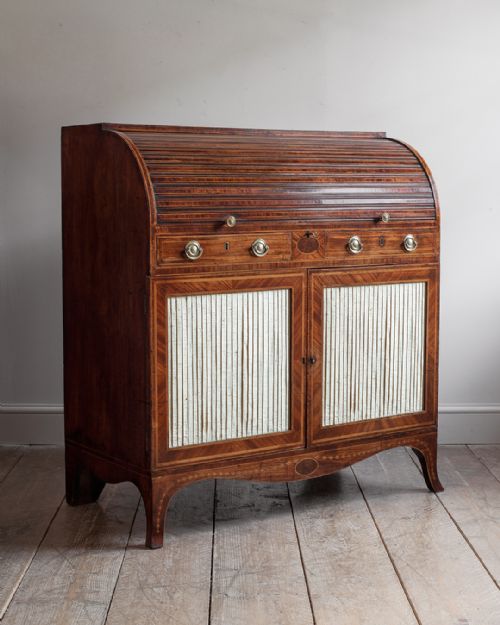
- A writing desk fitted with a rolling quarter-circle wooden shutter that conceals the writing slide and pigeonholes. When closed, it presents a smooth curved front.
- Secretaire bookcase
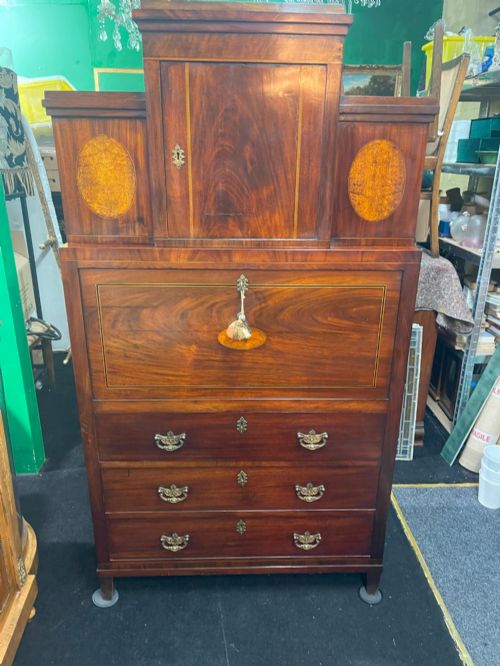
- A tall cabinet combining a shelved upper bookcase with a lower drawer that drops down to reveal a fitted writing desk. They serve for both display and correspondence.
Mahogany and Satinwood Desk: Frequently Asked Questions
How do I date a mahogany and satinwood desk?
Dating relies on stylistic markers, construction methods, and secondary timbers visible inside the drawers. Georgian and Regency pieces show hand-cut dovetails and native timber linings, whereas Edwardian reproductions often utilise machine-cut joints.
Label marks or stamped drawer edges occasionally reveal specific London makers. Comparing the proportion of the inlay work to known period pieces further clarifies the decade of manufacture.
Where should I place a freestanding desk?
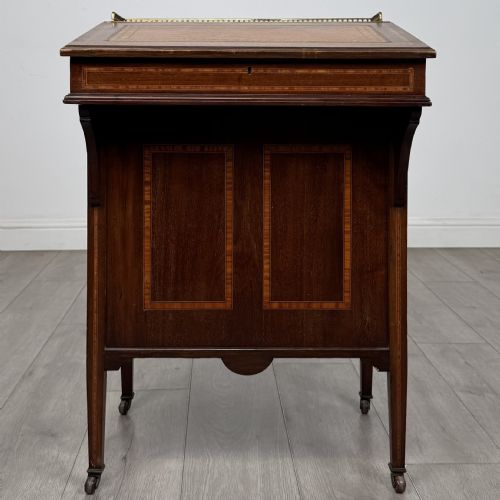
Freestanding cylinder desks and kneehole tables work well away from walls where their finished backs remain visible. Positioning them to catch natural sideways light protects leather writing surfaces from direct glare.
Keeping timber desks away from direct heat sources prevents the mahogany and satinwood veneers from drying and lifting over time.
How do I care for satinwood inlay?
Maintenance involves applying microcrystalline wax sparingly to nourish the wood without softening the glue beneath the inlay. Avoid using silicone sprays or harsh chemical cleaners that can cloud the French polish.
Dusting regularly with a soft dry cloth prevents abrasive particles from dulling the contrast between the dark mahogany and pale satinwood.
What is a Carlton House desk?
A Carlton House desk is a distinctive writing table with a tiered bank of drawers sweeping around the back and sides of the user. This configuration provides structured storage for stationery while maintaining a compact footprint.
Originating in the late eighteenth century, these desks were reproduced extensively during the Edwardian era with fine marquetry decoration.