
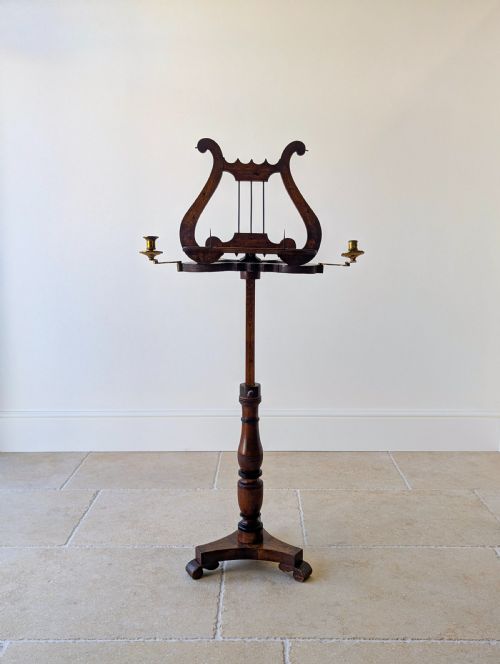


Lyre Sheet Music Stand
A lyre sheet music stand brings sculptural grace to a room, offering adjustable height and steady support for scores.
Lyre Sheet Music Stand
A lyre sheet music stand serves musicians and collectors, taking the form of a freestanding lectern or adjustable recital stand where the central support or music desk mimics the classical lyre instrument. Buyers exploring this category encounter varied timber and brass designs dating from the Georgian, Regency, and Victorian eras through to the Edwardian period.
The selection here ranges from single-sheet music stands and duet stands to multi-functional pieces like the inlaid mahogany Canterbury. Mahogany, walnut, rosewood, and oak provide the primary structural forms, frequently accompanied by satinwood inlay or patent mechanisms designed for the Victorian parlour.
Assessing craftsmanship and condition
Quality rests in the crispness of the timber carving, the precision of the lyre fretwork, and the integrity of the adjustable brass mechanisms. Superior examples exhibit tightly figured grain, such as burr walnut or rich rosewood, matched with robust moving parts that hold position without slipping.
Periods represented include Georgian, Regency, William IV, Victorian, and Edwardian.
Padbury
The Lyre Sheet Music Stand Glossary
- Lyre
- A U-shaped stringed instrument of ancient Greece whose symmetrical curves inspired the central openwork design of these music stands. This motif became especially popular during the Regency and Victorian periods.
- Canterbury
- A low piece of furniture featuring vertical partitions used for holding sheet music, books, or folios. Some Edwardian variants incorporate music stands or compartmentalised storage below the main desk.
- Duet stand
- A wider music stand designed to accommodate two musicians reading from a shared open score. These versions often feature a larger or double-sided reading desk.
- Patent
- A legally protected mechanical invention registered by a maker to safeguard a novel design. Examples include specialised leaf-turning devices and height-adjustment mechanisms.
Lyre Sheet Music Stand: Frequently Asked Questions
What is a lyre sheet music stand?
A lyre sheet music stand is a dedicated piece of furniture designed to hold scores at a readable height during performance. The defining feature is the openwork frame shaped like a classical lyre, placed centrally beneath the desk.
These pieces were standard fixtures in nineteenth-century drawing rooms and music parlours. They combine practical adjustability with decorative woodwork.
How do I date a music stand?
Dating relies on timber choice, construction methods, and stylistic cues from periods like Regency, Victorian, or Edwardian. Earlier Georgian and Regency examples often feature rosewood or mahogany with fine brass fittings, while later Victorian pieces utilise heavy carved walnut.
Patent marks and mechanical fasteners also help narrow the manufacturing window. Makers often stamped their inventions directly into the brass adjustments.
Can these stands hold heavy books?
Most antique music stands are built from sturdy hardwoods like mahogany, oak, or walnut designed to support substantial bound scores. Adjustable stems and heavy base platforms provide the necessary balance against the weight of the desk.
Duet stands and larger lecterns offer extra stability for multiple volumes. Care should still be taken when extending height mechanisms to the maximum limit.
How do I integrate one into a modern room?
A music stand works well as a focal point in a living room, study, or hallway, functioning both as sculpture and display. Many owners use them to display open art books, atlases, or family Bibles rather than sheet music.
Their slim profile allows them to fit into corners or beside seating areas without overwhelming the floor space. The warm tones of mahogany, walnut, and brass complement traditional and eclectic interiors.