



Low Mahogany Press
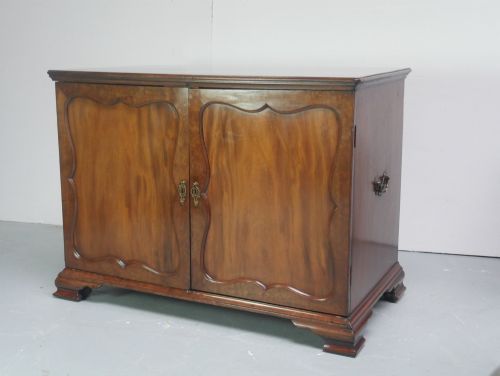
A low mahogany press is a compact, two-door storage cabinet built for domestic linens and clothes, offering sturdy proportions and rich timber grain.

Low Mahogany Press
A low mahogany press serves as a practical storage cabinet with a two-door configuration, often called a dwarf cupboard, house keeper's cupboard, or clothes press in the historical record. These pieces sit lower than traditional taller wardrobe presses, making them suitable for domestic spaces where height is limited.
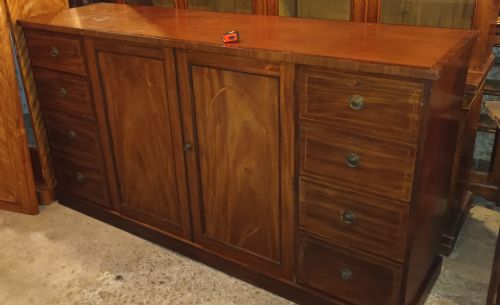
The pieces appearing on this page span the Georgian, Regency, William IV, and Victorian periods, stretching from the eighteenth century through to eighteen eighty. Forms include simple side cabinets, secretaire variants, and dwarf wardrobes constructed in solid mahogany and figured veneers.
How they were made
Cabinet makers utilised dense native and imported timbers, selecting solid mahogany for structural integrity and flame mahogany veneer for decorative surface impact on the doors and drawer fronts. Secondary woods provided internal framing for shelves and sliding trays.
Craftsmen applied contrasting stringing and banding using boxwood and ebony inlay to accentuate the geometric lines of the cabinet doors. Brass hardware, including handles, hinges, and lock escutcheons, finished the construction.
Listings span the Georgian, Regency, William IV, and Victorian periods, utilising mahogany, flame mahogany veneer, boxwood inlay, and brass.
What varies in quality
Quality rests upon the selection of timber figures and the precision of the cabinet work, where fine flame mahogany veneer and balanced grain patterns elevate a piece above standard utility items. The integration of secretaire drawers and subtle boxwood inlay demonstrates higher workshop ambition.
Structural refinement shows in the thickness of internal sliding trays, the neatness of dovetail joints on drawers, and the retention of original brass fittings rather than later replacements.
Gillows of Lancaster·Holland and Sons·Waring and Gillow
The Low Mahogany Press Glossary
- Press cupboard
- A large storage cabinet traditionally used for linens and clothing, featuring internal shelves or sliding trays behind double doors.
- Dwarf
- A descriptive term in cabinet making for furniture built with a reduced overall height compared to standard tall wardrobes or presses.
- Flame mahogany
- A veneer cut from the fork of the mahogany tree where the branches meet the trunk, producing a distinctive flickering flame pattern.
- Secretaire
- A cabinet incorporating a pull-down writing drawer fitted with small pigeonholes and internal small drawers.
- Banding
- A narrow strip of contrasting timber inlaid around the border of a drawer front or door panel to create a decorative frame.
Low Mahogany Press: Frequently Asked Questions
What is a low mahogany press used for?
These cabinets serve as versatile storage furniture for folding linens, clothing, and household goods within bedrooms or living spaces. Their reduced height allows them to function as surface display tables while concealing internal storage.
Historically, they held household textiles and gentlemen's attire, keeping fabrics clean and organised behind lockable timber doors.
How do I date a low mahogany press?
Dating relies on observing structural characteristics, timber choice, and decorative details such as inlay styles and hardware. Georgian pieces typically display simpler lines with solid mahogany, while Regency and William IV examples frequently introduce flame veneer and brass mounts.
Later Victorian versions often feature heavier proportions and flared cornices, aligning with the manufacturing traits recorded across the periods.
Are all low presses actually linen presses?
Not every low press contains the traditional internal sliding trays associated with linen storage. Many examples function simply as low wardrobes, side cabinets, or house keeper's cupboards with standard shelving.
Makers adapted the external form to suit different domestic requirements, resulting in variations like secretaire cupboards and clothes presses.
How do I care for a mahogany press?
Maintenance involves keeping the timber away from direct heat sources and strong sunlight to prevent the mahogany and veneer from drying out or fading. Gentle dusting with a soft cloth preserves the polish without stripping the natural finish.
Occasional application of traditional beeswax helps nourish the wood and maintain the lustre of the antique surface.