


Louis XVI Style Sideboard
A louis xvi style sideboard brings French neoclassical discipline and rich marquetry into a room, offering both display space and deep storage.
Louis XVI Style Sideboard
When you search for a louis xvi style sideboard, you encounter French and continental case pieces built primarily during the nineteenth and early twentieth centuries, alongside occasional eighteenth-century examples. These items span various forms, including commodes, side cabinets, credenzas, and formal sideboards designed with architectural symmetry and restrained proportion.
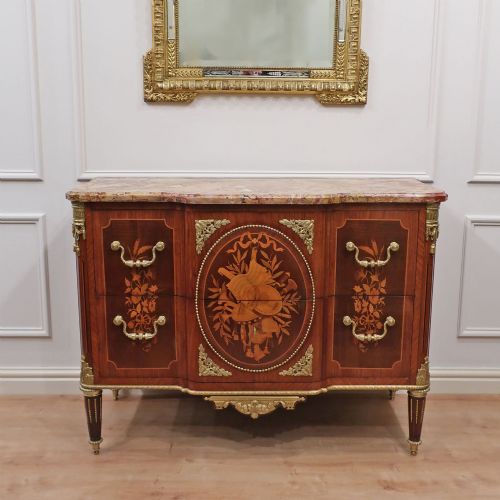
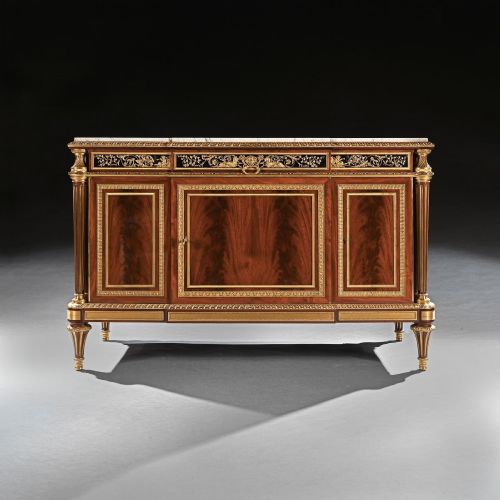
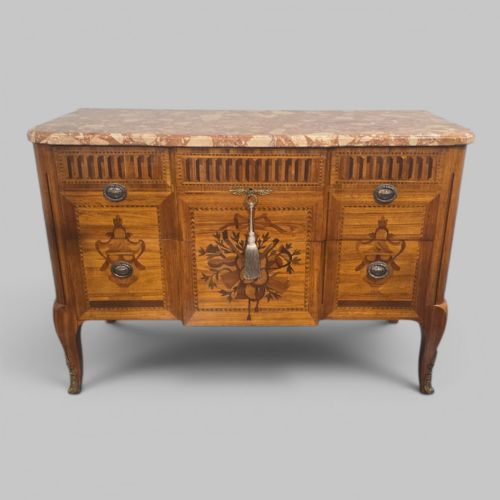
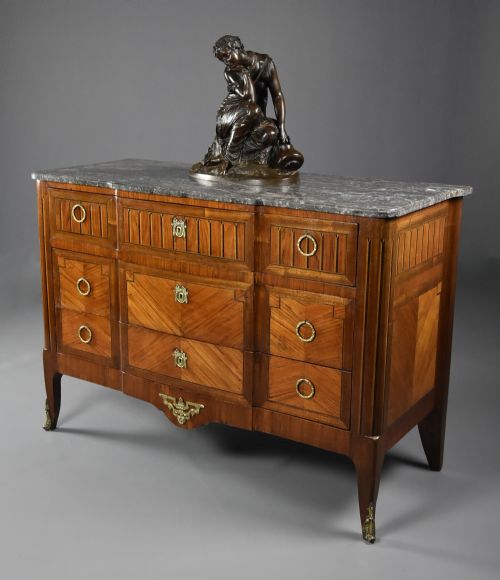
The version you are most likely to meet on this page is the nineteenth-century French commode or side cabinet featuring marquetry, parquetry, and a fitted marble top. Makers of this period frequently drew inspiration from royal cabinetmakers of the ancien régime, producing revival pieces that emphasise straight lines, fluted pilasters, and classical mounts.
Materials and construction methods
Cabinetmakers constructed carcass frames using native and exotic hardwoods such as walnut, mahogany, kingwood, and satinwood, often applying intricate geometric parquetry or floral marquetry veneers across the surface. These wooden elements combine with heavy cast and chased ormolu or gilt bronze mounts, which highlight structural corners, apron centres, and key escutcheons.
Many pieces incorporate polished natural stone surfaces, utilising white, grey, or scagliola marble tops fitted precisely to the upper profile of the commode or sideboard. Interior construction relies on traditional dovetailed drawer boxes and oak or pine secondary woods, finished by hand with French polish.
The inventory spans the eighteenth, nineteenth, and early twentieth centuries, dominated by French neoclassical revival pieces.
Distinctions in craftsmanship
Quality rests in the precision of the veneer work and the crispness of the metalwork, where master workshops distinguished themselves through meticulous execution. Finer examples display continuous, unbroken marquetry patterns across drawers and doors, coupled with fire-gilt bronze mounts that show sharp chiselling rather than soft, cast-down surface detail.
The integration of the marble top and the smoothness of the drawer action separate standard production items from pieces bearing maker signatures. Superior cabinets maintain structural integrity in their joints and timber movement control, ensuring the decorative surface remains stable over generations.
Henry Dasson·Joseph Zwiener·Jean-Henri Riesener·Paul Sormani
The Louis XVI Style Sideboard Glossary
- Ormolu
- Gilded bronze used for decorative mounts and furniture hardware. This technique involves applying a mercury-gold amalgam to cast bronze before heating to bond the gold.
- Marquetry
- Veneering technique arranging different coloured woods, shells, or ivory to create pictorial or geometric designs. Artisans cut these veneers together in packets to ensure tight, seamless joints.
- Parquetry
- Geometric mosaic woodwork forming repeating patterns like cubes or chevrons across cabinet doors and tops. It relies on precise cutting of small wood blocks.
- Commode
- A low chest of drawers or cabinet developed in France during the seventeenth century. In later revival periods, it served as a primary decorative storage piece in formal reception rooms.
- Meuble d'appui
- French term for a supportive or subsidiary piece of furniture, generally referring to a side cabinet or credenza standing against a wall.
Louis XVI Style Sideboard: Frequently Asked Questions
What rooms suit a louis xvi style sideboard?
These cabinets suit dining rooms, living spaces, and hallways where their formal proportions and decorative surfaces act as focal points. They provide enclosed storage for tableware or linens while offering a flat upper surface for lamps and decorative objects.
Their restrained classical lines allow them to sit comfortably alongside both traditional antiques and contemporary interior schemes. The inclusion of a marble top also provides a durable, heat-resistant surface for serving items.
How do I identify a nineteenth-century revival piece?
Nineteenth-century revival pieces often display mechanical uniformity in their dovetails and standardised hardware fixings that differ from eighteenth-century workshop practices. Examination of the secondary woods inside the drawers usually reveals nineteenth-century pine or oak milling standards.
Makers working in this era frequently reproduced specific royal models or incorporated signature gilt bronze mounts typical of Parisian workshops between eighteen-eighty and nineteen-hundred.
Are marble tops original to these cabinets?
Original marble tops fit the exact serpentine or breakfront contours of the wooden carcass without overhangs or gaps. The underside of period marble often shows matching inventory numbers or tool marks consistent with the cabinet's construction era.
Replacement marble is thicker or exhibits modern machine-cut edges that lack the subtle hand-beveined profiles found on nineteenth-century stones.
How should I care for the wood and ormolu?
Maintain the finish by dusting with a dry, soft cloth and applying a microcrystalline wax sparingly to nourish the wood without building up residue. Avoid placing cabinets in direct sunlight or near heat sources to prevent the marquetry veneers from lifting.
Clean gilt bronze mounts gently with a dry brush, avoiding liquid polishes that can strip the original fire-gilding from the metal surface.