




Louis XVI Style Bureau
When you handle a louis xvi style bureau, you meet the symmetrical restraint and classical mounts that defined late eighteenth century Parisian taste, revived across the nineteenth century.
Louis XVI Style Bureau
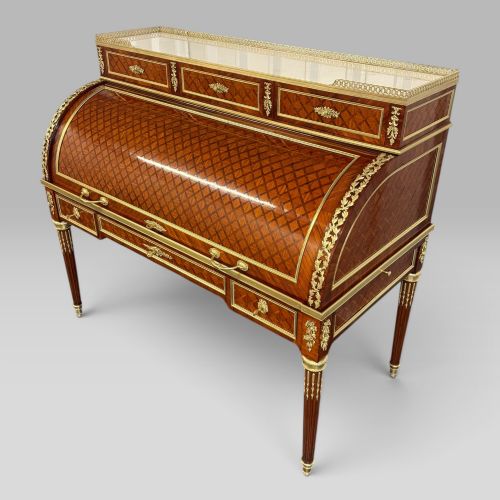
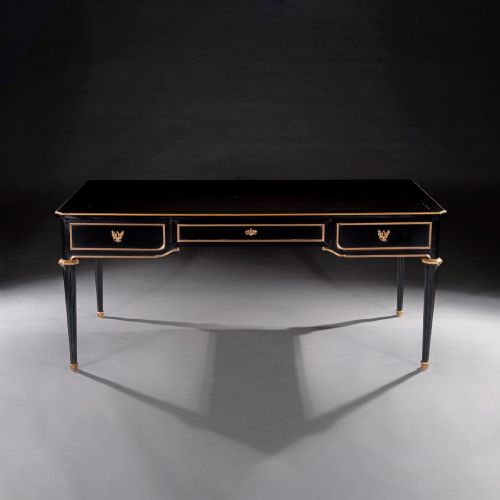
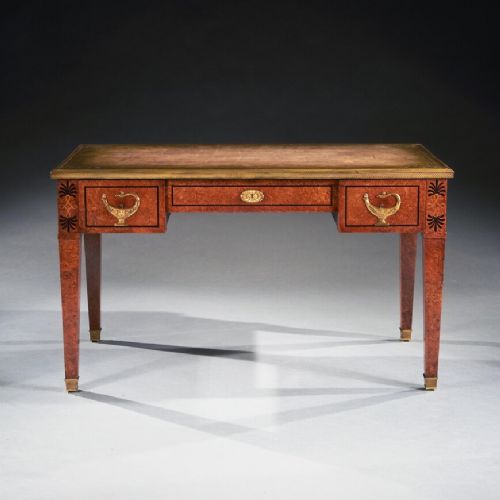
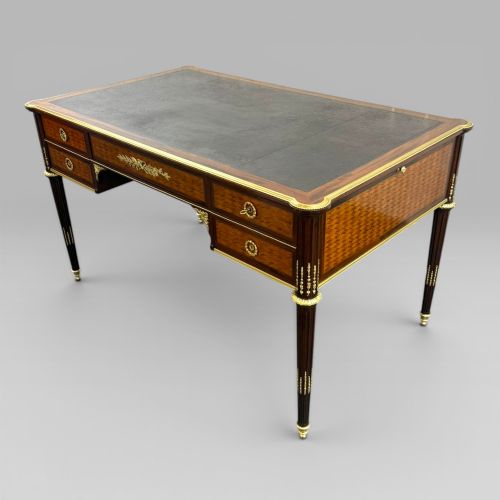
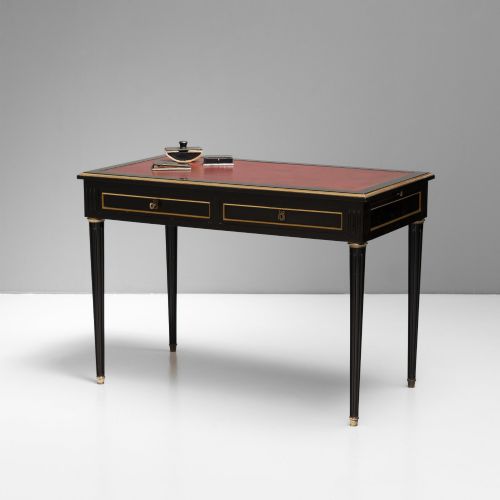
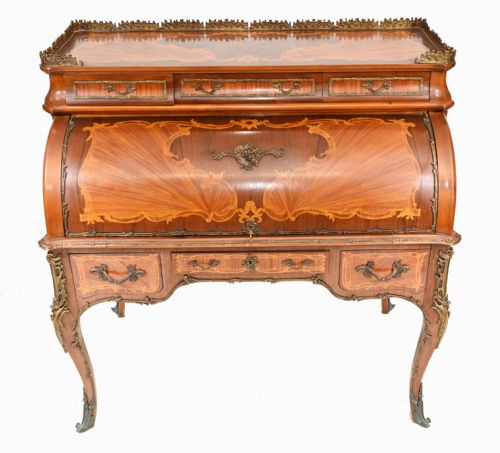
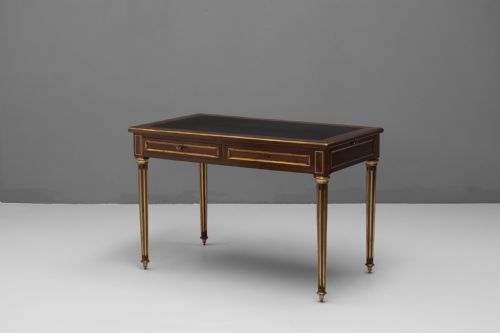
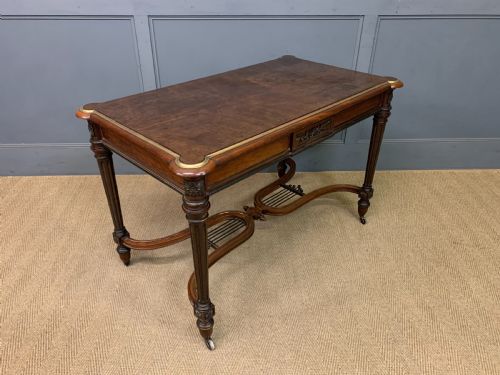
A louis xvi style bureau brings formal neoclassical writing furniture into nineteenth-century interiors, taking the form of bureau plats, cylinder desks, and secretaires. These pieces reproduce the proportions of the ancien regime, favouring rectangular writing surfaces and tapering fluted legs over the sweeping curves of earlier periods.
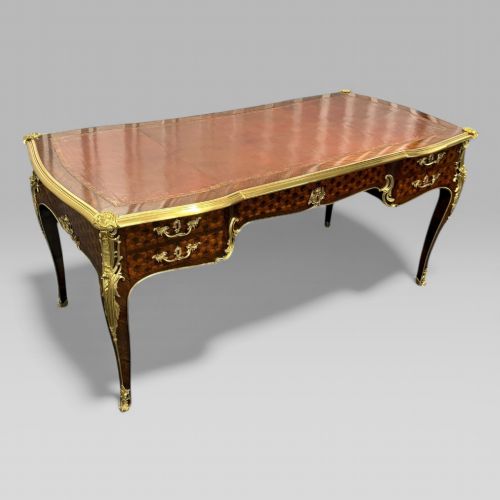
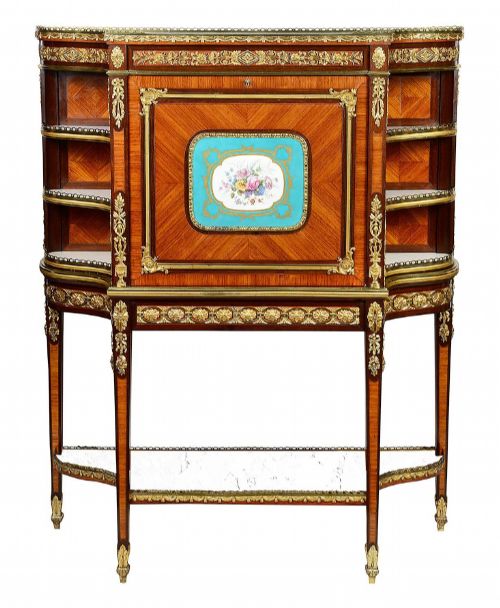
The versions met most frequently on this page date from the nineteenth century, ranging from simple mahogany writing tables to grander creations with elaborate parquetry and gilt bronze mounts. Makers of this era looked back to royal models, producing freestanding desks meant to command the centre of a room rather than sit against a wall.
How they were made
Cabinetmakers constructed carcass frames from solid timbers like mahogany, walnut, and satinwood, applying veneers of kingwood, tulipwood, and amboyna in geometric parquetry or floral marquetry patterns. Brass and ebonised woods also appeared, providing structured contrast to the warmer tones of the primary fruitwood veneers.
Cast ormolu and gilt bronze mounts provided the characteristic neoclassical hardware, framing panels, outlining drawers, and capping the feet with sabot mounts. Tooled leather inserts frequently lined the writing surfaces, secured by blind-tooled borders that matched the ink and gold tooling traditions of the period.
Several pieces conceal secret compartments behind drop-front flaps, designed for hiding love letters from prying eyes.
What varies in quality
Quality rests primarily on the crispness of the cast ormolu mounts and the precision of the underlying parquetry. Top-tier workshop pieces display heavy, finely chiselled gilt bronze that integrates seamlessly with the timber carcass, while simpler examples rely on lighter, unchased brass fittings.
The choice of secondary timbers and the thickness of the cabinet veneers also separate workshop standards. Master makers selected dense kingwood and mahogany, ensuring the drawers ran true and the structural joints remained stable across decades of domestic use.
François Linke·Blake London·Donald Ross·Paul Sormani·Zweiner·Henry Dasson·Jean Werner·Millet·Fournier
The Louis XVI Style Bureau Glossary
- Bureau plat
- A freestanding writing table fitted with drawers across the frieze, designed to sit in the middle of a room. This form serves as the most common expression of the style on the market.
- Ormolu
- Gilt bronze mounts applied to furniture edges, corners, and legs for decorative accent. The term derives from the French for milled gold.
- Parquetry
- Geometric wood veneers laid down in repeating patterns such as cubes or lozenges. This technique shows the cabinetmaker's skill in timber selection and sawing precision.
- Secretaire abattant
- A tall writing cabinet featuring a drop-front fall flap that conceals inner pigeonholes and small drawers. These pieces offer vertical storage combined with a concealed writing surface.
Louis XVI Style Bureau: Frequently Asked Questions
Where should I place a bureau plat?
A bureau plat is designed as a freestanding piece with finished back panels, making it ideal for the centre of a room. Placing it away from the wall allows the ormolu mounts and mahogany or kingwood veneers to be viewed from all angles.
Ensure the room has adequate natural light across the tooled leather writing surface. They pair well with traditional library settings and symmetrical interior layouts.
How do I care for leather inserts?
Tooled leather writing surfaces require gentle cleaning with a dry or barely damp cloth to avoid lifting the gold leaf tooling. Conditioning balms formulated for antique leather help prevent the surface from drying and cracking over time.
Keep these desks away from direct sunlight and heat sources, which can warp the timber carcass and shrink the leather panel inset. Avoid using modern chemical polishes on the surrounding wood veneers.
How do I tell nineteenth century copies apart?
Nineteenth-century revival pieces often display machine-sawn veneer thicknesses and modern construction methods inside the drawer boxes. Examining the interior secondary woods and the cut of the dovetails reveals the true manufacturing era.
Cast ormolu on nineteenth-century pieces tends to be heavier and more sharply chased than later twentieth-century reproductions. Maker stamps or signatures on the bronze mounts also help identify workshop origins.