



Louis XVI Secretaire
These pieces of louis xvi secretaire furniture bring refined writing cabinets and desks into a room, offering clever fall fronts and fitted drawers.
Louis XVI Secretaire
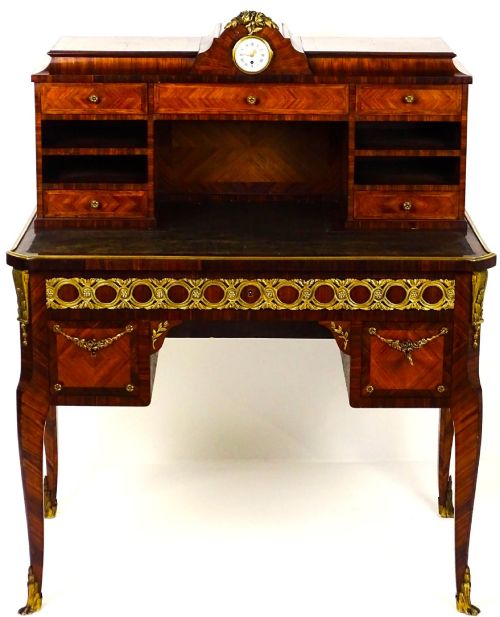
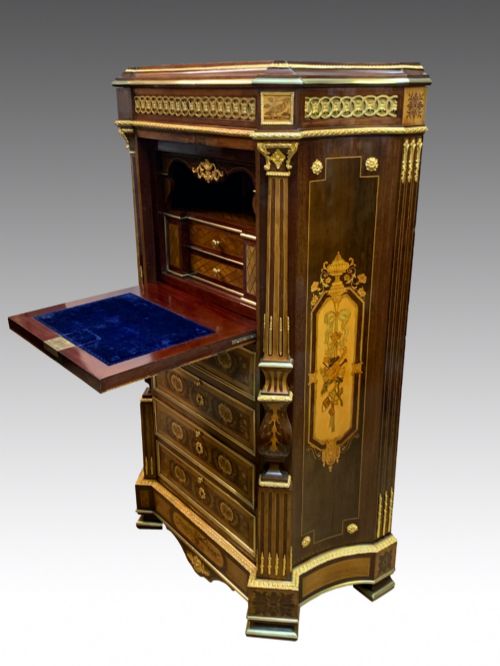
When you search for a louis xvi secretaire, you are looking at sophisticated writing furniture originating from French traditions and later revivals. These pieces combine a cabinet body with a drop-down writing surface, known as an abattant, concealing small drawers and pigeonholes inside.
You are most likely to meet nineteenth-century revival interpretations on this page, alongside genuine eighteenth-century examples and transition pieces. Makers used forms like the secretaire chest, writing cabinet, and escritoire, finished with distinctive marble tops and gilt bronze mounts.
The aesthetic draws on French neoclassical restraint, replacing heavy curves with straight lines, fluted pilasters, and architectural proportion. Walnut, mahogany, kingwood, and tulipwood provide the structural carcase, often decorated with elaborate marquetry or parquetry patterns.
How they were made
Cabinetmakers constructed the carcase using timber foundations like mahogany, walnut, or satinwood, veneered with decorative exotic woods such as kingwood and tulipwood. Marquetry and parquetry techniques created geometric patterns and floral inlay across the drop fronts and drawer faces.
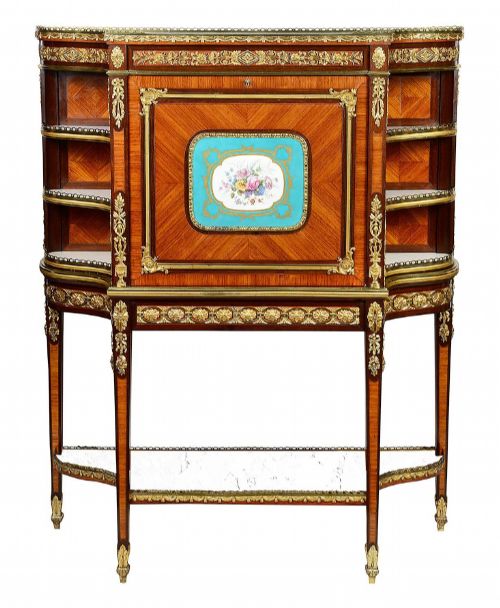
Ormolu mounts, also described as gilt bronze or brass, were cast and chased to highlight corners, key escutcheons, and feet. Marble slabs, typically white or variegated, fitted precisely onto the upper surface to provide a durable and luxurious top.
Listings feature mahogany, walnut, kingwood, and rosewood, alongside marble tops and ormolu mounts spanning eighteenth-century origins to nineteenth-century revival pieces.
What varies in quality
Quality rests in the precision of the veneer work and the crispness of the cast ormolu mounts rather than the mere presence of decoration. Finer pieces display seamless matching of timber grains across the fall front and drawer banks, showing deliberate hand-cut marquetry rather than stamped imitation.
The interior fit-up of small drawers and secret compartments dictates the grade of the cabinet, alongside the weight and thickness of the marble top. Robust secondary timbers inside the drawers and smooth action in the mechanical catches separate standard workshop output from master cabinetmakers.
Paul Sormani·Maison Krieger·Blake·Millet
The Louis XVI Secretaire Glossary
- Abattant
- A drop-down writing flap or fall front on a cabinet that conceals an interior of small drawers and pigeonholes. This surface serves as the main writing desk when lowered.
- Ormolu
- Gilded bronze mounts applied to furniture for decoration and edge protection. Makers chased the metal surfaces by hand to create sharp detail.
- Marquetry
- Inlaid wood veneers arranged in pictorial or decorative motifs across a surface. Craftsmen used various tinted and dyed woods to achieve tonal depth.
- Parquetry
- Geometric wood inlay forming repeating patterns such as cubes, lozenges, or squares. It differs from marquetry by relying on strict symmetry and straight lines.
- Escritoire
- A small writing desk or cabinet featuring a sloping or falling front. The term often describes French writing furniture with multiple internal compartments.
- Semanier
- A tall chest of drawers designed with seven tiers, one for each day of the week. These cabinets occasionally incorporate a secretaire drawer within the upper section.
Louis XVI Secretaire: Frequently Asked Questions
What is a secretaire abattant?
A secretaire abattant is a tall upright cabinet with a hinged front panel that folds down to create a writing surface. Inside, it houses a collection of small drawers and compartments for correspondence.
This form allowed owners to store writing materials and hide paperwork away when not in use, keeping the room tidy. It combines the storage capacity of a chest with the utility of a desk.
How do I use a secretaire daily?
You lower the front flap onto integrated support arms or side brackets to reveal the writing surface. The interior drawers and pigeonholes hold stationery, pens, and small items.
Keep the leather or wood writing surface conditioned and avoid placing excessive weight on the lowered flap. Treat the hinges and support mechanism with care when opening and closing.
How do I tell eighteenth-century pieces apart from later revivals?
Eighteenth-century originals show construction methods, tool marks, and timber shrinkage consistent with age and early hand-tool work. Revival pieces made in the nineteenth century often use machine-cut elements alongside hand-finishing, utilising styles from earlier reigns.
Examine the secondary timbers inside the drawers and the style of the carcase construction for clues. Cabinetmakers in later decades frequently copied eighteenth-century proportions precisely.
What are ormolu mounts?
Ormolu mounts are cast bronze elements treated with a gold-wash finish and applied to the corners, feet, and keyholes of fine furniture. They protected vulnerable wooden edges while adding decorative contrast.
These mounts required skilled chasing by hand after casting to sharpen the details of leaves, scrolls, or urns. They are characteristic of high-end French cabinetmaking.