
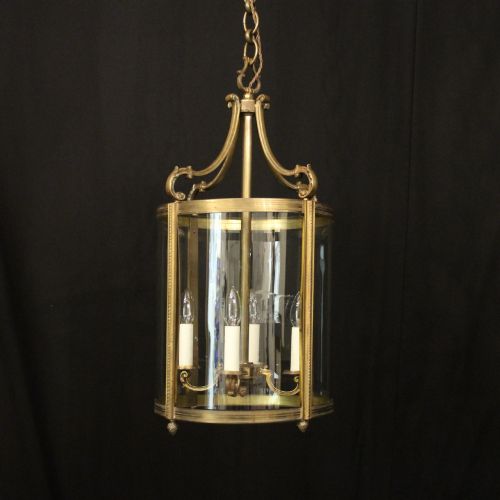
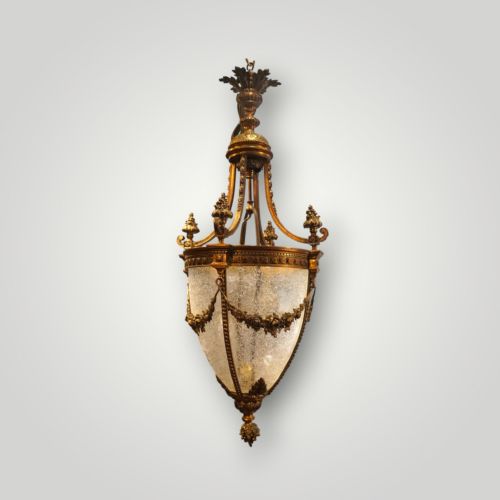
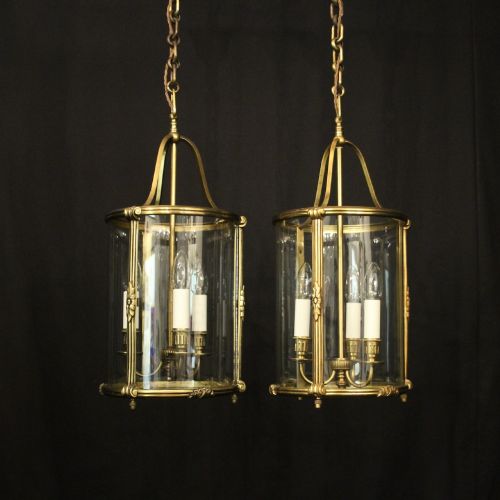
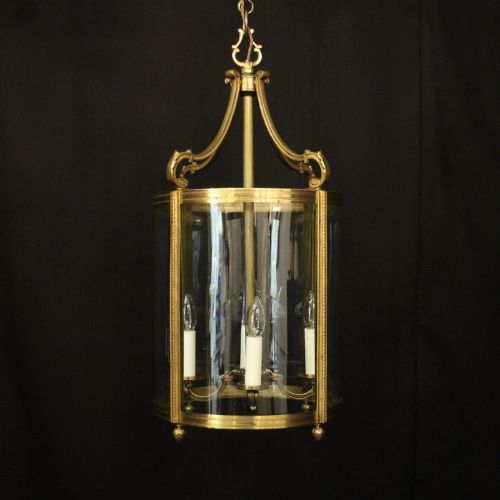


Louis XVI Pendant Lantern
Louis xvi pendant lantern pieces are French neoclassical hanging lights that bring architectural symmetry and warm illumination to high-ceilinged entrance halls.
Louis XVI Pendant Lantern
A louis xvi pendant lantern is a hanging ceiling light rooted in the architectural symmetry and classical restraint of late eighteenth-century France. Buyers searching for a louis xvi pendant lantern will find examples spanning the nineteenth century through the early twentieth century, alongside revivals from the nineteen-twenties.
The most common forms on this page are French hall lanterns and pendant lights featuring hexagonal or convex glass panels set within a metal frame. These pieces draw heavily on neoclassical motifs, chateau aesthetics, and palace designs such as those found at Versailles.
Most entries originate from French workshops adhering to the louis xvi style, utilising traditional hanging configurations designed for entranceways and corridors. The proportions range from compact single-bulb fixtures to large multi-light chandeliers and heavy gilt lanterns.
What varies in quality
The sophistication of the casting and the crispness of the chased details on the bronze or brass frame set finer examples apart from simpler production. Better pieces display sharp neoclassical motifs, substantial metal weight, and carefully fitted glass panels that align flush with the structural ribs.
The quality of the gilding and the integrity of the glass - whether cut, etched, or convex - contribute significantly to the visual presence of the lantern. Superior execution shows deep, even metallic finishes and glass components free of coarse distortions, maintaining clarity and balance across the entire hanging fixture.
Several lanterns on this page claim direct stylistic descent from the heavy-duty illumination once demanded by the Palace of Versailles.
The Louis XVI Pendant Lantern Glossary
- Gilt Bronze
- Bronze that has been coated with a thin layer of gold or gold-coloured alloy to give a rich metallic finish. This material resists tarnish and was widely utilised in French lighting.
- Neoclassical
- A style originating in the mid-eighteenth century inspired by the classical art and architecture of ancient Greece and Rome. It emphasises symmetry, straight lines, and classical motifs.
- Ormolu
- Finely ground high-carat gold applied to a bronze object through a mercury amalgam process or modern electroplating. The technique produces a bright golden surface popular in fine French metalwork.
- Convex Glass
- Glass panels that curve outward from the frame, designed to catch and refract light from multiple angles. This form adds depth and visual volume to hall lanterns.
- Hall Lantern
- A ceiling-hung light fixture specifically proportioned for corridors, entryways, and stairwells. These fixtures provide vertical illumination in transitional spaces.
Louis XVI Pendant Lantern: Frequently Asked Questions
Where should I hang a louis xvi pendant lantern?
These lanterns suit high-ceilinged entrance halls, grand stairwells, and formal dining rooms where their vertical proportions can hang freely.
Ensure there is adequate clearance beneath the lowest point of the fixture for foot traffic and door swings.
How do I date a louis xvi pendant lantern?
Examine the casting quality, the type of metal alloys used, and the assembly methods of the internal electrical or candle fittings.
While many pieces date from the nineteenth and early twentieth centuries, they often reproduce eighteenth-century neoclassical designs.
Are these lanterns wired for modern electricity?
Most surviving examples have been adapted for electrical lighting during the twentieth century to accommodate standard modern bulbs.
Check the internal wiring configuration with a qualified electrician to ensure compatibility with your home electrical supply.
What is the difference between brass and gilt bronze?
Gilt bronze consists of a copper-tin alloy coated with gold, offering a heavier weight and a deeper, warmer golden tone.
Brass is a copper-zinc alloy that may be polished to a bright yellow finish or gilded to resemble bronze.