

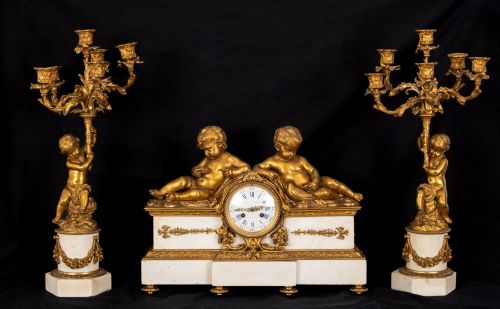

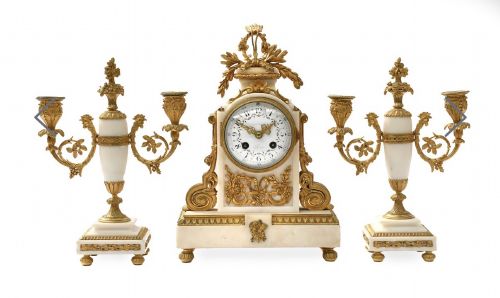
Louis XVI Ormolu Clock
A louis xvi ormolu clock brings the grand symmetry and refined classical ornament of eighteenth-century France into a room.

Louis XVI Ormolu Clock
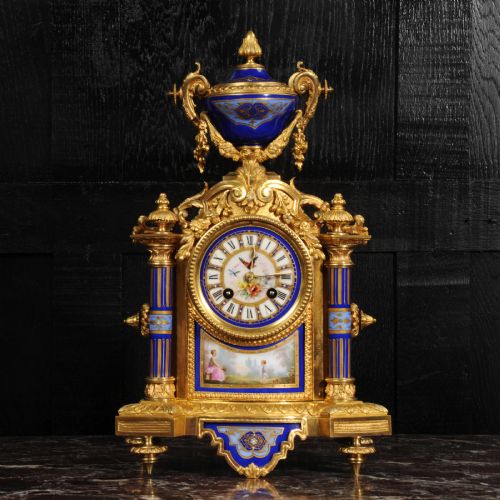
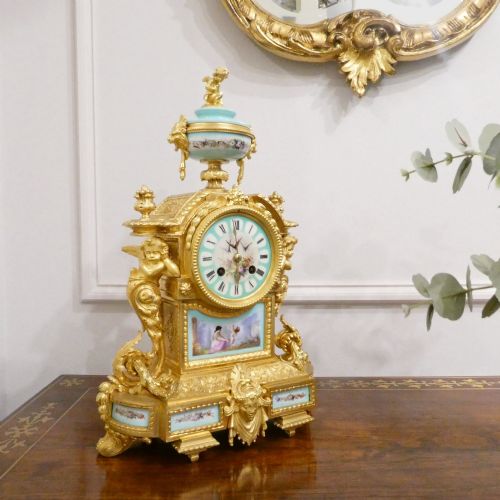
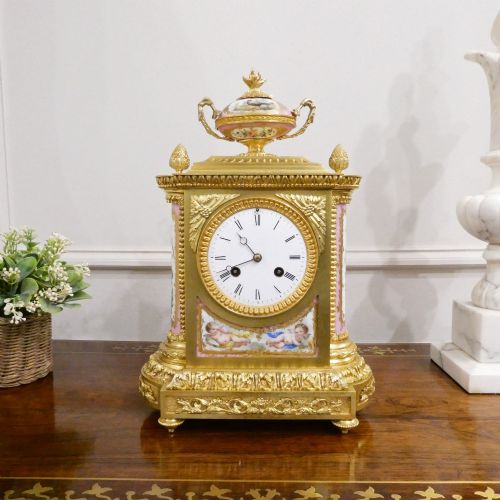
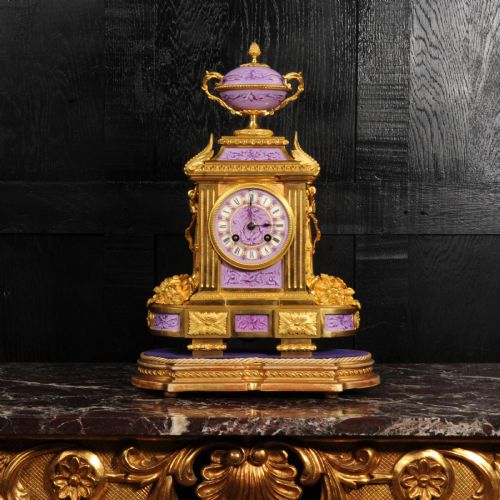
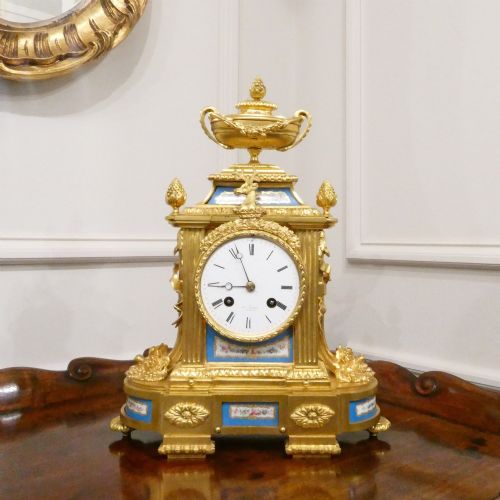
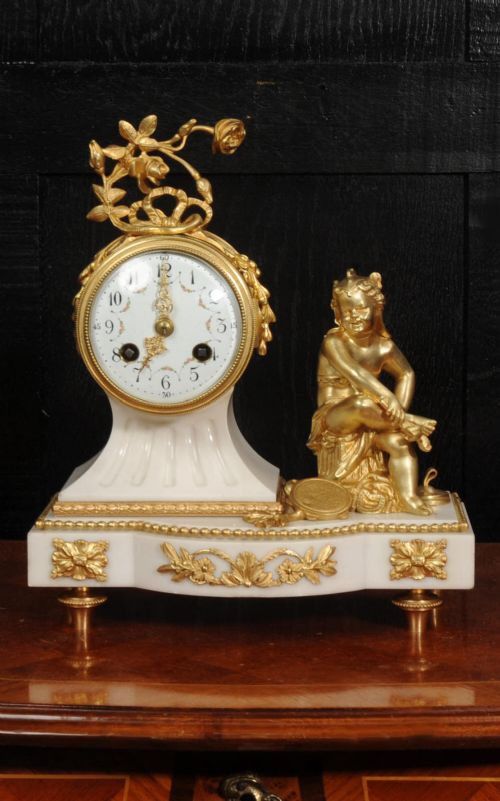
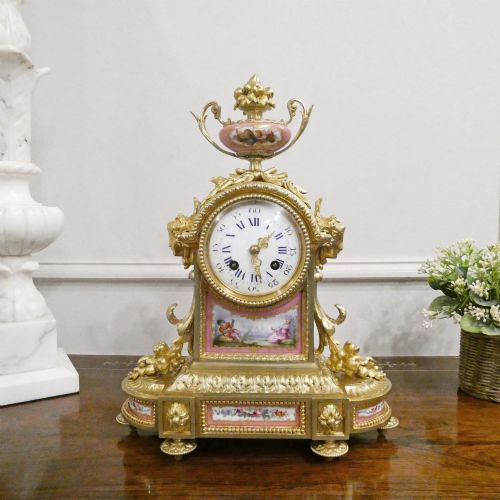
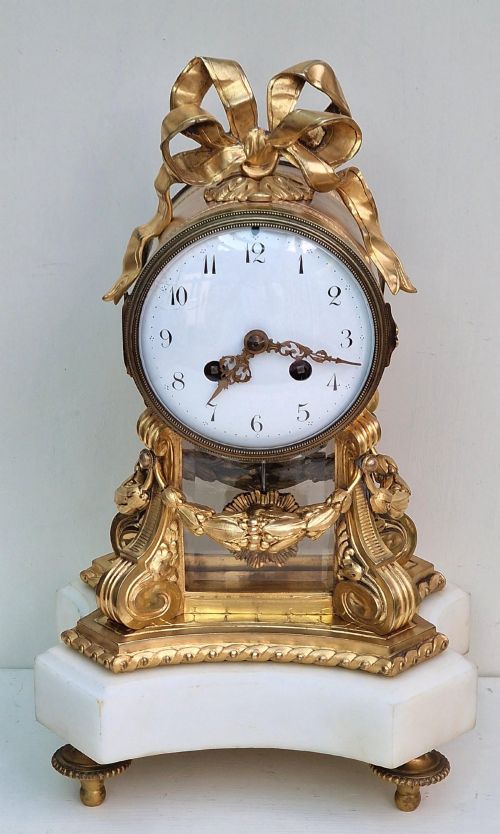
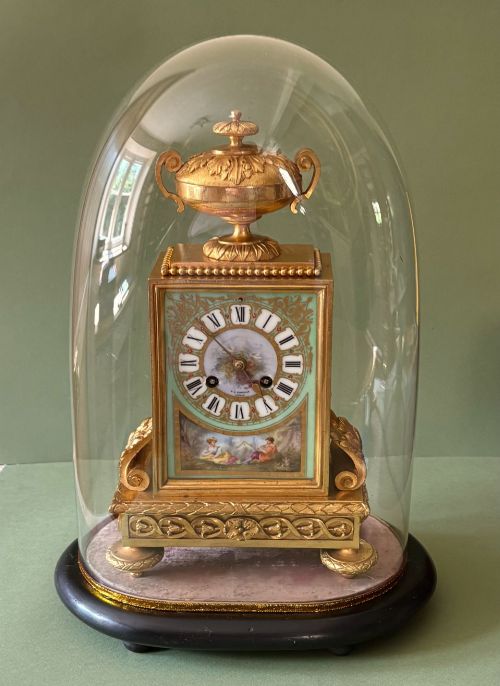
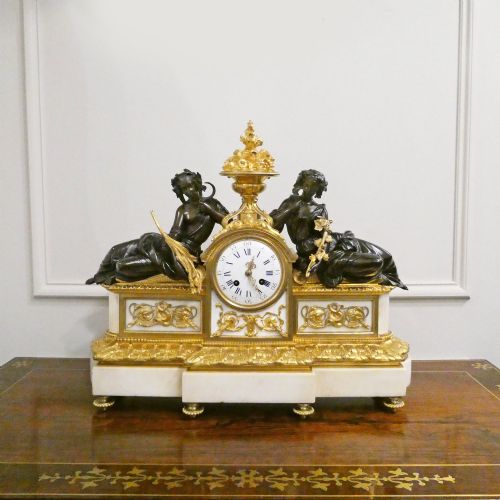
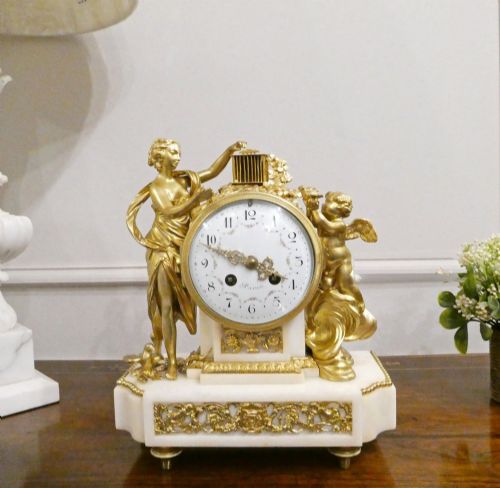
A louis xvi ormolu clock is typically encountered as a mantel clock, wall clock, or portico clock dating from the nineteenth century, produced in revival styles that echo the reign of Louis XVI. These pieces combine timekeeping with sculptural bronze work, frequently appearing as part of a garniture set flanked by matching candelabra. The forms range from architectural marble cases and lyre-shaped designs to elaborate cartel wall clocks.
The selection includes production from nineteenth-century Parisian workshops and major makers, alongside pieces reflecting subsequent revival periods up to nineteen hundred. Most examples draw upon neoclassical motifs such as urns, swags, ribbons, and classical figures. Collectors will find both table-standing boudoir models and substantial floor-standing or wall-hanging formats.
How they were made
Makers utilised cast bronze finished with mercury gilding or modern electroplating to create the characteristic golden ormolu surface, which was meticulously chased to sharpen the surface detail. This metalwork was combined with white, red, or rouge marble bases, inset porcelain panels decorated with enamel scenes, and brass clock movements.
Dial faces were commonly constructed from enamel on copper with delicate painted numerals, protected by curved glass bezels. Structural elements were pinned and screwed together, allowing complex garnitures and portico clocks to house precision mechanical movements inside decorative cases.
Louis XVI Ormolu Clock Retail Price Guide 2026
Typical asking prices for louis xvi ormolu clock among the pieces listed under this phrase on Sellingantiques today, from the lower quarter to the upper quarter. They describe what is for sale here now, not the wider market.
Some nineteenth-century models feature mystery dials where the hands appear to float without any visible connection to the internal movement.
What varies in quality
The quality of a louis xvi ormolu clock rests upon the crispness of the bronze chasing and the depth of the gilding, where superior examples exhibit hand-tooled definition in hair, drapery, and floral garlands rather than soft, mass-produced casting blur. The integration of materials also defines the tier, with dense, unblemished marble and hand-painted porcelain panels marking out the better productions from standard workshop output.
Mechanical execution further separates the range, as signed movements by established makers operating in Paris demonstrate higher grade escapements, robust gear trains, and precision balancing compared to anonymous commercial equivalents.
Japy Freres·Jean-Baptiste Delettrez·Achille Brocot·Henry Marc·Vincenti·Henry Dasson·Louis Goret·Le Roy·Louis Japy·Lemerle-Charpentier and Cie·Charles Hour·Remond
The Louis XVI Ormolu Clock Glossary
- Ormolu
- Gilt bronze produced by applying a mixture of gold and mercury to a bronze base and heating it, or through later electroplating. This finish gives the metal its bright golden lustre and protective layer.
- Garniture
- A set of matching decorative objects designed to be displayed together on a mantelpiece, usually comprising a central clock flanked by two matching vases or candelabra. These sets were popular in nineteenth-century formal interiors.
- Portico clock
- A clock featuring an architectural case supported by four columns, resembling a classical temple facade. This form was widely produced during the nineteenth-century revival periods.
- Cartel clock
- A wall-mounted clock housed in an ornate, asymmetrical or symmetrical frame attached directly to a wall bracket. They are frequently cast in gilt bronze with elaborate scrollwork.
- Chasing
- The manual post-casting process of refining and texturing metal surfaces with chisels and hammers. Fine chasing distinguishes high-end ormolu from simpler cast items.
Louis XVI Ormolu Clock: Frequently Asked Questions
What is a clock garniture set?
A clock garniture set consists of a central timepiece accompanied by matching side ornaments such as candelabra, urns, or vases. These suites were designed to create a balanced display across a mantelpiece.
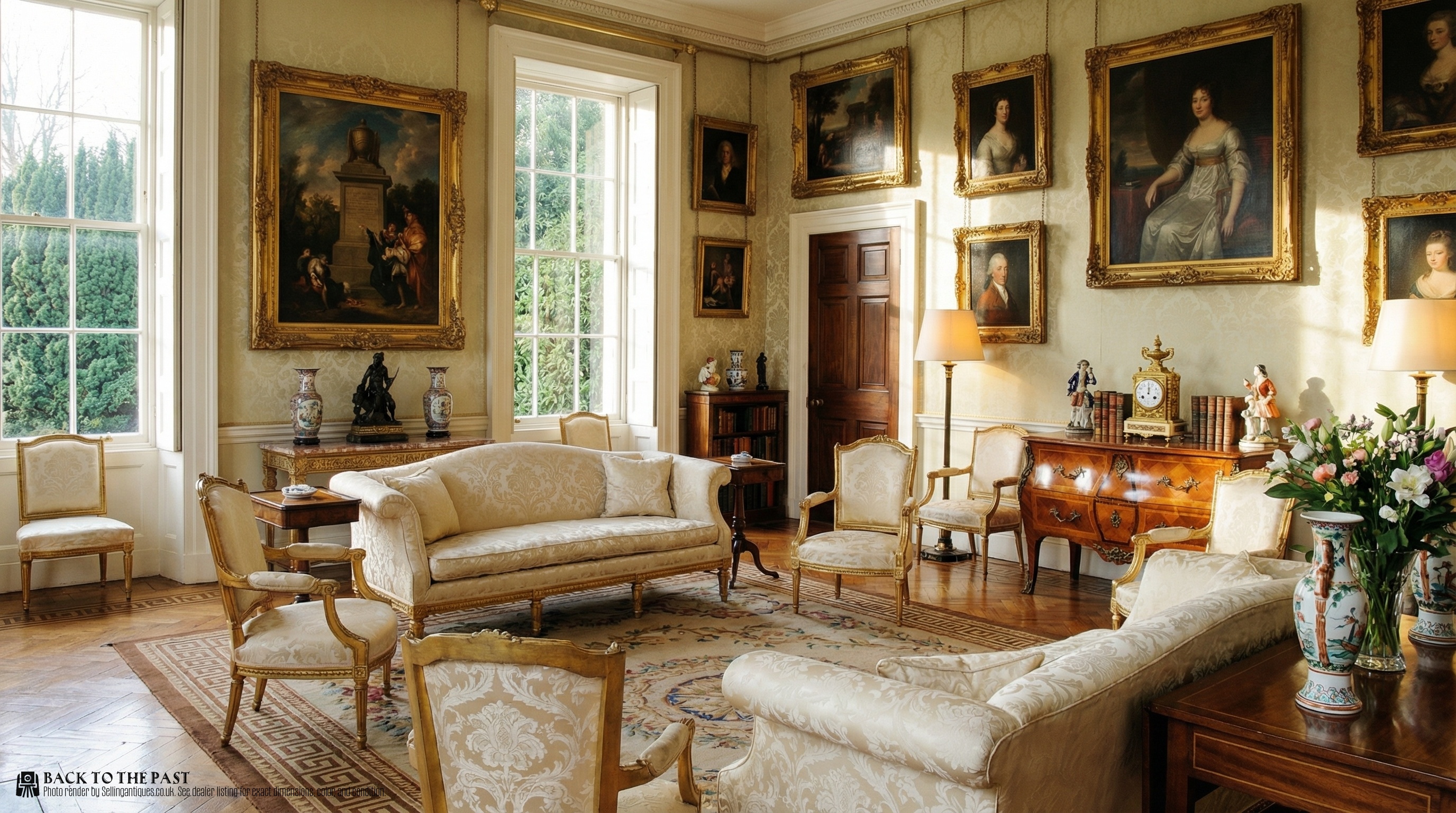
In nineteenth-century interiors, such matched sets anchored the decorative scheme of a formal reception room or parlour.
How do I wind an antique french clock?
Winding requires a dedicated key inserted into the winding arbors on the enamel dial face, turning gently until resistance is felt. Care must be taken not to overwind the mainspring.
Most mechanical movements require weekly winding, and it is standard practice to avoid moving the minute hand backwards across the hour.
What is the difference between ormolu and brass?
Ormolu is a surface finish applied to a bronze base, utilising gold to achieve a rich, warm golden appearance that resists tarnishing. Brass is a solid alloy of copper and zinc throughout its mass, possessing a different yellowish tone.
Antique ormolu mounts were heavily chased by hand after casting, whereas standard brass fixtures often display smoother, industrial surfaces.
Where were these clocks made?
The vast majority of these timepieces were manufactured in Paris, which served as the global centre for luxury clockmaking and bronze casting during the nineteenth century. Workshops collaborated with specialised founders and enamel painters.
Regional French makers also contributed, though Parisian pieces frequently bore the signatures of notable horologists on their movements and dials.