
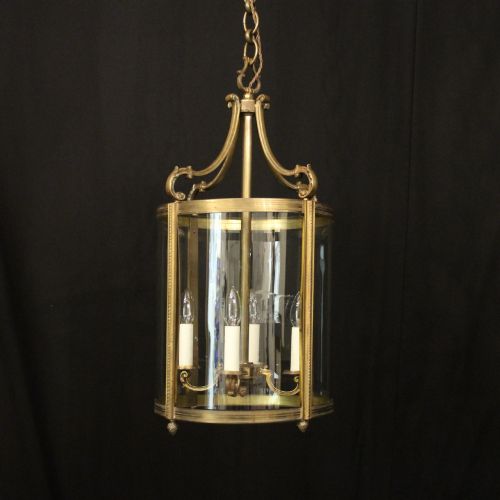
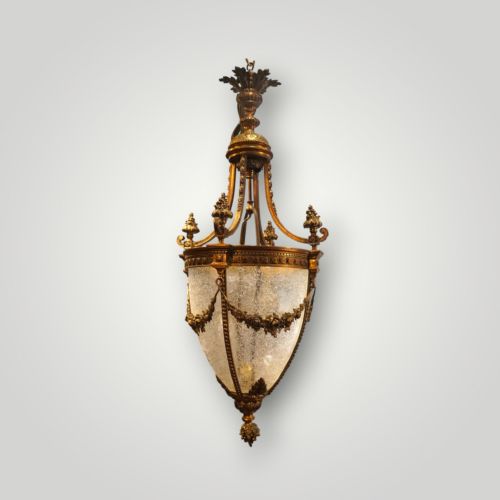
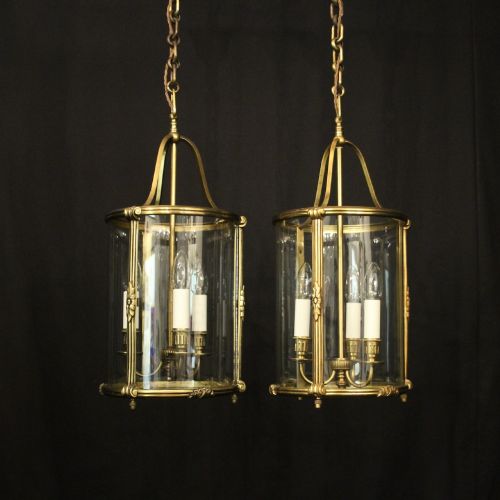
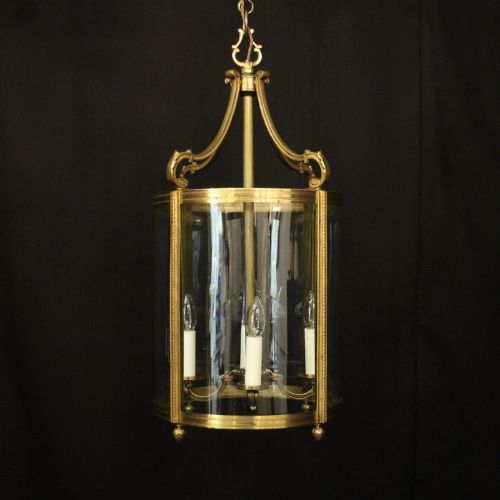


Louis XVI Lantern
A louis xvi lantern brings French Neoclassical proportion and warm illumination to high halls.
Louis XVI Lantern
When you search for a louis xvi lantern, you find hanging ceiling fixtures rooted in French Neoclassical design, often taking the form of hall lanterns, pendant lanterns, and ceiling lights. These pieces borrow the symmetry, urn motifs, and crisp lines of the late eighteenth century, though most examples encountered here date from the nineteenth and early twentieth centuries, including Edwardian interpretations and later twentieth-century revivals.
The dominant forms are hexagonal or rounded hanging lanterns suspended by chains or rods, occasionally appearing as pairs or configured with multiple interior lights like chandeliers. They serve as primary overhead lighting for corridors, vestibules, and entrance halls, combining glass panels with metal frames to cast diffuse illumination downward and outward.
Stylistic variations range from simple brass and glass constructions to elaborate ormolu frames modelled after fixtures in the Palace of Versailles. Whether styled as French Chateau or strict Louis XVI, these pieces rely on classical restraint and balanced geometry to anchor a room.
How They Were Made
Makers constructed these lanterns using cast metals such as bronze, brass, and ormolu, applying fire gilding or surface plating to create a durable gilt finish. Frames were cast in sections, chased by hand to sharpen architectural details, and joined to hold glazing securely in place.
The glazing consists of clear, frosted, or cut glass panels, sometimes with convex curves that soften the interior light and magnify the flame or bulb. Etched glass details and heavy cut glass bowls add texture and refract the light across the surrounding walls.
Listings feature periods spanning the nineteenth century, Edwardian era, and the 1920s and 1930s.
What Varies in Quality
The distinction between standard production and exceptional work lies in the crispness of the metal casting and the depth of the chasing. Finer examples display sharp acanthus leaves, crisp bead-reels, and heavy gauge gilt bronze rather than thin stamped brass.
Glass selection also dictates the tier of the piece, with thick convex or heavily cut crystal panels representing higher craftsmanship than flat, plain glass. Original gilding intact on heavy bronze frames elevates a lantern above later plated alternatives.
The Louis XVI Lantern Glossary
- Ormolu
- Gilded bronze, where a layer of gold amalgam is applied to a bronze base and heated to bond the metals. This technique produces a rich, deep lustre characteristic of high-end French lighting.
- Convex glass
- Curved glass panels that bulge outward from the lantern frame. This shape disperses light more widely and adds visual weight to the fixture.
- Hall lantern
- A ceiling-hung light fixture designed specifically for narrow entryways, corridors, and stairwells. They provide directed illumination while maintaining vertical clearance.
- French Neoclassical
- A style spanning the mid-eighteenth to early nineteenth centuries that revived classical Roman and Greek motifs. It emphasises straight lines, symmetry, and architectural ornamentation.
- Cut glass
- Glass decorated by grinding facets or patterns into the surface using a wheel. In these lanterns, cut glass bowls and panels catch and scatter the internal light.
Louis XVI Lantern: Frequently Asked Questions
Where should I hang a louis xvi lantern?
These lanterns suit high-ceilinged entrance halls, stairwells, and long corridors where a vertical hanging fixture commands the space. Their proportions make them effective focal points in formal reception rooms.
Ensure adequate ceiling height for the drop of the chain and the physical dimensions of the frame before hanging.
How do I wire an antique lantern?
Most antique lanterns are adapted for modern electrical wiring by running a cord through the suspension rod or chain to an internal candle sleeve or cluster. A qualified electrician can rewire the fixture safely using modern components while preserving the historic frame.
Internal sockets are usually updated to accommodate standard candelabra bulbs.
How do I tell if a lantern is nineteenth century?
Nineteenth-century examples typically feature heavy cast bronze frames, hand-chased surface details, and thick glass panels that show minor irregularities from period manufacturing. Makers often utilised sand casting, leaving distinct texture on the reverse of the metal.
Later twentieth-century reproductions tend to have lighter gauge brass and machine-stamped uniformity without hand finishing.