


Louis XV Secretaire Abattant
These louis xv secretaire abattant pieces are elegant drop-front writing cabinets offering hidden compartments and refined surfaces that anchor a room.
Louis XV Secretaire Abattant
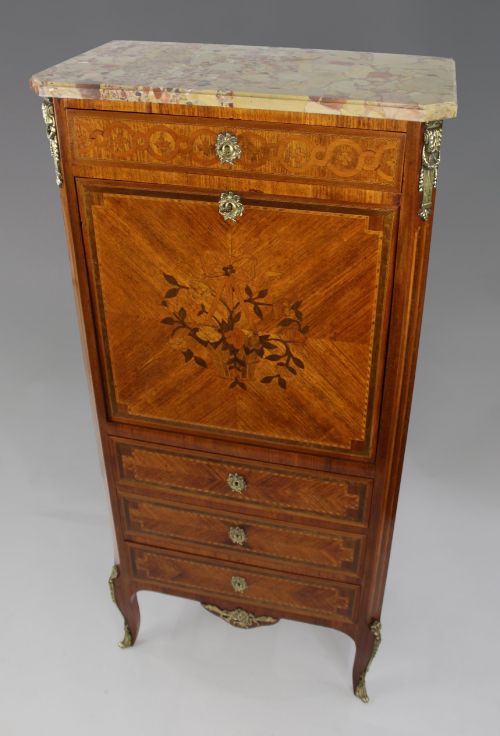
A louis xv secretaire abattant is a tall drop-front writing cabinet designed for both storage and correspondence, featuring a vertical fall-front panel that conceals a fitted interior of small drawers and pigeonholes. These versatile pieces function primarily as writing desks while maintaining a compact footprint against a wall.
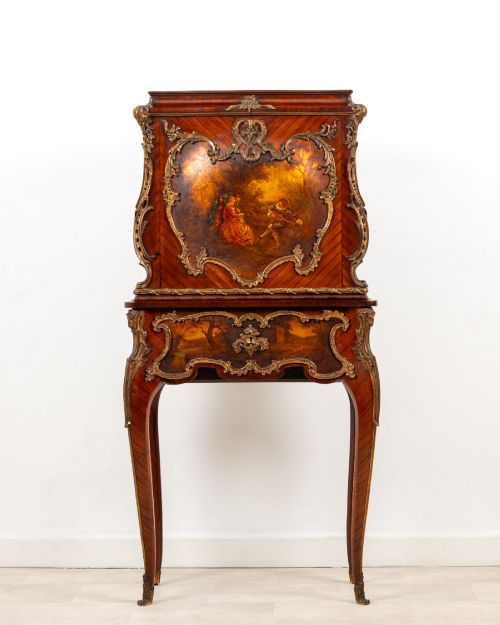
The versions most commonly met on this page belong to the nineteenth-century revival periods, particularly around eighteen-eighty, capturing the ornate aesthetic of eighteenth-century French cabinet making. Makers drew heavily on French Rococo Revival and Louis XV Revival styles to produce dramatic writing furniture for grand interiors.
Examples appear in forms ranging from traditional tall cabinets to standing writing cabinets and escritoires, often incorporating marble tops. The surviving selection demonstrates how cabinet makers adapted the classic form across different decades, from the eighteenth century through to nineteen-twenty.
Assessing quality and execution
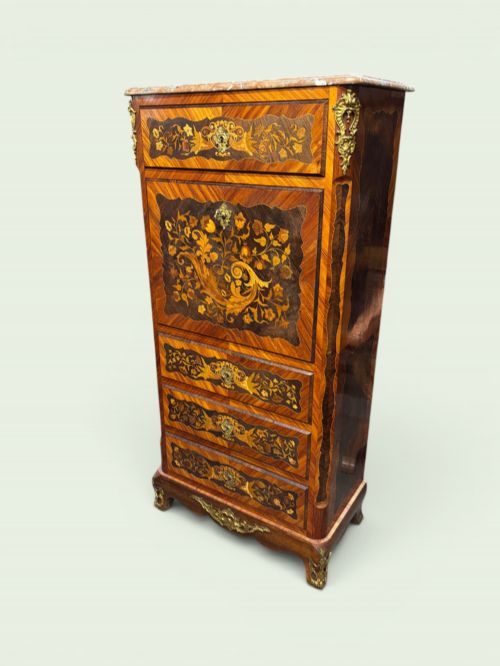
Quality rests in the crispness of the ormolu mounts and the depth of the marquetry work across the carcass. Finer pieces display hand-chased gilt bronze mounts that integrate seamlessly with the timber contours rather than appearing cast in a uniform mould.
The precision of the veneering and the complexity of the timber grain selection distinguish superior examples from simpler production. Cabinet makers who invested time in matching wood grains across the fall-front and drawers achieved a much more cohesive visual rhythm.
The integrity of the internal pigeonholes and the smooth operation of the drop-front hinge mechanism indicate the original standard of joinery. Original marble tops that fit the wooden frame without excessive gaps also contribute to a higher standing.
Listings feature pieces spanning from the eighteenth century through the nineteenth century and into nineteen-twenty.
The Louis XV Secretaire Abattant Glossary
- Secrétaire à abattant
- A tall writing cabinet with a vertical drop-front panel that opens to reveal a fitted writing surface and small drawers. This form allows owners to conceal correspondence when not in use.
- Ormolu
- Gilt bronze mounts applied to furniture for decorative and structural edge protection. The technique involves applying finely ground gold amalgam to cast bronze.
- Kingwood
- A dense, heavily figured Brazilian timber prized for its rich brown colour and striking dark grain patterns. Cabinet makers used it extensively for luxury veneering.
- Marquetry
- The art of applying small pieces of veneer to a structure to form decorative patterns and pictorial scenes. Artisans cut various coloured woods to fit together precisely.
- Vernis Martin
- A type of glossy resin varnish applied in imitation of Japanese lacquer, frequently decorated with painted scenes. It gained popularity in eighteenth-century France and inspired later revival pieces.
Louis XV Secretaire Abattant: Frequently Asked Questions
What is a secretaire abattant used for?
These cabinets served primarily as private writing desks and storage units for correspondence, documents, and valuables. The drop-front panel provides a stable horizontal writing surface when lowered.
Inside, small drawers and pigeonholes organise letters and writing implements, while the lower cabinet doors conceal larger storage compartments for books or papers.
How do I date a secretaire abattant?
Dating relies on examining the construction methods, timber types, and secondary woods used inside the carcass. Eighteenth-century originals show hand-cut joinery and period-specific mount designs.
Nineteenth-century revival pieces often feature machine-sawn elements, standardised screw types, and revival styles that reinterpret earlier French aesthetics.
Where should I place this cabinet?
The tall, upright profile makes these pieces suitable for living rooms, studies, or bedrooms where floor space is limited. They require enough clearance in front for the drop-front to open fully.
Positioning them away from direct sunlight and heat sources protects the polished veneer and leather writing surfaces from drying out.
Are marble tops original?
Many nineteenth-century revival cabinets were manufactured with fitted marble tops to match eighteenth-century prototypes. The marble adds weight and a durable surface to the top of the case.
Checking the fit against the wooden moulding helps determine whether the top belongs to the original construction period.