



French Marquetry Secretaire
A french marquetry secretaire combines precise wood inlay with a drop-down writing surface, offering both concealed storage and decorative presence.
French Marquetry Secretaire
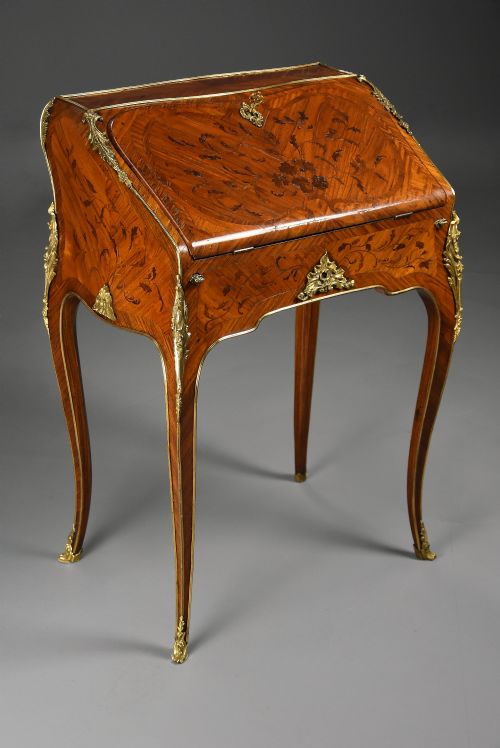
A french marquetry secretaire is a specialised writing cabinet designed to conceal papers behind a fall-front panel while displaying intricate patterned wood veneers. These pieces range from upright secretaire abattant forms to slope-front desks and smaller bonheur du jour cabinets.
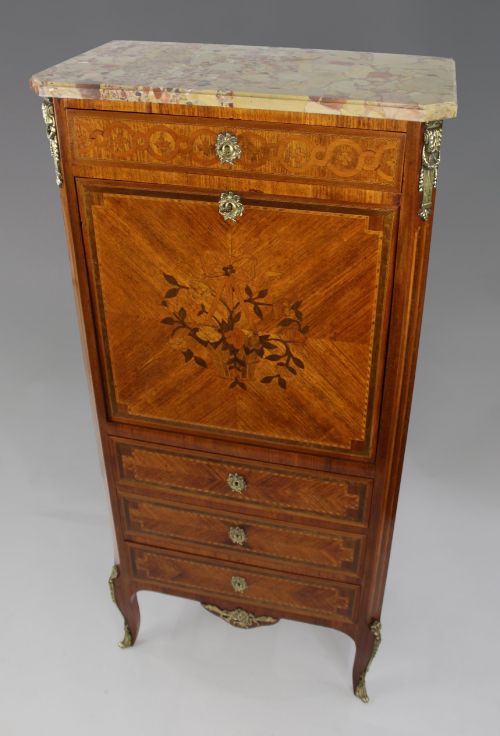
The most common examples on this page date from the nineteenth century, reflecting revivals of earlier Louis styles alongside mid-eighteenth-century origins. Makers utilised diverse forms, including bombe shapes and upright cabinets fitted with marble tops.
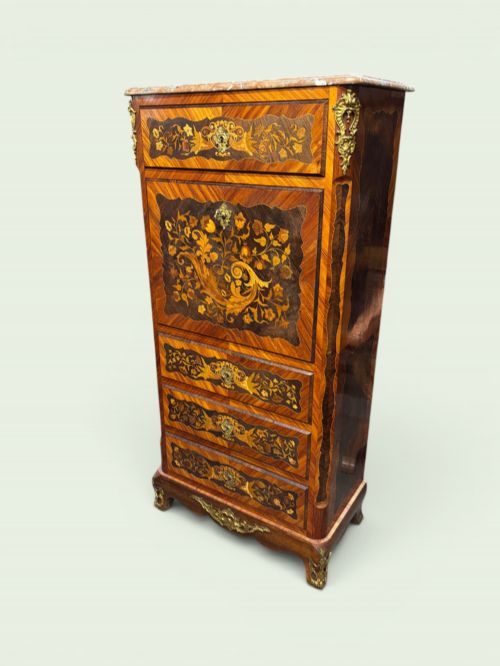
Buyers encounter surfaces decorated with floral, geometric, or pictorial inlay set into rosewood, kingwood, walnut, and satinwood. Many examples incorporate brass or gilt bronze mounts that frame the marquetry panels.
Materials and Construction
Cabinetmakers constructed these pieces using native and exotic timbers such as kingwood, rosewood, walnut, and tulipwood over sturdy oak or pine carcases. Veneers were sawn thinly and arranged meticulously to form complex pictorial or geometric marquetry and parquetry designs.
Metal components, including ormolu, gilt bronze, and brass mounts, were cast and chased to protect corners and accentuate the contours of the woodwork. Many carcases were finished with heavy marble slabs fitted directly to the top surface.
The site's listings demonstrate a strong nineteenth-century preference for kingwood and rosewood veneers paired with marble tops and ormolu mounts.
Markers of Quality
The sophistication of the timber selection and the precision of the veneer cutting define the tier of a piece. Finer examples display subtle tonal gradations within the floral or geometric motifs rather than simple, repetitive veneer patterns.
The integration of the mounts and the weight of the hardware reveal the maker's hand. High-grade items feature finely chased ormolu that conforms precisely to the wooden contours, alongside well-fitted internal drawers and smooth drop-front mechanisms.
Maison Krieger·BVRB
The French Marquetry Secretaire Glossary
- Secrétaire abattant
- An upright writing cabinet featuring a hinged fall-front panel that drops to create a writing surface. This form conceals an interior arrangement of small drawers and pigeonholes.
- Marquetry
- The art of applying small pieces of veneer to a structure to form decorative patterns or pictures. Craftsmen selected contrasting timbers to achieve natural shading without the use of paint.
- Ormolu
- Gilded bronze used extensively for decorative mounts and hardware on furniture. The technique involves applying a gold amalgam to bronze and heating it to drive off the mercury.
- Kingwood
- A dense, heavy timber with rich brown and violet colouring, prized by cabinetmakers for decorative veneers. It was frequently used in French furniture during the eighteenth and nineteenth centuries.
- Bombe
- A swelling or outward curving contour found on the sides and fronts of certain cabinets and chests. This shape requires advanced woodworking skill to fit veneer across curved surfaces.
French Marquetry Secretaire: Frequently Asked Questions
What is a secretaire abattant?
A secretaire abattant is an upright cabinet with a vertical front panel that hinges downward to form a writing desk. This design keeps correspondence and writing materials neatly tucked away behind decorative wood panels.
Inside, these cabinets typically house small drawers and compartments for stationery. The closed front presents an uninterrupted display of marquetry or veneers.
How do I distinguish Louis XV from Louis XVI styles?
Louis XV pieces favor curved lines, asymmetrical floral marquetry, and bombe silhouettes. Ormolu mounts on these items usually take organic, flowing forms.
Louis XVI furniture shifts toward straight lines, symmetrical parquetry patterns, and neoclassical geometric details. The legs and supports tend to be straighter and more restrained.
Where should I place a secretaire in my home?
These cabinets suit studies, drawing rooms, or quiet hallways where their decorative fronts can be appreciated. The upright proportions allow them to fit into wall spaces that wider desks cannot accommodate.
Keep the timber away from direct sunlight and heat sources to protect the delicate wood veneers and prevent the marquetry from drying out.
What maintenance do marquetry surfaces require?
Marquetry surfaces benefit from occasional dusting with a soft, dry cloth and minimal exposure to moisture. Avoid using modern silicone polishes, which can build up and dull the timber over time.
Applying a traditional wax polish periodically helps nourish the wood and preserves the sheen of the original polish. Maintaining stable indoor humidity prevents the veneers from lifting.