



Louis XV Gueridon Table
A louis xv gueridon table brings fluid rococo curves and rich marquetry to a room, offering a functional surface rooted in French design.
Louis XV Gueridon Table
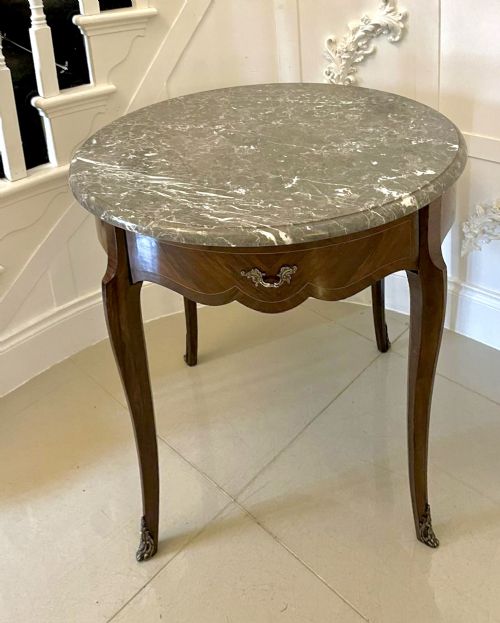
A louis xv gueridon table appears in forms such as occasional tables, wine tables, side tables, and pedestal tables. These pieces draw on French revival styles, including French Rococo and the Louis XV style, often channeling the atmosphere of a French chateau.
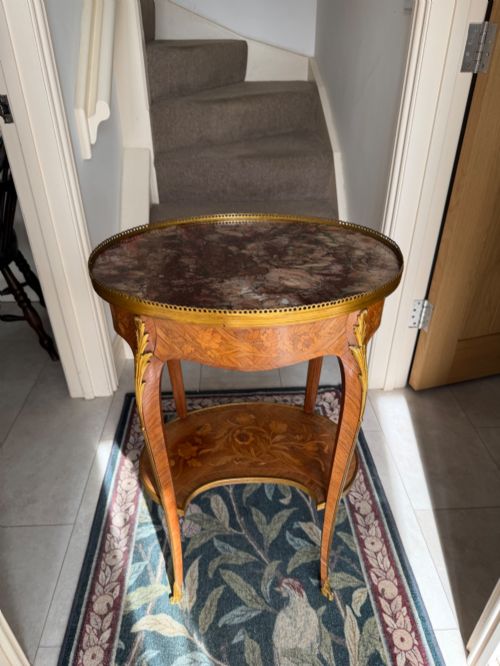
The selection ranges from the nineteenth century into the twentieth century, capturing decades of cabinet-making traditions. Buyers encounter round tops, two-tier formats, and kidney-shaped designs suited to intimate spaces.
Originating largely from French workshops or British interpretations of continental taste, these small tables serve as lamp tables, centre tables, and display surfaces.
Materials and Technique
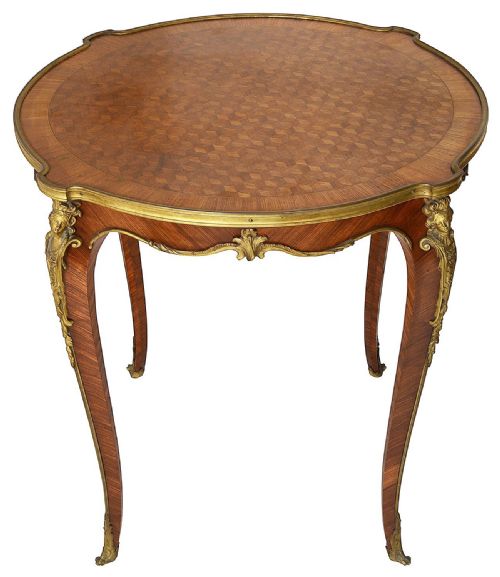
Cabinet-makers built carcasses in timbers such as kingwood, walnut, mahogany, and rosewood, frequently applying intricate marquetry and parquetry inlay. These veneers create geometric patterns or floral motifs across the surface.
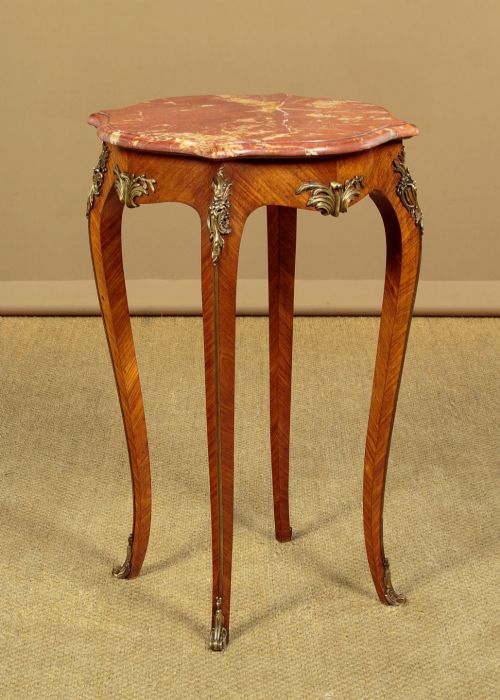
Metal ornamentation defines the aesthetic, utilising cast ormolu, gilt bronze, chiseled brass, and gilt brass mounted alongside the timber. Mounts trace the cabriole legs and aprons, highlighting the characteristic asymmetry.
Tops feature shaped marble or onyx slabs, sometimes framed by pierced brass galleries that contain items resting on the surface.
Some nineteenth-century tables include hidden galleries designed to stop your wine glass sliding off during an enthusiastic French discussion.
Craftsmanship and Detail
Quality rests upon the precision of the cabinet-work, seen in the seamless alignment of parquetry and the crispness of the gilt-bronze or ormolu mounts. Finer examples display hand-chiseled detailing on the metalwork rather than cast repetition.
The choice of timber and the complexity of the veneer work distinguish standard production from master craftsmanship. Gradations in quality appear in the fluidity of the cabriole legs and the integration of the marble or onyx top.
L.Martin of Paris·Francois Linke·Zwiener Jansen Sucesseur
The Louis XV Gueridon Table Glossary
- Guéridon
- A small French occasional table, often round and supported by a central pedestal or slender legs. The form evolved during the seventeenth century and remained popular through later revivals.
- Ormolu
- Gilded bronze applied to furniture mounts and decorative objects. The technique involves a mercury-gilding process on cast bronze bases.
- Marquetry
- Decorative veneer patterns assembled from thin slices of wood, shell, or ivory to form pictures or geometric designs. Artisans fit these elements together before gluing them to the table surface.
- Cabriole leg
- A furniture leg that curves outward in a convex arc and then bends inward in a concave arc, ending in a pad or foot. This profile is central to the rococo aesthetic.
- Parquetry
- Geometric wood inlay forming patterns such as cubes, chessboards, or herringbone designs. It differs from marquetry by relying on angular shapes rather than figurative motifs.
Louis XV Gueridon Table: Frequently Asked Questions
What is a gueridon table?
A guéridon is a small French table designed for occasional use as a lamp, wine, or display surface. These tables typically feature circular tops supported by slender legs or a central column.
Originating as candle stands, the form developed into decorative occasional furniture during various French revival periods.
How do I style a louis xv table?
These tables function well beside seating as lamp or side tables, or freestanding in the centre of a room. Their compact size allows placement in hallways, drawing rooms, or bedrooms.
The decorative mounts and marble tops provide a focal point that contrasts with modern or traditional interiors.
How do I date these tables?
Dating relies on construction methods, timber choice, and stylistic cues from the nineteenth and twentieth centuries. Revival pieces often emulate eighteenth-century prototypes while employing nineteenth-century machine tools or assembly techniques.
Maker signatures, stamps on bronze mounts, and wear patterns on the timber help narrow the timeline.
What is the difference between ormolu and gilt brass?
Ormolu consists of cast bronze finished with a gold mercury amalgam, producing a deep, warm metallic lustre. Gilt brass uses a brass base metal with applied gold plating or gilding.
Ormolu mounts generally appear on higher-end pieces due to the cost of bronze casting and finishing.