
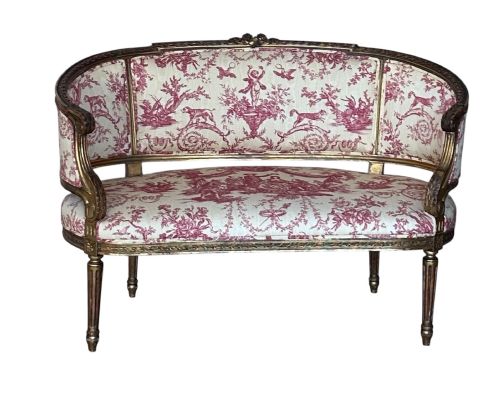
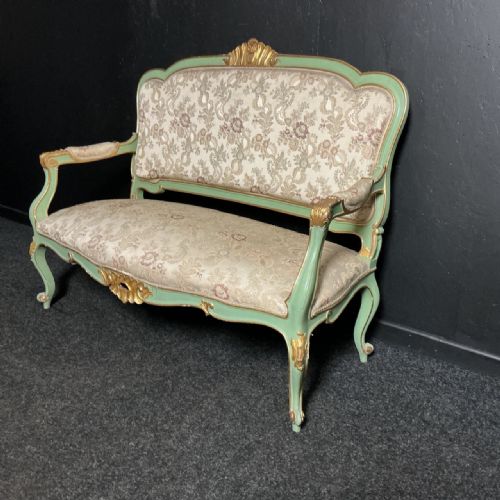
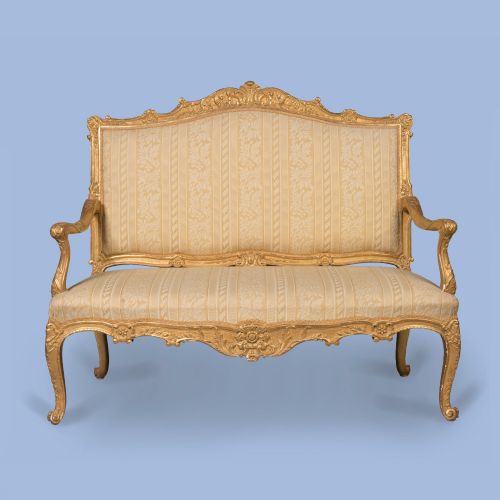


Louis XV French Canape
A louis xv french canape brings sweeping curves and carved wood into a room, offering an elegant seat rooted in historical revival.
Louis XV French Canape
When you search for a louis xv french canape, you encounter seating designed with flowing serpentine lines and asymmetric floral motifs characteristic of the Rococo Revival. These pieces span the nineteenth century and early twentieth century, reflecting ongoing enthusiasm for French aristocratic aesthetics.
You are most likely to meet walnut or giltwood frames upholstered in various textiles, ranging from silk to modern velvet. They appear as two-seat settees, larger salon sofas, or parts of matched salon suites.
The forms adapt classical French seating for domestic comfort, featuring cabriole legs and curved backs that frame the sitter. They serve as focal points in reception rooms and boudoirs alike.
Materials and construction
The frames rely on solid hardwoods like walnut, sometimes treated with paint, gold leaf, or giltwood to achieve a lustrous finish. Woodworkers carved these materials by hand, shaping the crest rails and aprons with deep relief scrolls.
Upholstery techniques involved webbing, stuffing, and covering the internal frame with fabric, textile, or tapestry. Many examples survive with later reupholstery that complements the antique woodwork.
Assessing craftsmanship
Quality reveals itself in the crispness and depth of the wood carving, where finer pieces display fluid, hand-chiseled details rather than shallow, mechanical shaping. The choice of primary timber also distinguishes standard production from superior frames.
Proportion and structural integrity separate exceptional examples from simpler ones, with better pieces maintaining balanced curves and sturdy joinery across the seat rails and cabriole legs.
The Louis XV French Canape Glossary
- Canapé
- An antique French sofa or settee featuring an upholstered back and seat within a decorative wooden frame. These pieces typically seat two or three people.
- Giltwood
- Wood that has been covered with a thin layer of gold leaf or gilt paint. This finish creates a bright, reflective surface popular in formal French seating.
- Cabriole leg
- A furniture leg that curves outward and then tapers inward to a foot, resembling an animal's leg in motion. It forms a defining feature of the Louis XV style.
- Rococo Revival
- A nineteenth-century design movement that emulated the ornate, curving aesthetic of the eighteenth-century French court. It prioritized asymmetry, natural motifs, and flowing lines.
Louis XV French Canape: Frequently Asked Questions
Where should I place a canapé?
These settees work well as central seating pieces in a drawing room or placed against a panelled wall in a hallway.
Their decorative backs make them suitable for floating away from walls where the carved woodwork remains visible from all angles.
How do I care for giltwood frames?
Dust the carved wooden surfaces gently with a dry, soft cloth to prevent the accumulation of dirt.
Avoid using liquid cleaners or polishes on gold leaf or painted finishes, as moisture can lift the delicate metallic application.
Can I use modern fabric for reupholstery?
Modern textiles can be used successfully if the weight and pattern suit the historical scale of the frame.
Many pieces have been recovered multiple times over their lifespan to match changing interior schemes while preserving the antique timber.
Are these settees comfortable for daily sitting?
The padded backs and upholstered seats provide firm support suited for conversation rather than lounging.
Padding firmness varies depending on whether the internal webbing and stuffing date to the original period or recent restorations.