
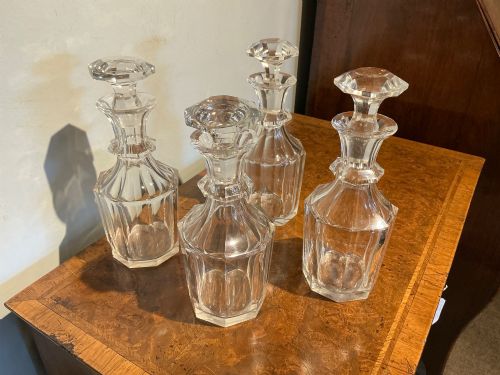
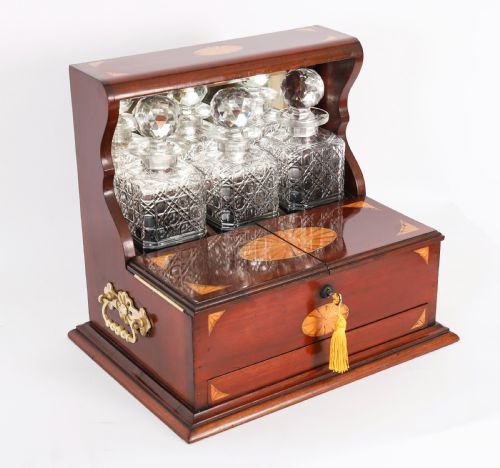


Liqueur Decanter Set
A liqueur decanter set brings together small-scale bottles and matching glasses for after-dinner service, spanning styles from Victorian ornate stands to geometric Art Deco designs.
Liqueur Decanter Set
A liqueur decanter set comprises matched vessels and glasses designed for serving spirits, often housed in fitted boxes, stands, or trays. You will frequently encounter nineteenth-century tantalus sets and twentieth-century glass services.
The objects take several forms, including locking cave a liqueur boxes, silver-plated trays holding multiple decanters, and tiered stands complete with shot glasses. These configurations reflect the social dining habits of the Victorian era and the modernist entertaining styles of the nineteen-thirties.
Originating from French, German, Czech, and British makers, the selections range from heavily decorated nineteenth-century lead crystal to clean-lined Art Deco glass services.
Materials and construction
Makers utilised clear and coloured glass, lead crystal, and cut glass, often embellishing the vessels with enamel, gilding, or silver-plated metalwork. Wooden cases incorporate satin wood inlay and carved elements.
Mounts and stands frequently employ brass, ormolu, silvered pewter, and solid silver, providing secure framework for the glass containers. Craftspeople combined traditional glass-blowing with wheel-cutting and metal casting techniques.
Materials recorded across the inventory include lead crystal, ormolu, satin wood, black glass, brass, and silver-plated metal.
Distinctions in quality
Quality reveals itself in the weight and clarity of the crystal, the precision of the wheel-cutting, and the complexity of the enamelling. Heavier glass bodies and sharply defined facets distinguish finer production.
The refinement of the housing determines the tier of the piece, from simple trays to intricate satin wood boxes lined with fitted compartments and locking mechanisms. Maker attribution through signatures or distinct design traits further separates standard sets from notable workshop examples.
Baccarat·Val Saint Lambert·Karl Palda·Moser·Salviati·W.M.F.
The Liqueur Decanter Set Glossary
- Tantalus
- A locking drink cabinet or frame that secures decanters within a metal bar to prevent unauthorised pouring while displaying the contents. The mechanism typically requires a key to release the bottles.
- Cave a liqueur
- A French fitted box or casket containing a set of liqueur decanters and matching glasses. These often feature velvet or satin linings and elaborate exterior woodwork or ormolu mounts.
- Lead crystal
- Glass containing metal oxide that increases weight, brilliance, and refractive index. This material allows for deep, sharp wheel-cutting.
- Ormolu
- Gilded bronze or brass mounts used extensively in nineteenth-century decorative arts. The finish provides a rich gold-coloured accent to wooden boxes and glass stands.
- Silvered pewter
- A metal alloy treated with a silver coating to mimic solid silver wares. It saw wide adoption during the Art Nouveau period for fluid, sculptural frames and trays.
Liqueur Decanter Set: Frequently Asked Questions
What is a tantalus set?
A tantalus set is a locking frame that holds decanters securely in place, named after the mythological figure because the drinks remain visible yet out of reach.
These pieces typically feature a wooden base with a metal locking bar across the stoppers, operated by a small key.
How do I identify a cave a liqueur?
A cave a liqueur is a portable French box or casket designed specifically to house a complete set of liqueur decanters and small glasses.
Opening the hinged lid reveals a fitted interior compartment lined with fabric, keeping every glass and bottle secure during transit.
What materials were used for these sets?
The sets combine glass and crystal vessels with various structural frames made from brass, ormolu, silver-plated metal, and fine woods like satin wood.
Surface decoration ranges from hand-painted enamel and gilding to complex geometric cutting and silvered pewter mounts.
How do I date an antique set?
Dating relies on stylistic markers, such as the heavy ornamentation and naturalistic motifs of nineteenth-century Victorian and Art Nouveau pieces versus the streamlined geometric shapes of nineteen-thirties Art Deco designs.
Maker marks, box construction methods, and the specific type of metal plating also help establish the period of manufacture.
How were these decanter sets used?
These sets served as a formal after-dinner amenity in middle and upper-class homes, holding cordials and liqueurs for guests.
Hosts kept the bottles locked in tantalus frames or decorative boxes to regulate consumption and protect valuable crystal.