



Lighthouse Marine Artwork
Lighthouse marine artwork captures the solitary beacons of the coast, rendered in oils and watercolours across the nineteenth and twentieth centuries.
Lighthouse Marine Artwork
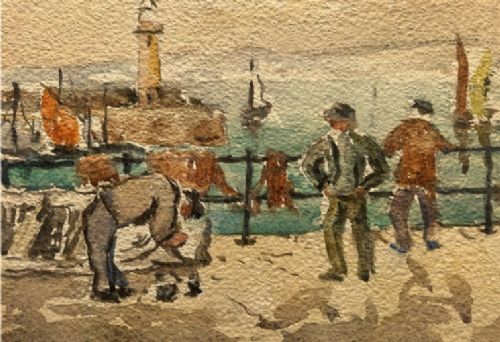
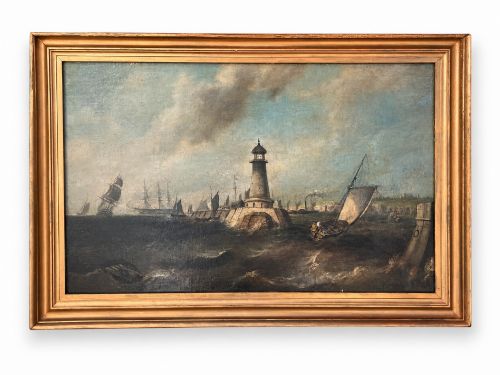
When you search for lighthouse marine artwork, you are looking at coastal scenes and maritime watercolours that place coastal towers at the centre of the composition. These pieces range from nineteenth-century oils on canvas to early twentieth-century watercolours, capturing working harbours and distant navigational lights. The versions most commonly met on this page are Victorian maritime paintings and framed watercolours produced during the nineteenth and twentieth centuries.
The subjects span British and European shores, from Cornish dioramas and West Indiaman ships off Eddystone to French beach scenes and Portuguese coastal landscapes. You will find oil paintings on canvas as well as delicate paper watercolours, often housed in gilded wood frames. Styles shift from traditional maritime realism to folk art and Victorian fine art, reflecting the changing tastes of coastal artists across the decades.
How they were made
Artists working on these marine subjects relied primarily on oil paint applied to canvas or wood panels, alongside watercolour pigments on paper. Many nineteenth-century works use oil on canvas to capture the heavy motion of the sea and the stark white masonry of the towers against stormy skies. Watercolours from the Edwardian and later periods use lighter washes of pigment on paper to render softer coastal light and distant headlands.
Presentation was integral to the finished piece, with many works set into heavy gilded wood frames that matched the formal tastes of the Victorian and Edwardian eras. Dioramas incorporated three-dimensional elements constructed from wood and glass, creating a diorama effect that brought the coastal subject into physical relief. Each medium dictated how the lighthouse was framed against the water, whether through thick impasto in oils or transparent washes in watercolour.
Lighthouse Marine Artwork Retail Price Guide 2026
Typical asking prices for lighthouse marine artwork among the pieces listed under this phrase on Sellingantiques today, from the lower quarter to the upper quarter. They describe what is for sale here now, not the wider market.
Materials recorded in these maritime works include oil paint, watercolour, canvas, paper, wood, glass, and gilded wood.
What varies in quality
Quality in these maritime works rests upon the artist's command of light, atmosphere and maritime architecture, separating routine ship portraits from masterly coastal scenes. The best examples capture the specific movement of the sea and the precise structural detail of the lighthouse tower without stiffness. Weaker pieces rely on formulaic waves and repetitive vessel forms that lack the atmospheric conviction of works by named marine painters.
The handling of the medium itself marks out the finer pieces, particularly in how oil paint builds the texture of breaking waves or how watercolour preserves the luminosity of paper. Original framing in period gilded wood also elevates a piece, whereas inappropriate modern framing diminishes the historical context of the artwork. The strongest works demonstrate a harmony between the coastal landscape and the vessel or beacon within it.
Nicholas Condy·Ernest F. Hill·John Callow·Arthur Wilde Parsons·Joseph Heard
The Lighthouse Marine Artwork Glossary
- Maritime diorama
- A three-dimensional representation of a ship and lighthouse, constructed using carved wood and enclosed behind glass within a frame.
- Oil on canvas
- Pigment suspended in drying oil, applied to a stretched woven fabric support that forms the primary surface for many nineteenth-century marine paintings.
- Watercolour
- A painting method in which the pigments are suspended in a water-based solution, frequently used on paper for lighter coastal studies and topographical views.
- Gilded wood
- Wood that has been coated with a thin layer of gold leaf or metallic paint, standard for framing nineteenth-century fine art.
- West Indiaman
- A large merchant ship built for trade between Europe and the West Indies, often depicted navigating dangerous coastal waters near a lighthouse.
Lighthouse Marine Artwork: Frequently Asked Questions
What is lighthouse marine artwork?
These pieces are paintings and watercolours depicting lighthouses, coastal scenes, and maritime vessels across the nineteenth and twentieth centuries.
They record working shipping lanes and coastal landmarks using oil on canvas, paper, and three-dimensional diorama construction.
How were these paintings used?
Maritime artworks were typically displayed in the parlours and drawing rooms of maritime homes, merchant offices, and coastal residences.
They served as both decorative furnishings and proud records of naval trade, local harbours, and familiar coastal beacons.
How do I date a lighthouse painting?
Dating relies on stylistic evidence, artist signatures, framing materials, and the rigging or design of the ships depicted in the composition.
Victorian pieces often feature heavy gilded frames and dark palettes, while twentieth-century works lean towards lighter watercolours and looser brushwork.
How do I care for antique marine art?
Protect oil paintings and watercolours from direct sunlight and high humidity to prevent fading, cracking, and paper degradation.
Keep framed artworks in stable indoor temperatures and dust gilded wood frames gently with a dry, soft brush.