

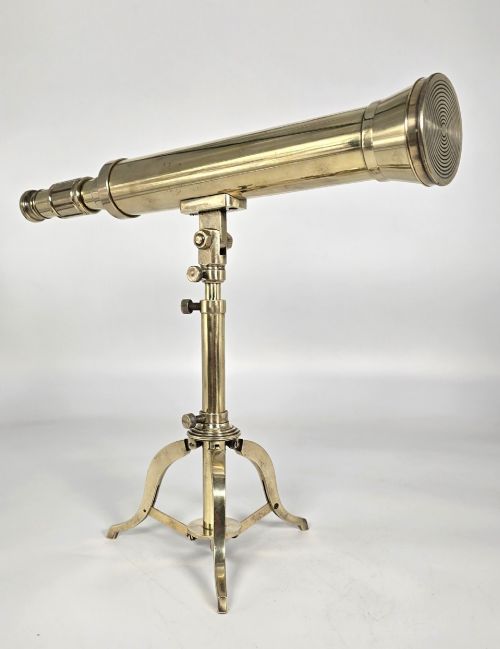


Library Telescope on Tripod
A library telescope on tripod brings terrestrial views and celestial study indoors, combining heavy brass optics with steady wooden or metal floor stands.
Library Telescope on Tripod
A library telescope on tripod is a serious scientific instrument designed for indoor observation of land and stars during the Georgian, Victorian, and Edwardian eras. These pieces bridge the gap between working observatory tools and domestic display items, built for gentlemen's studies and drawing rooms.
You are most likely to meet 19th century and Victorian examples on this page, alongside Georgian precursors and early 20th century iterations. Brass barrels dominate the form, mounted on folding brass, mahogany, or iron tripod stands that raise the eyepiece to a comfortable standing or seated height.
How they were made
Opticians constructed the main optical tubes from polished brass, housing precise glass lenses designed to gather light for terrestrial and astronomical use. Makers turned mahogany and other timbers for accessory stands and storage boxes, pairing them with heavy cast iron or brass for stability.
Tripod bases utilised folding joints and screw adjustments to secure the heavy barrels at precise angles. Makers engraved signatures and retail locations directly onto the brass draw tubes, identifying workshops in London.
Library Telescope on Tripod Retail Price Guide 2026
Typical asking prices for library telescope on tripod among the pieces listed under this phrase on Sellingantiques today, from the lower quarter to the upper quarter. They describe what is for sale here now, not the wider market.
Listings feature instruments spanning from the 18th century through the Edwardian era, incorporating mahogany, iron, and brass.
What varies in quality
Optical clarity and aperture diameter dictate the standard of execution, where larger objective lenses demand greater skill from the optician. The weight and rigidity of the tripod stand separate utilitarian instruments from those made for wealthy patrons.
Signature quality depends on the reputation of the maker inscribed on the brass barrel, alongside the survival of original fitted wooden boxes and matching folding tripods. Superior execution shows in crisp engraving and smooth mechanical focusing actions.
W. & T. Gilbert·Clarkson·Steward of London·S & B Solomons·Matthew Berge London·G.adams·Dollond·Broadhurst Clarkson & Co·Negretti and Zambra
The Library Telescope on Tripod Glossary
- Terrestrial
- Designed for viewing land objects and distant scenery rather than stars. This optical setup includes erecting lenses to present an upright image.
- Aperture
- The diameter of the main glass lens that gathers light. Larger measurements indicate greater optical power.
- Draw tube
- The sliding brass section inside the main barrel used to achieve focus. Multiple draws allow the telescope to collapse for storage.
- Objective
- The primary glass lens at the front end of the telescope. It forms the initial image before the eyepiece magnifies it.
- Tripod
- A three-legged supporting stand that keeps the instrument steady during observation. These often fold for compact storage.
Library Telescope on Tripod: Frequently Asked Questions
What is a library telescope?
A library telescope is a mid-sized optical instrument designed to sit inside a room rather than a permanent observatory dome. These pieces allowed users to study distant landscapes or celestial bodies from the comfort of a home library.
Built with heavy brass tubes and supported by sturdy floor tripods, they combined practical scientific utility with impressive interior presence.
Can I use these to view stars?
Many of these instruments serve dual purposes for terrestrial landscapes and basic astronomical viewing. Changing the eyepiece or adjusting the draw tubes alters the focal length for different types of observation.
While historic optics lack modern coatings, they still provide clear views of the moon and brighter planets.
How do I date a brass telescope?
Dating relies heavily on the engraved signature of the maker and the address listed on the brass barrel. Historical trade directories record the working dates of London opticians.
Design shifts in the tripod mount and storage box construction also offer clues to whether a piece originates from the Georgian or Edwardian period.
Where should I place it at home?
Position the tripod near a window with a clear view to let the instrument function as intended while catching natural light. Ensure the floor is stable so the heavy brass barrel remains secure on its folding legs.
Keep the piece away from direct heat sources to protect the wooden stands and historic brass finishes.