

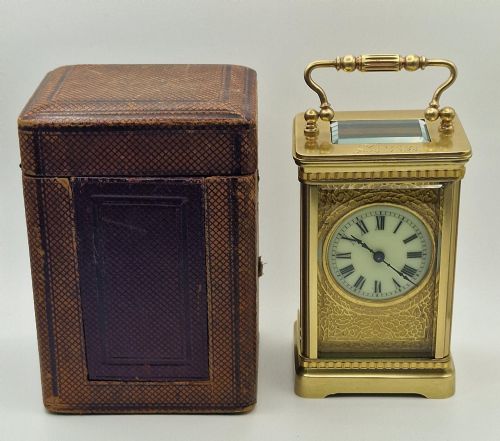
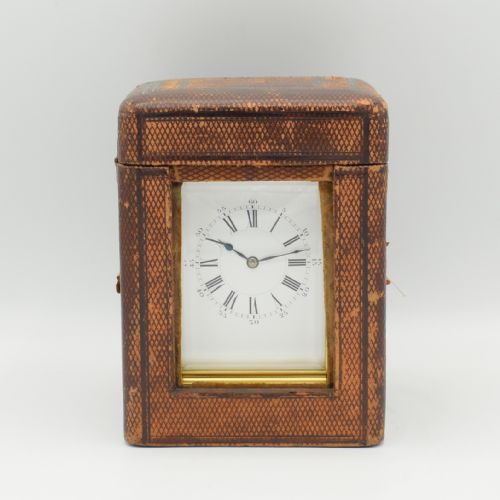
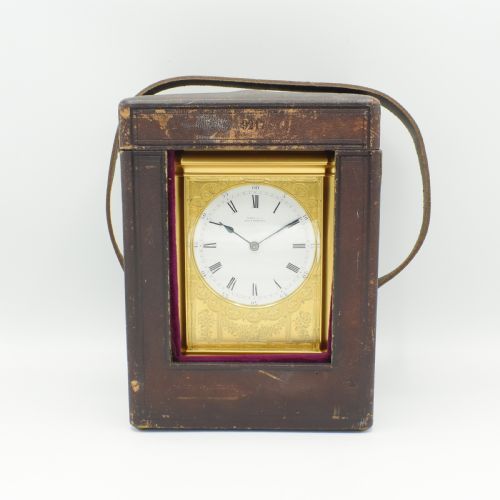


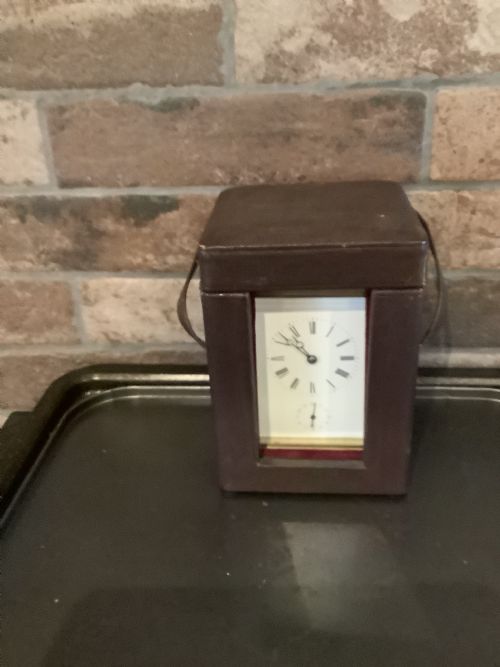


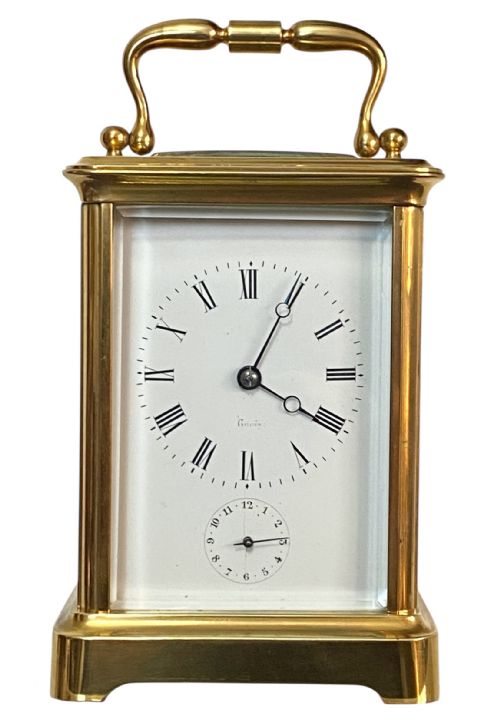


Leather Travel Case Clock
These leather travel case clock pieces combine mechanical precision with sturdy portability, offering collectors functional timekeeping encased in protective housings.
Leather Travel Case Clock
When searching for leather travel case clock items, collectors encounter a specialised group of portable timepieces designed for journeys, desk use, and domestic display. The listings encompass carriage clocks, desk clocks, and boudoir timepieces produced primarily across the nineteenth and twentieth centuries.
Examples on this page span from nineteenth century Victorian pieces through Edwardian items to Art Deco designs. Makers housed these mechanisms in brass, gilt brass, gilt bronze, and chrome-plated metal, frequently pairing them with protective leather travel cases and original boxes.
Carriage clocks dominate the selection, appearing in various forms including miniature formats, gorge cases, and fully engraved styles. Several incorporate striking mechanisms, alarms, or grand sonnerie complications alongside enamelled dials.
How They Were Made
Craftsmen utilised brass and gilt bronze to construct the heavy metal frames of these timepieces, frequently applying gilding and intricate hand engraving to the exterior surfaces. Glass panels were fitted to the sides and top to expose the internal gear trains and escapements to view.
Makers housed the movements within protective outer cases fabricated from leather, sometimes retaining original fitted boxes to shield the delicate brass components during transit. Dials were often rendered in enamel or metal, driven by eight-day movements that incorporated platforms and escapements.
Leather Travel Case Clock Retail Price Guide 2026
Typical asking prices for leather travel case clock among the pieces listed under this phrase on Sellingantiques today, from the lower quarter to the upper quarter. They describe what is for sale here now, not the wider market.
The listings here span the nineteenth century through the Art Deco era, utilising brass, glass, enamel, and leather.
What Varies in Quality
Quality differences emerge in the complexity of the movement and the intricacy of the metalwork, distinguishing standard production pieces from high-grade signed examples. Fully engraved cases and advanced complications such as repeating alarms or grand sonnerie striking mechanisms elevate a piece above simple time-only models.
The preservation of the protective leather case or original box significantly influences the desirability of a piece. Finer examples display crisp hand engraving on the brass mask and dial, superior gilding, and robust mechanical execution by recognised makers.
Henri Jacot·Harrods of London·Hunt and Roskell·Alfred Hollinge
The Leather Travel Case Clock Glossary
- Carriage clock
- A portable spring-driven timepiece designed for travellers during the nineteenth century. These clocks usually feature a rectangular brass case with glass panels and a swinging handle.
- Gorge case
- A distinct rectangular brass carriage clock case style characterised by stepped mouldings at the top and base. This form provides a sturdy housing for the movement.
- Grand sonnerie
- A complex striking mechanism that sounds both the hours and the quarters automatically as they pass. Such movements represent higher levels of horological skill.
- Platform escapement
- The small self-contained assembly holding the balance wheel and hairspring located on top of the movement. It replaced the pendulum to allow portable timekeeping.
- Boudoir timepiece
- A smaller decorative clock intended for private rooms rather than public spaces. These often feature delicate dial decoration and compact dimensions.
Leather Travel Case Clock: Frequently Asked Questions
What is a carriage clock?
A carriage clock is a portable mechanical timepiece developed in the nineteenth century for use while travelling. They are housed in brass frames with glass panels and fitted with a carrying handle on top.
Most run on spring-driven eight-day movements and are designed to keep accurate time despite the motion of transit.
How do I wind these clocks?
Winding requires a matching key inserted into the winding arbors located on the backplate of the movement. Care must be taken not to overwind the mainsprings.
Many examples include a small platform escapement visible through the glass top, which regulates the beat of the clock.
Why are leather cases important?
Leather travel cases and original boxes were made to protect the delicate brass and glass exterior of the clock during journeys. Surviving cases add context and safeguard the metalwork.
Finding a timepiece with its original fitted case is valued by collectors because these protective elements were frequently separated and lost over time.
How do I identify the period?
Period identification relies on stylistic cues, case shapes, and engraving patterns typical of Victorian, Edwardian, or Art Deco design. Heavy gilt brass gorge cases point to the nineteenth century.
Later pieces from the twentieth century often utilise chrome-plated metal and streamlined forms associated with the Art Deco aesthetic.