
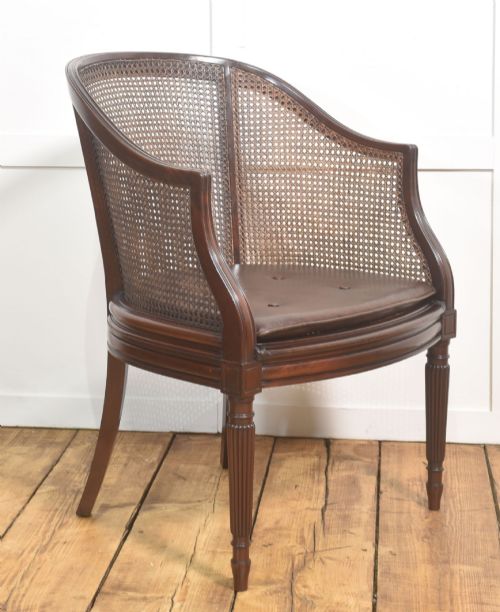
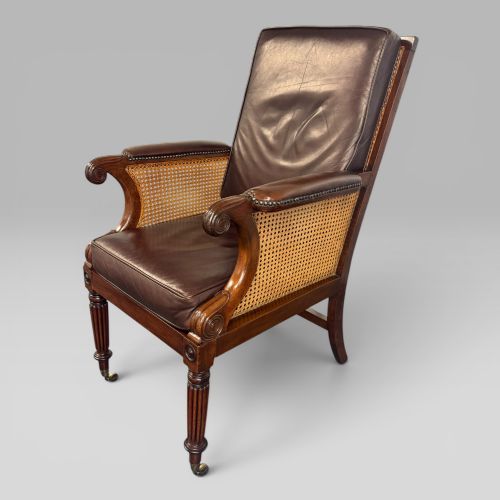


Leather Seat Cane Chair
These leather seat cane chair examples combine woven plant material and hide across periods from the nineteenth century to the twentieth.
Leather Seat Cane Chair
A leather seat cane chair brings together open woven panels and hide upholstery, appearing most frequently in library armchairs, bergères, and dining chairs. The pieces found here span the nineteenth century, Regency period, and twentieth century, incorporating revival styles such as Jacobean and Louis XV alongside classic Regency designs.
Armchairs and bergères dominate the selection, often featuring supportive cane work alongside leather squab cushions or upholstered pads. Side chairs and dining chairs also appear, offering lighter seating framed in mahogany, oak, walnut, or rosewood.
The materials reflect practical seating needs across different decades, pairing breathable cane panels with durable leather for daily use in studies, libraries, and formal rooms.
Materials and construction
Frames are constructed from hardwoods including mahogany, oak, walnut, and rosewood, sometimes accented with brass fittings or carved details. Timber selection dictates the structural weight, ranging from dense rosewood to sturdy oak.
Cane is woven tightly into frames to form resilient panels for backs and sides, while leather is utilised for seat cushions and upholstery. These natural materials are combined to balance structural flexibility with firm support.
One exceptional library chair transforms cleverly into library steps in the manner of Richard Hicks Bridgens.
Judging the work
Quality rests in the precision of the timber carving and the tightness of the cane weaving. Finer pieces demonstrate careful joinery and well-fitted leather cushions that complement the wooden frame without crowding it.
Proportion and stylistic consistency separate standard examples from finer ones. Balanced armchairs and matched sets show greater attention to traditional forms, whether executed in a Regency or revival style.
The Leather Seat Cane Chair Glossary
- Bergère
- An enclosed upholstered armchair with cane or solid sides, popular in the Regency period and later revivals. The design offers a deep, comfortable seat often accompanied by a loose cushion.
- Cane
- Woven plant material used to create open panels on chair backs and sides. It provides a lightweight yet durable structural surface.
- Mahogany
- A dense hardwood commonly utilised in nineteenth-century chair frames for its rich colour and durability. It takes a fine polish and holds intricate carving well.
- Regency
- A stylistic period spanning the early nineteenth century defined by classical restraint and revived antique forms. Furniture from this era often incorporates clean lines alongside mahogany or rosewood.
Leather Seat Cane Chair: Frequently Asked Questions
How do I clean the leather?
Wipe the leather gently with a soft, damp cloth to remove dust and surface debris.
Avoid harsh chemical cleaners that might dry out or crack the hide over time.
Are these chairs comfortable?
Many library chairs and bergères include loose leather cushions designed for extended sitting.
The supportive cane backs also offer a degree of flexible comfort compared to solid wood.
How do I date a chair?
Examine the timber species, construction joints, and stylistic details such as Regency curves or Jacobean carving.
Comparing the primary materials and overall form helps place the piece within nineteenth or twentieth-century traditions.
Can I use them daily?
These chairs function well for everyday use provided the cane panels and wooden frames remain stable.
Placing them away from direct heat sources helps preserve both the leather and the woven cane.