

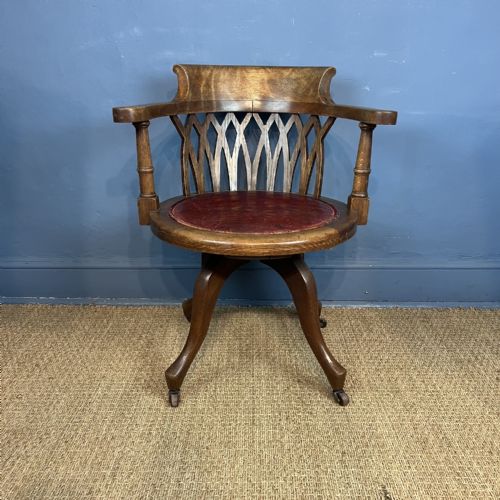
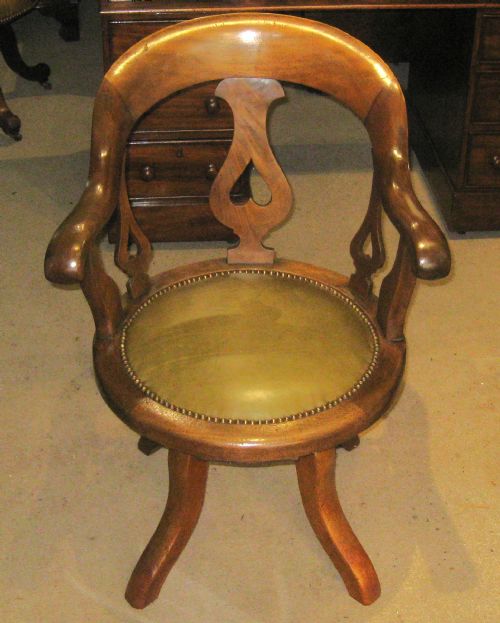
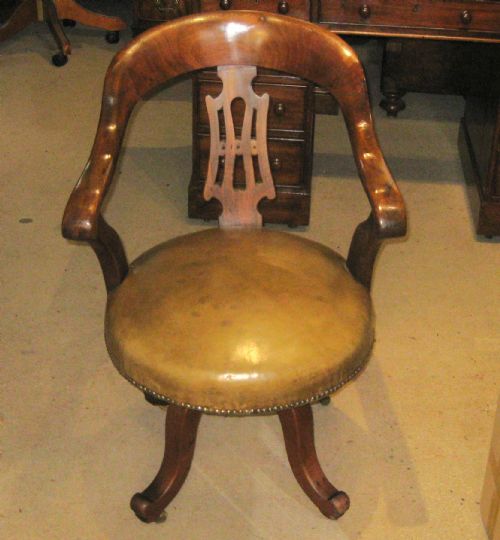
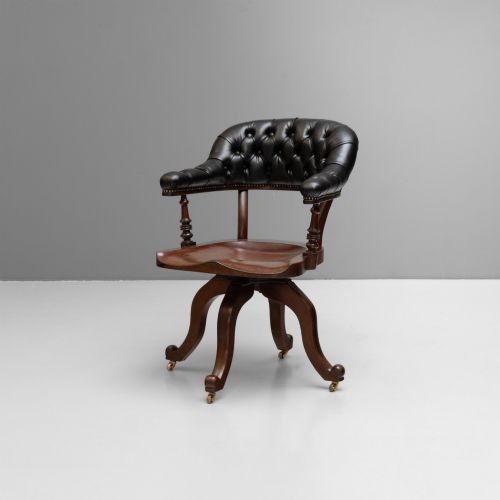


Leather Revolving Armchair
A leather revolving armchair brings traditional weight and mobility to a study, uniting a heavy timber frame with a swivelling base.
Leather Revolving Armchair
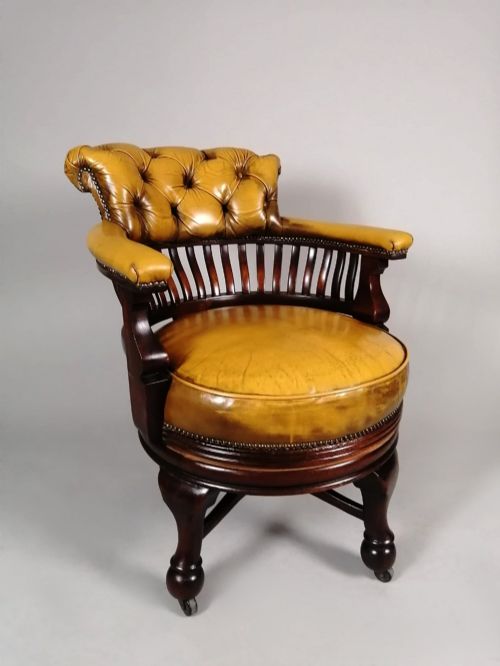
A leather revolving armchair serves as a functional seat for a desk or office, combining the comfort of an armchair with a swivelling mechanism. When exploring this phrase, buyers encounter substantial seating designed primarily for working environments.
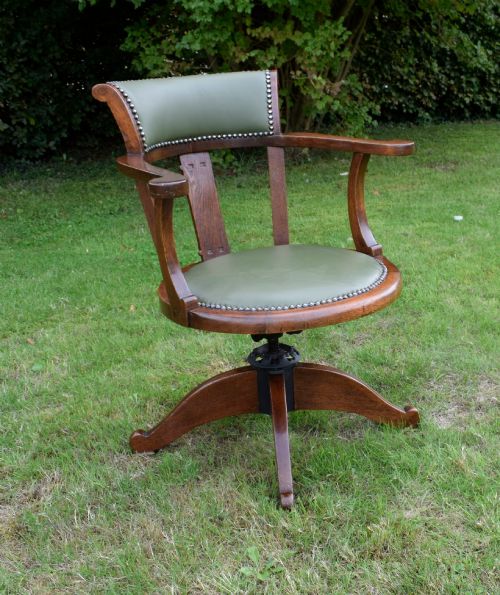
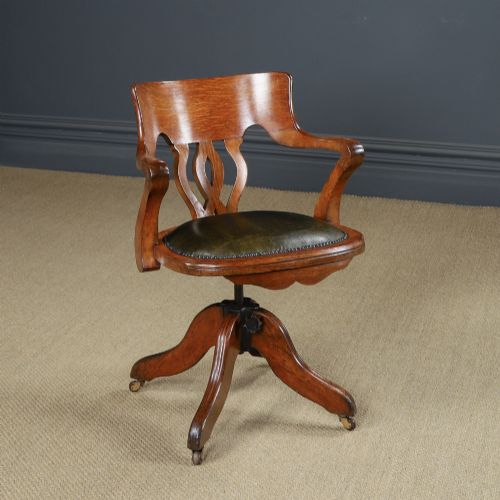
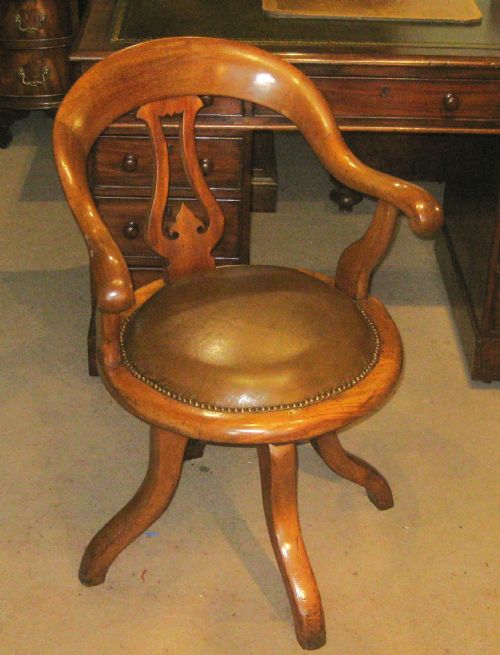
The selections span the late nineteenth century into the early twentieth century, taking the form of Victorian and Edwardian desk chairs, office chairs, and ship's chairs. Mahogany and oak dominate the timber frames, paired with upholstered leather seats.
Victorian examples often utilise rich mahogany or walnut with deep buttoning, while Edwardian pieces frequently appear in oak with adjustable swivel and tilt actions. These chairs reflect the changing demands of administrative spaces during the industrial expansion.
How they were made
Makers built these chairs using sturdy timbers such as mahogany, oak, walnut, and beech for the primary frames, supporting the weight of the swivelling mechanism. Solid wood was turned, carved, and joined to form the arms, backs, and bases.
Iron, steel, and brass components formed the revolving and tilting mechanisms hidden beneath the seat or exposed in the central column. Leather upholstery, sometimes finished with buttons, was stretched over padding and secured to the wooden seat frame with tacks.
Several entries feature ostrich leather alongside traditional bovine hides, giving administrative seating an exotic twist.
What varies in quality
The calibre of a leather revolving armchair depends on the selection of timber and the complexity of the cabinetwork in the frame. Denser hardwoods and more deeply carved details separate standard utility seating from finer library and office pieces.
The engineering of the revolving and tilting mechanism dictates the operational smoothness of the seat. Robust iron and brass swivel actions maintain their stability over decades of daily movement.
Kendrick & Jefferson·Maple & Co.
The Leather Revolving Armchair Glossary
- Swivel
- A mechanism allowing the upper portion of the chair to rotate fully around its vertical axis. This permits movement without shifting the heavy base.
- Captain's Chair
- A low-backed wooden armchair designed for comfort during long hours at a desk. These often feature curved back rails supported by numerous spindles.
- Tilt Action
- A mechanical function enabling the seat back to lean backward against spring tension. It adds a layer of ergonomic adjustment found in later nineteenth and twentieth-century designs.
- Tub Chair
- An armchair with a continuous curved back and arms forming a semi-circular enclosure. This shape envelops the sitter for added support.
- Bentwood
- Wood steamed and bent into curved structural shapes without cutting the grain. This technique provided strength and flowing lines to office seating.
Leather Revolving Armchair: Frequently Asked Questions
What is a leather revolving armchair?
A leather revolving armchair is a sturdy seating option designed for desks and offices, featuring a swivelling base and an upholstered leather seat. They emerged strongly during the Victorian and Edwardian periods to meet the needs of administrative work.
These chairs combine the structural presence of timber armchairs with mechanisms that allow rotation and sometimes tilting, making them practical for active workspaces.
How do I date a revolving desk chair?
Dating relies on examining the timber species, the style of the carving, and the engineering of the swivel mechanism beneath the seat. Victorian examples often utilise mahogany or walnut with rich finishes, whereas Edwardian versions frequently feature oak and simpler lines.
Patent dates on iron hardware or the presence of specific design markers like bentwood components also help narrow down the period of manufacture.
Were these chairs used on ships?
Some heavy oak models are designated as ship's chairs or feature maritime connections, built to withstand motion and heavy use at sea. Their weighted bases and secure revolving actions kept occupants stable in variable environments.
Over time, the heavy timber construction and durable leather upholstery made these robust forms popular in domestic studies and land-based offices alike.
How do I care for the leather upholstery?
Maintaining the leather involves keeping the hide nourished with appropriate balms to prevent drying and cracking over the years. Gentle dusting and avoiding direct sunlight help preserve the colour and suppleness of the material.
Original leather often shows patination from decades of use, which owners typically prefer to preserve rather than replace.