
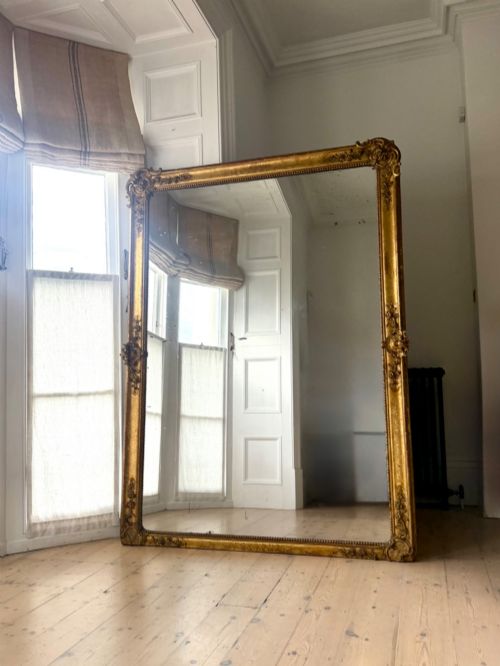
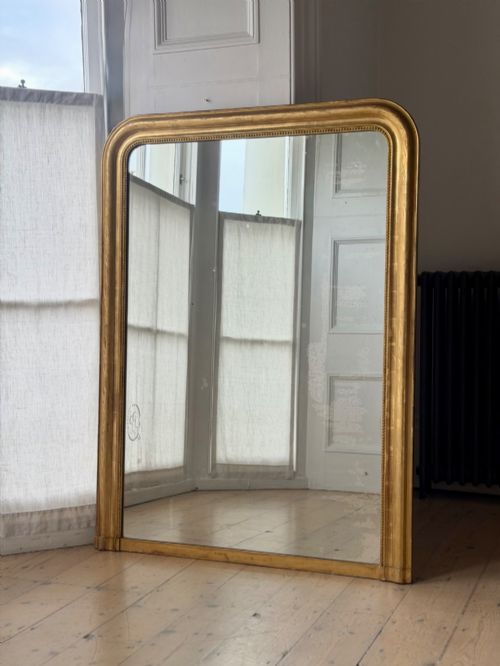
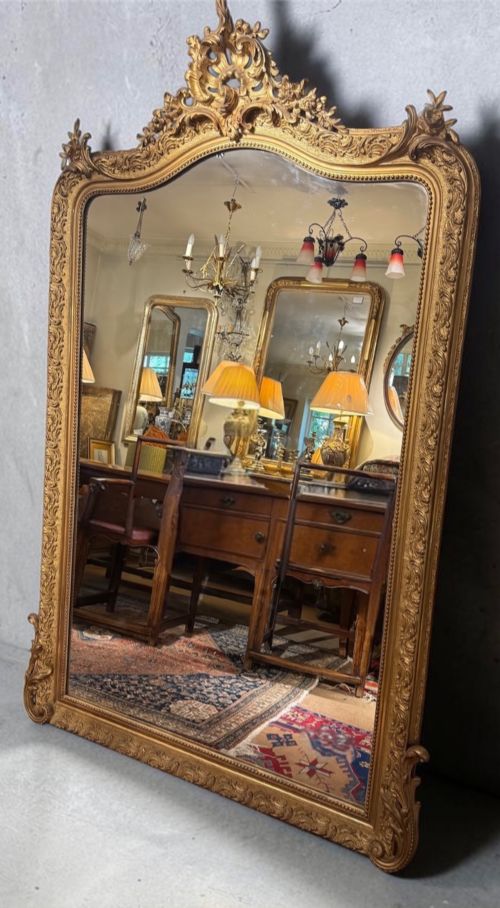


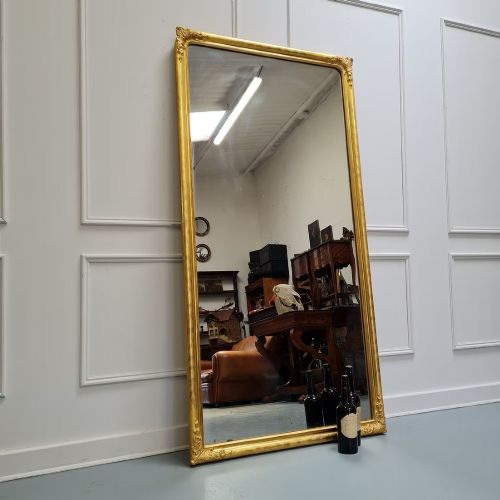


Leaning Gold Floor Mirror
A leaning gold floor mirror brings scale and reflected light to a room, offering grand proportions in giltwood and gesso.
Leaning Gold Floor Mirror
When you search for a leaning gold floor mirror, you find tall wall dressing mirrors, leaner mirrors, and overmantle mirrors designed to rest directly against a wall. These pieces originate primarily from nineteenth-century France and England, spanning periods such as Victorian, Napoleon III, Louis Philippe, and Edwardian styles. The listings on this page show large formats built to stand at full height, often featuring arched or shaped tops.
The most common examples you meet here are nineteenth-century French and English works utilising original mercury glass. Makers shaped these frames to serve as pier, console, cheval, or dressing room mirrors, creating tall and narrow profiles alongside expansive rectangular formats. They reflect nineteenth-century design tastes ranging from French Rococo Revival and Second Empire aesthetics to clean Victorian lines.
How they were made
Makers constructed the primary frames of these mirrors from wood, pine, and carved wood, building sturdy internal structures to support heavy glass. Over this wooden base, artisans applied layers of gesso and plaster composition to form intricate relief ornaments and mouldings. Giltwood frames received applications of gold leaf or silver and gold leaf to achieve a brilliant metallic sheen.
The glazing utilised heavy glass and mercury glass, held securely within large frames designed for tall floor placement. Carved wood and gesso elements were shaped by hand before gilding, resulting in ornate designs with shaped or arched tops. These traditional materials account for the substantial weight and enduring presence of nineteenth-century leaner mirrors.
Current listings feature nineteenth-century pieces from 1800 to 1900, encompassing French and English origins in Victorian and Rococo Revival styles.
What varies in quality
The standard of a leaning gold floor mirror depends heavily on the depth and crispness of the carved wood and gesso ornamentation. Finer examples display sharp, well-defined decorative details on their arched or shaped tops, whereas simpler versions show softer or more uniform mouldings. The application of the original gold leaf or silver and gold leaf also distinguishes finer pieces by its rich texture and longevity.
Another factor is the condition and authenticity of the glass itself, particularly when mercury glass is present within the original frame. Frames that retain their original gilt surfaces and structural integrity without heavy modern alterations command greater appreciation. The overall scale and proportion relative to the mirror's height ultimately set the finest examples apart from standard wall mirrors.
The Leaning Gold Floor Mirror Glossary
- Giltwood
- Wood that has been coated with gold leaf or a thin layer of gold paint. This finish gives the frame its characteristic luminous appearance.
- Gesso
- A plaster-like mixture applied to wood frames to create a smooth surface for carving and gilding. It allows for intricate relief decoration.
- Mercury glass
- A type of silvered glass produced in the nineteenth century by pouring a mercury amalgam between double-walled glass. It produces a distinctive mottled reflective quality.
- Leaner mirror
- A large tall mirror designed to stand upright by leaning against a wall rather than hanging from brackets. These pieces are often full height.
- Overmantle mirror
- A wide mirror traditionally placed on the wall above a fireplace mantel. Many nineteenth-century examples share similar gilt and gesso construction.
Leaning Gold Floor Mirror: Frequently Asked Questions
How do I safely lean a heavy floor mirror against a wall?
These large nineteenth-century mirrors require stable placement on a flat floor surface with adequate friction against the skirting board. Professional wall-anchoring straps attached to the upper frame prevent accidental tipping while maintaining the leaning aesthetic.
Ensure the weight distributes evenly across the wooden base and frame structure. Consulting a specialist helps secure heavy giltwood and gesso pieces safely in domestic spaces.
What is the difference between an overmantle mirror and a leaner mirror?
Overmantle mirrors historically sat above fireplace surrounds, featuring horizontal proportions or arched tops suited for mantel placement. Leaner mirrors are built taller and narrower to stand directly on the floor for full-body reflection.
Both types utilise similar nineteenth-century giltwood, gesso, and mercury glass materials. Their primary distinction lies in their original architectural placement and overall height proportions.
How should I clean original mercury glass and gilt frames?
Dust giltwood and gesso frames gently with a soft, dry brush to protect the delicate gold leaf surface. Avoid liquid cleaners or chemical polishes that can damage the historical finish.
Clean the glass sparingly with a soft cloth slightly dampened with distilled water. Take care to keep moisture away from the edges where the glass meets the wooden frame.
How do I identify a Napoleon III or Louis Philippe mirror?
Louis Philippe mirrors typically feature simple, elegant rectangular frames with rounded upper corners and subtle decorative crests. Napoleon III pieces often display heavier ornamentation influenced by French Second Empire and Rococo Revival styles.
Examining the carved wood, gesso relief work, and backboards reveals construction methods characteristic of these nineteenth-century French periods. Original mercury glass further confirms the historical period of manufacture.