



Late Victorian Persian Rug
These late victorian persian rug examples bring dense wool knotting and natural dyes into a room, offering durability and historical craft.

Late Victorian Persian Rug
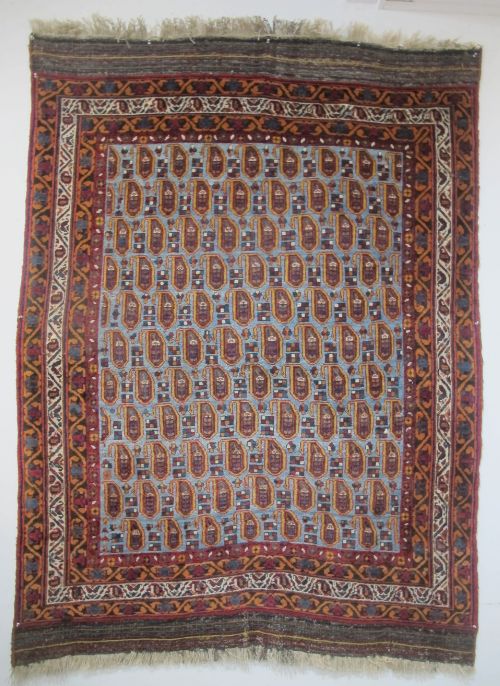
A late victorian persian rug spans village and tribal floor coverings produced across Persia and Central Asia during the final decades of the nineteenth century. Buyers searching for a late victorian persian rug encounter large carpets, room-size runners, and smaller prayer formats originating from centres such as Heriz, Sultanabad, and Fereghan. These floor coverings reflect regional weaving traditions that employ distinct design vocabularies, from geometric medallions to all-over shrub patterns.
The selection here includes pieces attributed to specific tribal confederations and regional workshops operating around eighteen-eighty to nineteen-hundred. You will find examples bearing the large-scale geometry typical of north-west Persian production alongside finer urban weaves from central districts. Each piece carries the characteristic handle and colour palette of its specific origin.
Village rugs dominate the available forms, bringing robust construction suited to everyday domestic use. These textiles bridge the gap between utilitarian floor coverings and collectible antique art, retaining the marks of hand-carded wool and vegetable colour extraction.
How they were made
Weavers constructed these carpets using hand-spun wool foundations and pile yarns, frequently employing cotton for warps and wefts in larger format carpets. The structural integrity relies on dense knotting tied by hand onto vertical looms. Natural dyes derived from plants and minerals provide the palette, yielding colours that mellow softly over decades of exposure and light.
The dying process involved botanical and mineral substances to achieve deep reds, indigo blues, and earthy tones that define the period aesthetic. Artisans worked from traditional memory designs or regional cartoons, translating geometric and curvilinear motifs onto the loom without mechanical aids.
Certain Baluch carpets display the kalam donneh pencil box motif, preserving a tiny storage box design forever knotted into the wool.
What varies in quality
Knot density and the precision of the design execution set individual pieces apart. Higher quality examples display greater intricacy in drawing and a finer balance between the wool pile and the supporting cotton or wool foundation. The handling of the material, from the initial carding of the wool to the final clipping of the pile, dictates how the surface wears over time.
The purity and depth of the natural dyes also distinguish superior rugs. Subtle variations within the colour field, known as abrage, indicate genuine vegetable dyeing where dye baths varied between batches. The sophistication of the regional design, whether a bold Serapi medallion or a delicate Fereghan field, influences the overall aesthetic impact.
The Late Victorian Persian Rug Glossary
- Warp
- The stationary vertical threads stretched on the loom across which the horizontal weft threads and knots are interlaced. They form the foundational skeleton of the rug and often appear as fringe at either end.
- Weft
- The horizontal threads passed back and forth between rows of knots to bind the structure together. In many Persian carpets, these threads are beaten down tightly to secure the pile.
- Pile
- The vertical surface of yarn loops or cut ends that forms the soft top layer of the rug. It is created by tying individual knots around the warp threads and determines the texture and depth of the piece.
- Abrash
- A natural variation in colour shading caused by changes in dye batches or hand-spun wool lots. Collectors prize this tonal shift as evidence of traditional dyeing methods.
- Prayer rug
- A small format rug featuring a mihrab or niche design at one end, traditionally used by Muslims for daily prayers. The niche points towards Mecca during use.
Late Victorian Persian Rug: Frequently Asked Questions
How do I clean a vintage wool carpet?
Professional dusting and gentle surface washing by a specialist familiar with natural dyes represent the safest maintenance approach. Vacuuming with a suction-only attachment prevents damage to the hand-tied foundation.
Avoid aggressive chemical treatments or modern steam cleaning, which can strip natural vegetable dyes and weaken old wool fibres. Regular rotation ensures even wear across high-traffic floor areas.
Can I use these rugs in high traffic areas?
Sturdily constructed village and tribal carpets handle moderate foot traffic well thanks to dense wool knotting and robust cotton or wool foundations. Placing a quality underlay beneath the rug prevents sliding and cushions the pile against hard floors.
Delicate urban prayer formats suit quieter rooms or wall placement to minimise mechanical friction on the fine wool pile. Assessing the existing condition of the foundation guides optimal placement in a home.
How do I identify a Heriz carpet?
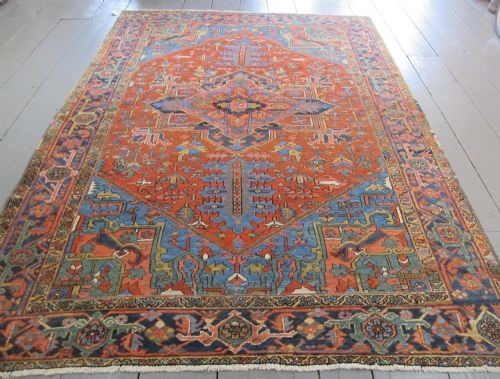
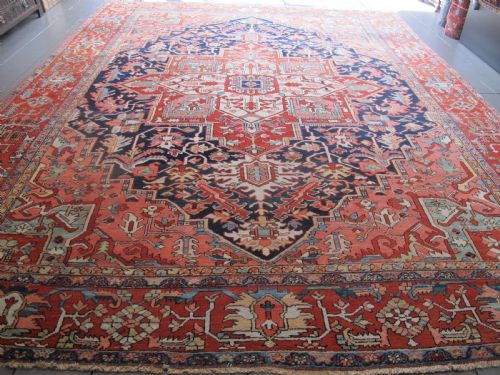
Heriz carpets from north-west Persia typically feature bold, geometric central medallions supported by massive corner spandrels and sturdy, architectural framing borders. The wool tends to be heavy and resilient, designed to withstand rigorous domestic use.
Unlike curvilinear city carpets, Heriz designs employ angular, rectilinear drawing executed with a robust palette of terracotta, indigo, and ivory.
What is a Baluch rug?
Baluch rugs originate from nomadic and semi-nomadic groups inhabiting the borderlands between Persia, Afghanistan, and Turkmenistan. They frequently utilise dark indigo and deep brown grounds offset by rich red and orange geometric motifs.
These smaller formats often incorporate camel hair in the brown areas, which can naturally wear away faster than dyed wool due to its unique chemical properties.