


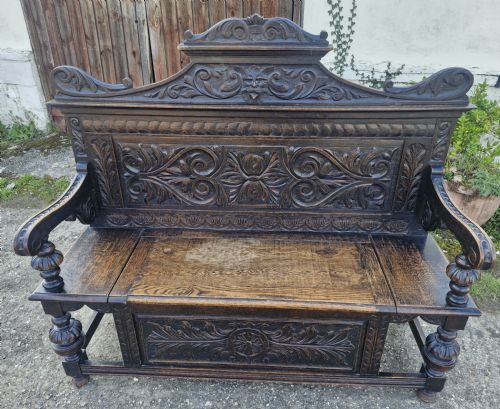


Late Victorian Hall Bench
A late victorian hall bench is a sturdy entrance seat, offering practical storage and imposing period character for any hallway.
Late Victorian Hall Bench
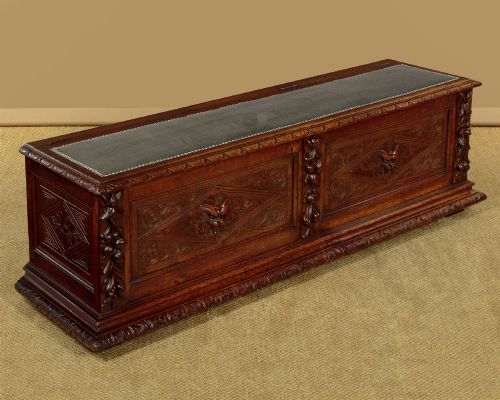
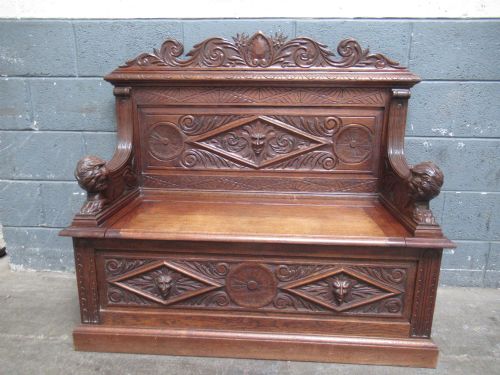
A late victorian hall bench serves as a functional entrance seat, frequently incorporating lift-up lids or hinged boxes for concealing boots and household items. The pieces seen here span the Victorian era, specifically clustered around the eighteen eighties and nineties, capturing a distinct period of domestic craftsmanship.
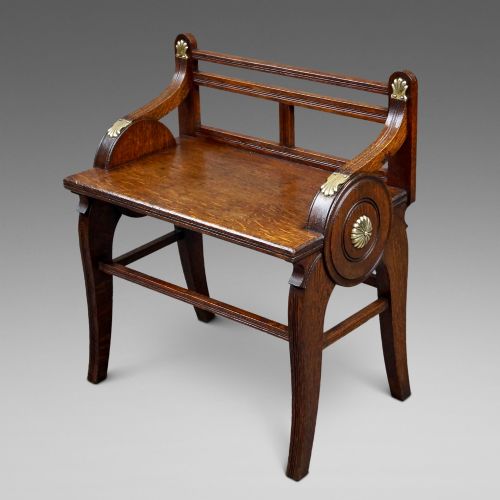
Most examples encountered on this page are constructed from oak, often featuring heavy carving and high panelled backs suited to grand or rustic hallways. Alternative woods such as mahogany, elm, and ash appear alongside variations like monk seats, settle forms, and window benches.
Materials and construction
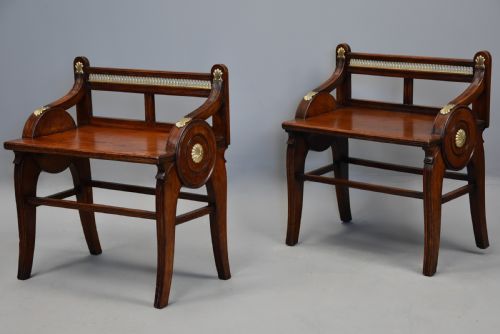
Makers of the era relied primarily on solid oak, complemented by mahogany, elm, and ash, building frames designed to withstand heavy daily use in busy entranceways. Brass mounts, hinges, and occasional leather or damask upholstery add functional detail and contrast to the dark timber surfaces.
Joinery techniques involve traditional framing and panel construction, paired with deep relief carving depicting foliage and geometric motifs. Lift-up seats are integrated cleanly into box bases or settle structures using robust iron or brass hardware.
Several examples double as tables through clever folding mechanisms, proving Victorians loved multitasking furniture just as much as we do.
Assessing quality and design
The standard of a late victorian hall bench depends heavily on the crispness of its hand-carving and the integrity of its timber. Pieces produced by documented cabinet makers demonstrate superior timber selection and more refined proportions than standard utilitarian workshop output.
The presence of original fittings, such as brass mounts and sturdy hinge mechanisms, elevates a piece above those altered or repaired with modern replacements. Furthermore, unusual structural configurations like convertible monk seats or matched pairs alter the desirability within the category.
James Shoolbred & Co.
The Late Victorian Hall Bench Glossary
- Settle
- A wooden bench with a high back, solid arms, and often a storage box beneath the seat. This form provides a draught barrier in traditional entranceways.
- Monks bench
- A versatile convertible seat featuring a hinged back that folds down to form a table top. It combines multi-functional utility with compact proportions.
- Hall bench
- A seating item placed in an entrance hall, typically incorporating coat hooks, umbrella stands, or a compartment for footwear. These pieces anchor the reception space of a home.
- Damask upholstery
- A reversible figured fabric woven on a jacquard loom, used to cover padded seats in traditional interiors. It introduces texture and pattern to the woodwork.
Late Victorian Hall Bench: Frequently Asked Questions
What is a late victorian hall bench?
A late victorian hall bench is a wooden seat designed for an entrance hallway, often featuring a high back and a lift-up lid for storing boots and accessories.
These items date from the late nineteenth century and reflect the heavy timber construction and decorative carving popular during that period.
How were hall benches used originally?
Originally placed in the entrance or vestibule of a home, these seats provided a convenient place for residents and visitors to put on or remove footwear.
Many examples included built-in storage compartments to keep hallways tidy by concealing hats, gloves, and walking sticks.
How do I identify a late victorian piece?
Identification relies on observing characteristic nineteenth-century stylistic markers, such as deep oak carving, panelled backs, and traditional joinery methods.
Materials commonly consist of oak, mahogany, and elm, sometimes accompanied by maker stamps or brass hardware typical of the era.
How do I care for an antique wooden bench?
Maintain the timber by keeping the bench away from direct heat sources and sudden temperature fluctuations that can cause wood to split or warp.
Apply suitable beeswax periodically to nourish the surface and preserve the natural sheen of the aged wood.