



Late 18th Century Commode
A late 18th century commode brings architectural line and figured timber to a room, offering practical storage disguised as formal furniture.
Late 18th Century Commode
A late 18th century commode is a low storage unit, frequently catalogued among chests of drawers or side cabinets, designed for the principal rooms of a house. These pieces bridge the shift from robust baroque forms to the refined geometry of the neoclassical period.
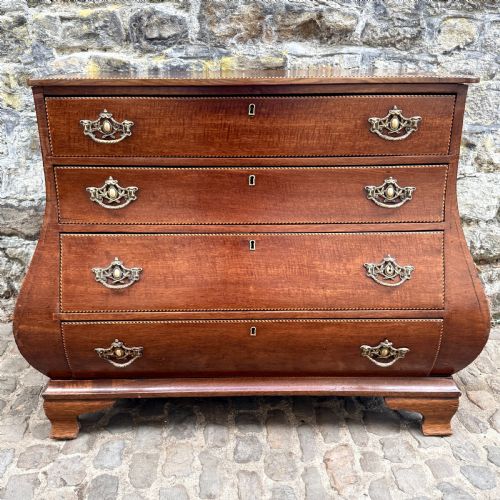
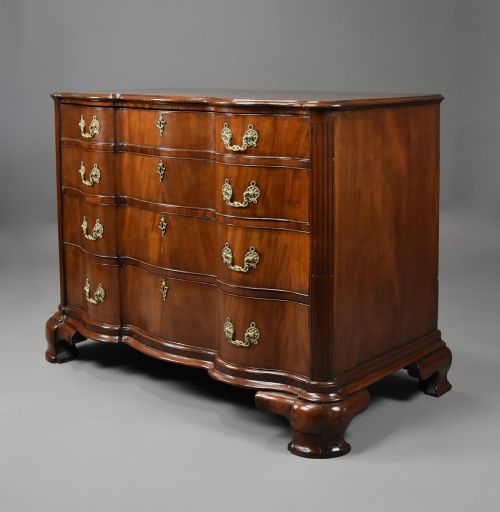
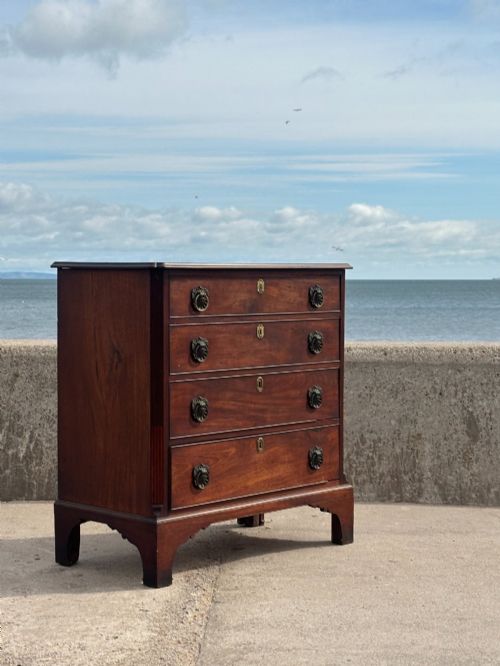
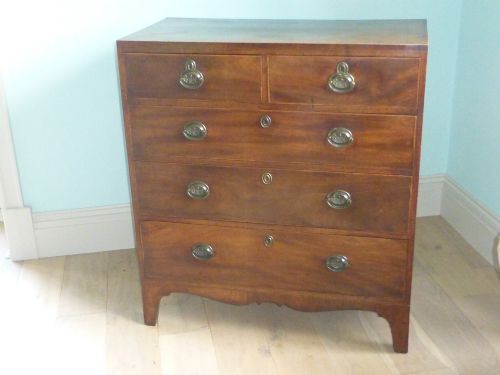
The version most commonly met on this page is the mahogany chest of drawers from the George III period, often featuring a serpentine or bow front. Alongside English pieces, continental examples in walnut, kingwood and fruitwood appear frequently.
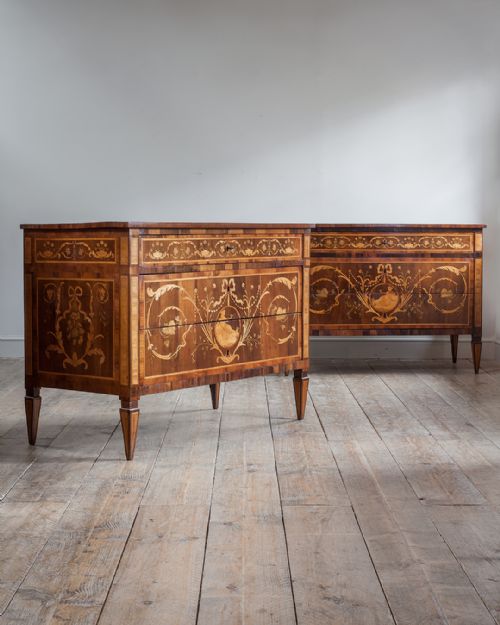
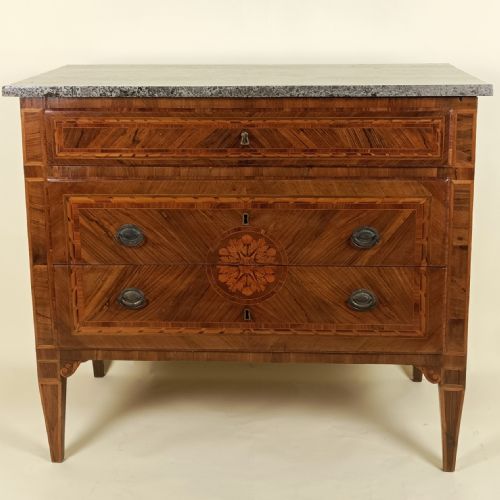
Makers and workshops across England, France, Italy and the Netherlands produced these forms, applying regional tastes such as Dutch oxbow shapes, French gilt bronze mounts and Italian marquetry to the core carcase.
Materials and construction
Cabinet makers relied upon solid timbers for structural carcases, applying veneers of mahogany, walnut, kingwood, tulip wood and satinwood to display the grain. Inlays of boxwood and stringing provided geometric contrast on drawer fronts and tops.
Secondary framing frequently utilised oak and fruitwood, while decorative enrichment included cast gilt bronze mounts, marble slabs fitted to the top surface, and detailed marquetry panels in contrasting woods.
Joinery techniques such as dovetailed drawer construction and bracket feet secured stability, while shaped serpentine and oxbow fronts required advanced skill in timber bending and hand sawing.
The listings on this site record English, French, Dutch and Italian origins, employing mahogany, walnut, kingwood and satinwood.
Factors of quality
Quality rests upon the selection of timber figures, where book-matched veneers and burr walnut or mahogany create balanced visual patterns across the drawer fronts. The crispness of inlaid boxwood stringing and marquetry further separates standard work from master execution.
Construction methods dictate longevity, visible in the hand-cut dovetails of the drawer linings and the precise fit of the carcase joints. Original hardware, such as brass handles and escutcheons, alongside undamaged marble tops, preserves the integrity of the piece.
The Late 18th Century Commode Glossary
- Serpentine
- A front shape curving outward at the centre and inward at the sides. This contour demands precise cabinet work to maintain symmetry.
- Marquetry
- The art of forming decorative patterns using thin veneers of different woods. Artisans assemble these pieces like puzzles to cover furniture surfaces.
- Crossbanding
- A border of veneer laid around the edge of a panel with the grain running perpendicular to the centre. It creates a neat visual frame for drawer fronts.
- Oxbow
- A double-curved furniture front that sweeps inward at the centre and outward at the ends. It represents an elaborate variation of the standard curved chest.
- Directoire
- A French transitional style bridging Louis XVI and the Empire periods. It is characterised by restrained classical lines and reduced ornamentation.
Late 18th Century Commode: Frequently Asked Questions
How do I spot a restored piece?
Examine the timber surfaces under good light to check for consistency in the polish and wear patterns across the top and sides. Mismatched handles or filled escutcheon holes often indicate past hardware changes.
Look inside the drawers and beneath the carcase for modern fixings or replacement secondary wood. Honest age shows through natural shrinkage and gentle, uneven fading of the veneers.
Are these commodes suitable for daily use?
These pieces function well for storing clothing, linens or tableware within modern living spaces. The generous proportions of Georgian chests offer substantial drawer capacity.
Care should be taken with marble-topped and veneered surfaces to avoid moisture damage and heavy impacts. Using coasters and placing them away from direct heat sources protects the historic timber.
How do I tell English and continental pieces apart?
English examples from this era predominantly utilise solid mahogany with understated bracket feet and boxwood stringing. The focus remains on timber grain and clean structural proportions.
Continental pieces from France, Italy and the Netherlands frequently employ walnut, kingwood or fruitwood paired with marble tops, gilt bronze mounts and complex marquetry. Their silhouettes lean toward dramatic serpentine and oxbow curves.
What does a caddy top mean?
A caddy top describes a moulded wooden surface that steps upward toward the outer edges, resembling the lid of a tea caddy. This profile adds depth and architectural definition to the top of a chest.
Cabinet makers shaped these edges by hand using specialised planes to create the characteristic stepped tiers. It appears frequently on fine Georgian mahogany pieces from this era.