


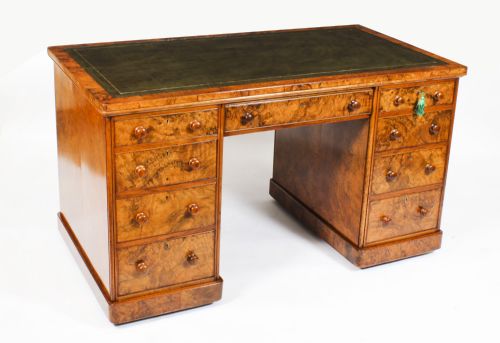


Large Walnut Office Desk
A large walnut office desk delivers serious presence and deep, rich grain, making it the anchor piece of a traditional study.
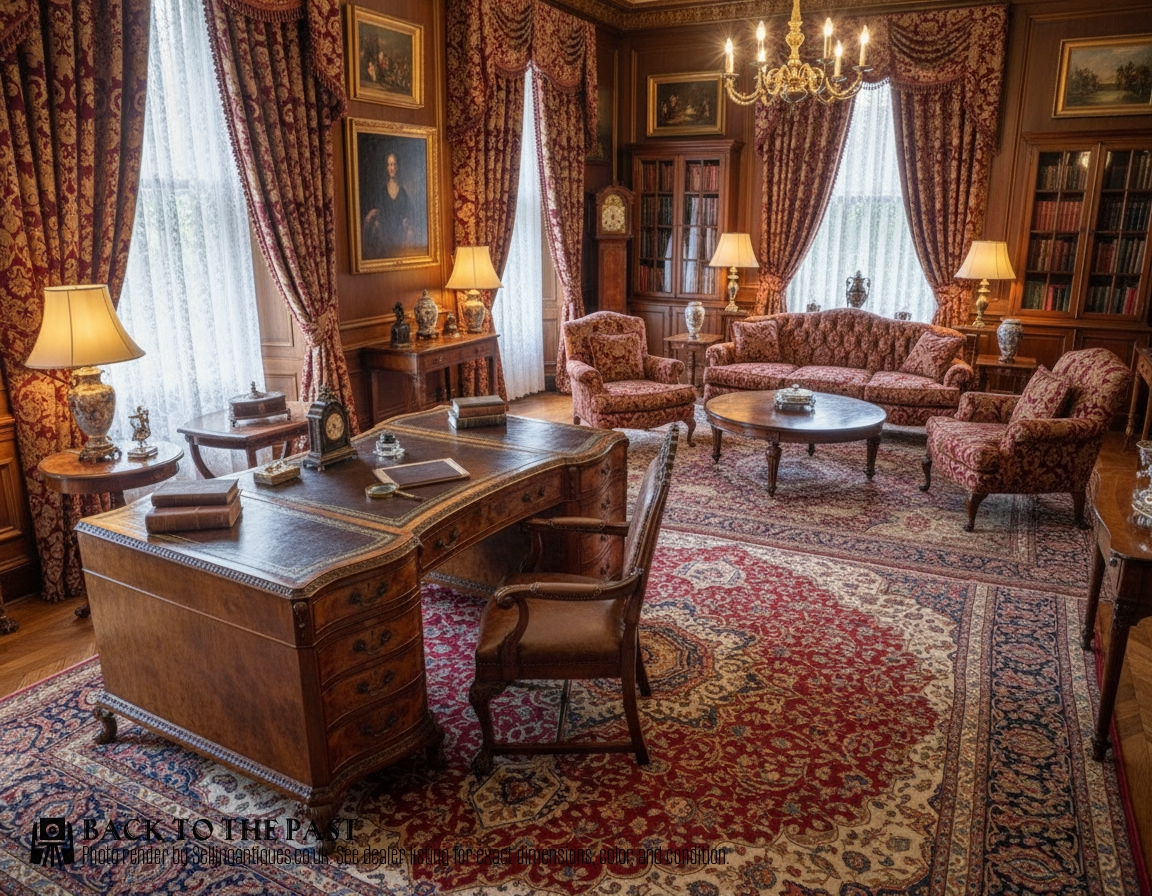
Large Walnut Office Desk
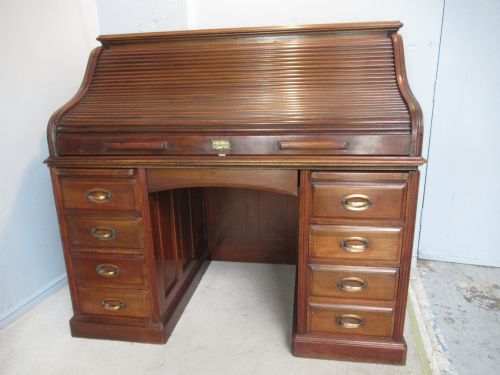
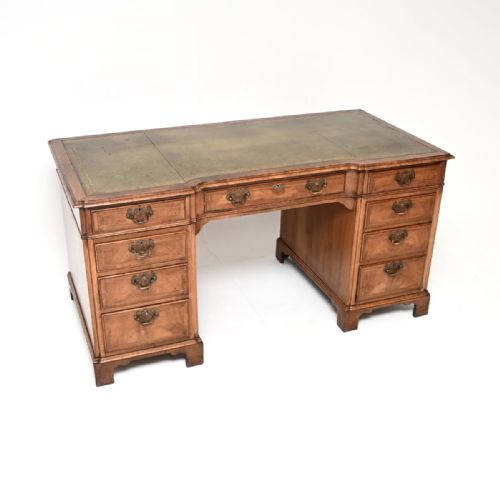
A large walnut office desk is a substantial workspace designed for professional use, most frequently appearing here as a partners desk or a pedestal desk. These pieces provide expansive writing surfaces, often lined with leather, combined with banks of drawers or cupboards beneath.
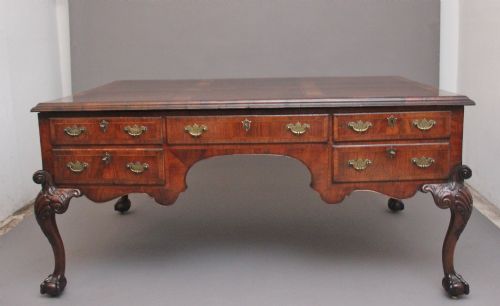
The versions most commonly met on this page date from the nineteenth century and the Edwardian era, spanning styles from Victorian and Edwardian to revival designs like Queen Anne and Chippendale. They range from kneehole configurations to double-sided partners desks meant to stand free in the middle of a room.
Makers such as Edwards and Roberts and Whytock and Reid appear in the record, alongside pieces attributed broadly to the nineteenth century or around nineteen ten. The forms draw on solid walnut and burr walnut, creating a commanding focal point for an executive office or library.
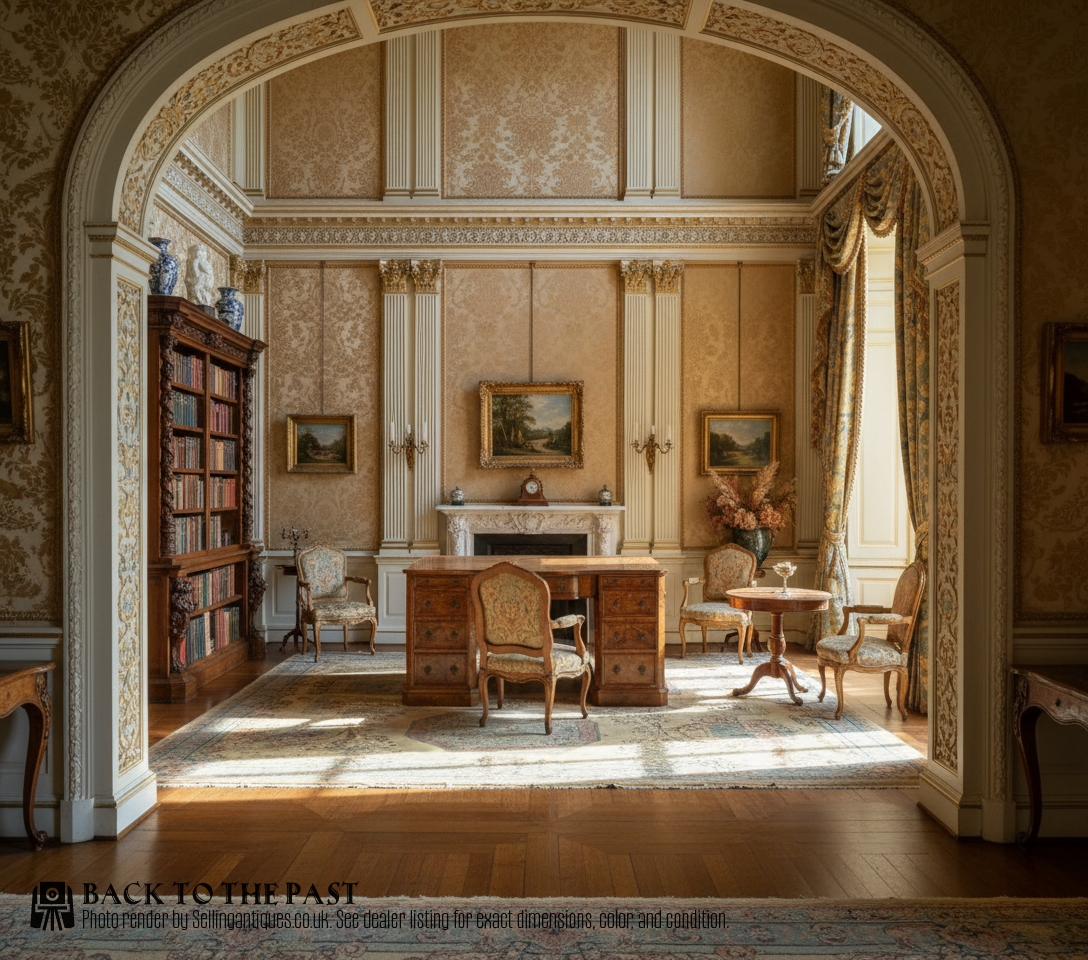
How they were made
These desks rely on walnut and burr walnut veneers applied over secondary timbers, chosen to showcase the distinctive, swirling grain patterns of the wood across expansive top surfaces and drawer fronts. Cabinetmakers matched these figured veneers symmetrically to create striking visual panels.
Writing surfaces frequently integrate tooled leather inserts, surrounded by crossbanded timber borders. Drawer construction involves traditional joinery, complemented by brass handles, escutcheons, and occasional locking mechanisms.
The listings here feature nineteenth-century and early twentieth-century desks, incorporating materials such as burr walnut, oak, brass, and leather.
What varies in quality
Quality in these desks rests primarily on the choice of timber and the dexterity of the veneer work, where superior examples display carefully selected burr walnut with rich, uninterrupted figuring. The depth of the colour and the crispness of any carved detailing, such as those found on revival pieces, further separate standard production from finer cabinetmaking.
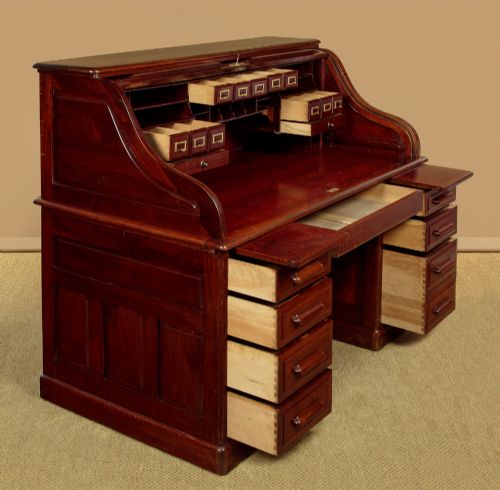
Internal construction, including solid drawer linings and the integrity of the original brass hardware, marks the distinction between workshop levels. A balanced proportion across massive partner proportions dictates whether a desk holds its visual weight successfully.
Edwards and Roberts·Whytock and Reid
The Large Walnut Office Desk Glossary
- Partners desk
- A large pedestal desk designed with drawers and cupboards on both sides, allowing two people to work opposite one another. These were traditionally used by banking partners or senior professionals.
- Pedestal desk
- A heavy freestanding desk comprising a top section resting on two separate pedestals or banks of drawers. They offer substantial storage capacity.
- Burr walnut
- Timber taken from the abnormal growth of a walnut tree, yielding highly decorative, swirling grain patterns. It is prized for fine veneer work on cabinet doors and desk tops.
- Kneehole desk
- A desk featuring a central recessed space for the user's legs, flanked by pedestals of drawers. This form provides a compact yet functional workspace.
- Crossbanding
- A strip of veneer applied perpendicularly to the main grain of a surface, often framing the perimeter of a desk top. This technique creates a neat border effect.
Large Walnut Office Desk: Frequently Asked Questions
What is a partners desk?
A partners desk is a large double-sided workspace fitted with drawers and cupboards on both the front and the back. This layout allowed two people to sit and work opposite each other in a shared office.
They were built with substantial proportions to serve senior professionals, bankers, and partners in legal or commercial firms.
How do I care for a walnut desk?
Walnut benefits from consistent indoor humidity and protection from direct sunlight, which can fade the rich natural tones of the wood over time. Regular dusting with a soft, dry cloth maintains the finish without building up residue.
Leather inserts require specific leather balms to prevent cracking, while the surrounding timber responds well to traditional beeswax polishes applied sparingly.
Are these desks suitable for modern offices?
These large desks suit contemporary workspaces provided the room has sufficient floor area to accommodate their substantial physical presence and surrounding chairs. Their generous surfaces and deep drawers offer practical storage for modern paperwork and devices.
Placing them in the centre of a room as a focal point allows the finished back of a partners desk to be fully appreciated.
How can I tell the period of a desk?
Dating relies on examining the construction methods of the drawers, the style of the brass hardware, and the predominant decorative aesthetic. Victorian and Edwardian examples often display distinct revival motifs or characteristic burr walnut veneers.
Secondary timbers inside the drawers and the style of the structural mouldings provide further clues to the exact era of manufacture.