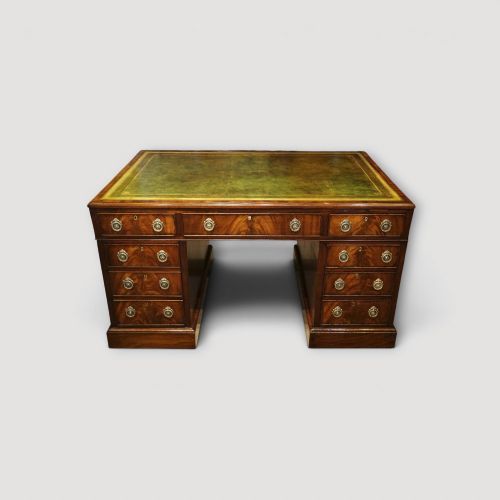
Regent Antiques has dated this Burr Walnut Partners Desk to the 1900s.
It is made from beautiful burr walnut.

It is fitted with three frieze drawers with six further drawers arranged around a central kneehole on each side. The drawers all with solid walnut linings and hand cut dovetails.
Complete with locks and key it stands on an elegant plinth base.

It is a freestanding partners desk and is the same on each side.
Instil the elegance of a bygone era to a special place in your home with this fabulous decorative antique partners desk.
Provenance:
Barrington Hall, Essex.

Condition:
In excellent condition having been beautifully cleaned, polished, waxed and releathered in our workshops, please see photos for confirmation.
Dimensions in cm:Height 78 cm x Width 178 cm x Depth 124 cm - DeskHeight 62 cm x Width 65 cm - Kneehole

Dimensions in inches:Height 2 foot, 7 inches x Width 5 foot, 10 inches x Depth 4 feet, 1 inch - DeskHeight 2 foot x Width 2 foot, 2 inches - Kneehole
Barrington Hall
is a Grade II* listed 18th-century English country house in Hatfield Broad Oak, Essex, England.

The original manor of Hatfield Broad Oak was bought by Sir Francis Barrington in 1612. The Barringtons were the hereditary woodwards (foresters) of Hatfield Forest. Prior to 1600 the family seat was an earlier Barrington Hall, which once stood on a moated site north of the village of Hatfield Broad Oak. In 1735, John Shales Barrington succeeded his cousin the 5th Baronet Barrington to the estate. He began to build a new Georgian manor but the plan was not concluded until after his death and the house was not occupied on a permanent basis until 1863. After his death, the house was owned by Sir Fitzwilliam Barrington. The Barrington family sold their interest in Hatfield Forest in 1832 to John Archer Houblon after the death of Sir Fitzwilliam Barrington.

A partners desk
is an antique desk form, which is basically two pedestal desks constructed from the start as one large desk joined at the front, for two users working while facing each other.
This piece of furniture was first conceived in the United Kingdom to accommodate the work of banking partners. These gentlemen were usually senior bank officials who wished to work together while keeping the convenience and the prestige of a pedestal desk.

Walnut & Burr Walnut
Walnut is a hard, dense, tight- grained wood that polishes to a very smooth finish. It is a popular and attractive wood whose colour ranges from near white in the sapwood to a dark hew in the heartwood. When dried in a kiln, walnut wood tends to develop a dull brown colour, but when air-dried can become a rich purplish-brown. Because of its colour, hardness and grain, it is a prized furniture and carving wood. Walnut veneer was highly priced and the cost would reflect the ‘fanciness’ of the veneer – the more decorative, then the more expensive and desirable.

Burr walnut refers to the swirling figure present in nearly all walnut when cut and polished, and especially in the wood taken from the base of the tree where it joins the roots. However the true burr is a rare growth on the tree where hundreds of tiny branches have started to grow. Burr walnut produces some of the most complex and beautiful figuring you can find.

Walnut "burrs" were often used to make fabulous furniture. Veneer sliced from walnut burl is one of the most valuable and highly prized by cabinet makers and prestige car manufacturers and is also a favourite material for shotgun stocks.
Our reference: A4772
Regent Antiques has dated this Burr Walnut Partners Desk to the 1900s.
We specialise in english and continental furniture, silver, porcelain and decorative items.
You can view the stock and full dealer information on the Regent Antiques Profile Page
Regent Antiques is a registered member of LAPADA CINOA

Antique Victorian Burr Walnut Partners Pedestal Desk Circa 1900 178x124cm