

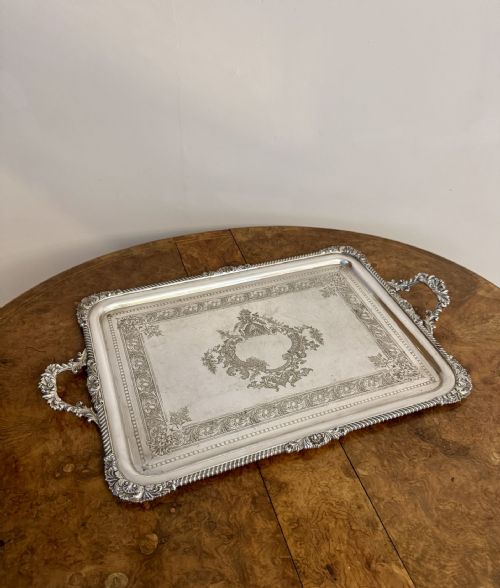
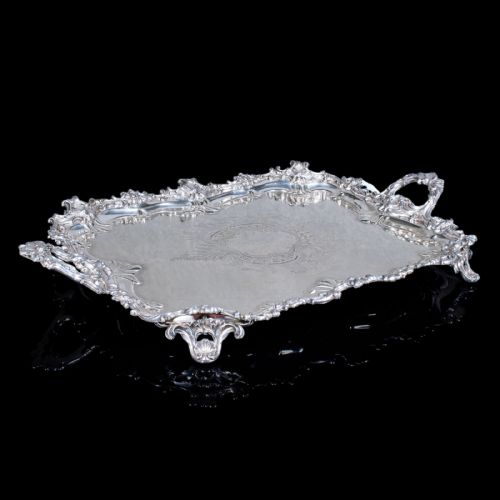


Large Silver Butler Tray
A large silver butler tray combines generous proportions with solid construction, serving both drinks and afternoon tea while anchoring a room with period weight.
Large Silver Butler Tray
A large silver butler tray is a substantial serving piece designed for carrying decanters, tea services, and cocktails across a room or presenting them on a stand. These objects appear most frequently from the Victorian and Edwardian eras, constructed in substantial dimensions to handle heavy service.
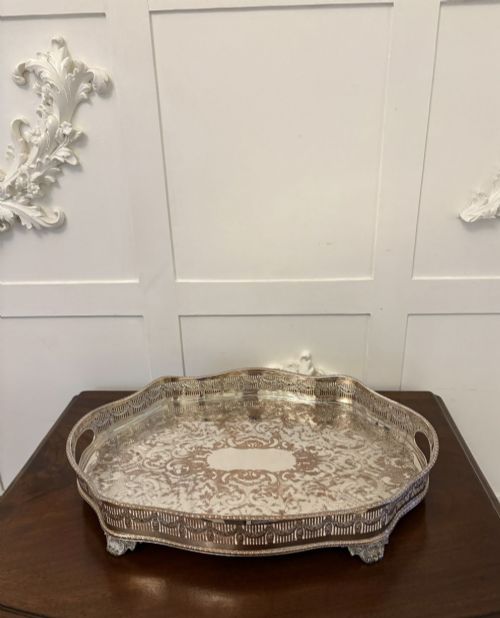
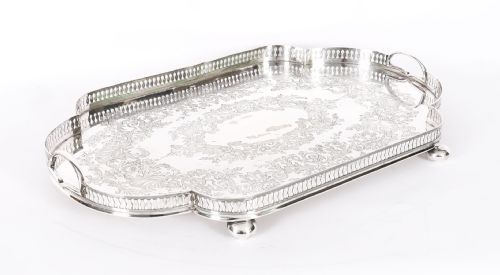
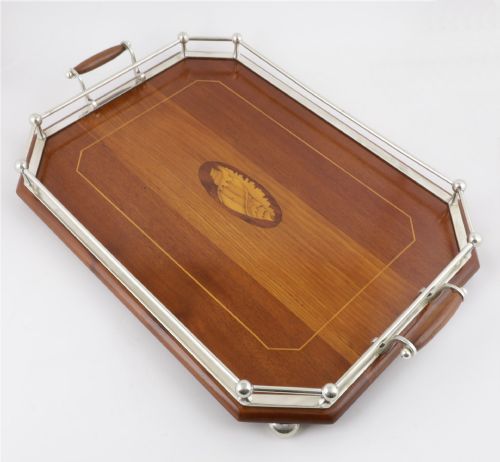
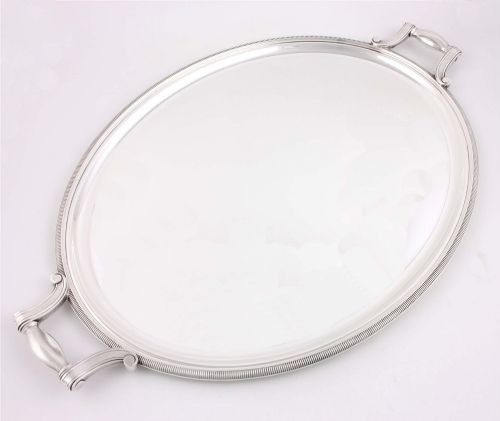
Buyers encounter forms ranging from flat engraved tea trays to gallery trays with pierced brass or silver-plated borders, alongside occasional mahogany or oak folding bases. Oval and octagonal shapes dominate the selection, often fitted with integral handles for practical carriage.
Originating primarily from English workshops and Sheffield makers, these trays reflect the formal entertaining habits of the nineteenth and early twentieth centuries. They function today as both practical drinks surfaces and decorative centerpieces on low tables.
What varies in quality
Quality rests in the weight of the metal blank and the depth of the silver deposition, which determines how well the surface resists wear over generations of use. Thicker base plates prevent flexing when loaded with heavy decanters and silver teapots.
The crispness of hand-engraving and the structural integrity of applied borders separate standard production from superior workshops. Pierced galleries and cast handles require precise soldering and clean finishing to demonstrate superior craftsmanship.
Listings feature sterling silver, silver plate, copper, mahogany, and oak across Victorian, Edwardian, and Art Deco periods.
James Deakin·Harrison Bros Sheffield·Mappin & Webb·Christofle·Elkington & Co·Hukin & Heath·Atkin Brothers·Lee & Wigfull·J.H. Potter
The Large Silver Butler Tray Glossary
- Gallery tray
- A tray featuring a raised pierced or solid metal border around the perimeter to prevent decanters from sliding off during service. These borders often incorporate pierced geometric or fretwork patterns.
- Electroplated nickel silver
- A base metal alloy of copper, nickel, and zinc coated with a layer of pure silver using an electrolytic process. This method became widespread in the nineteenth century as a durable alternative to solid silver.
- Sheffield plate
- An early fusing technique where a sheet of silver is fused to a thicker copper core by heat and pressure before rolling. Pieces made this way display characteristic copper bleed along cut edges.
- EPNS
- An abbreviation for electroplated nickel silver, commonly stamped onto the reverse of late Victorian and Edwardian serving items. It indicates the metallic composition beneath the silver plating.
- Salver
- A flat serving tray, typically round or octagonal, raised on small feet rather than fitted with carrying handles. They were traditionally used for presenting letters, calling cards, or glasses.
Large Silver Butler Tray: Frequently Asked Questions
How do I clean a silver plated tray?
Use a specialised silver cream applied with a soft cloth, working gently across the engraved surfaces to avoid removing the plating. Rinse with warm water and dry immediately with a clean cotton cloth to prevent water spots.
Avoid abrasive pastes and modern dipping solutions, which strip the protective patina and can damage the underlying copper or base metal on older pieces.
Can I use these trays for serving drinks?
These trays are fully functional for carrying glassware, decanters, and cocktail services, just as they were intended in period households. Their substantial weight and sturdy handles provide a secure grip during transport.
Place felt pads underneath heavy crystal decanters to protect the silver surface from scratching during regular use.
How do I distinguish sterling silver from plate?
Examine the reverse or rim for official hallmarks, which on British sterling include a walking lion passant, a town mark, and a date letter. Silver plated items instead carry manufacturer marks denoting electroplate or EPNS.
Sheffield plate from the eighteenth and early nineteenth centuries often reveals a thin line of reddish copper where the base metal shows through wear along high points.