


Large Living Room Carpet
A large living room carpet anchors a substantial interior with historic Persian and Turkish floor coverings woven in wool, cotton and silk.
Large Living Room Carpet
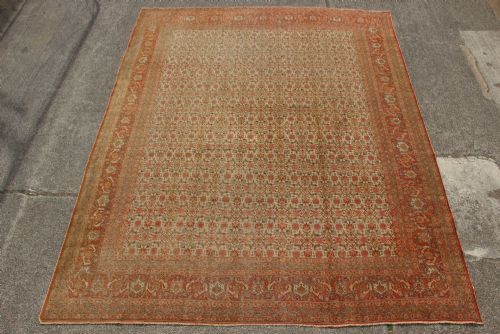
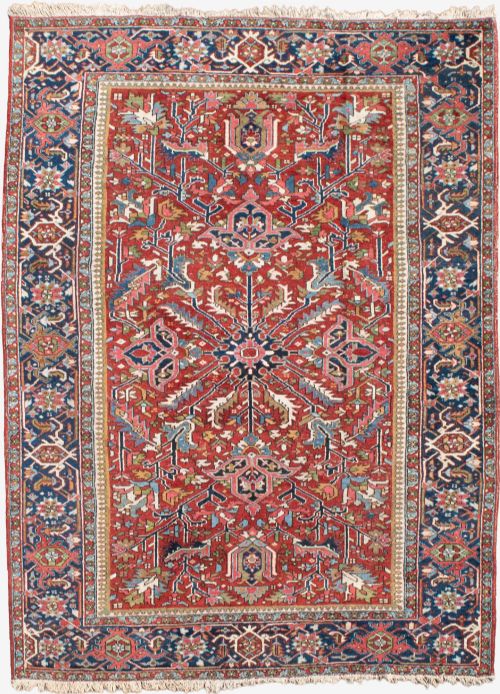
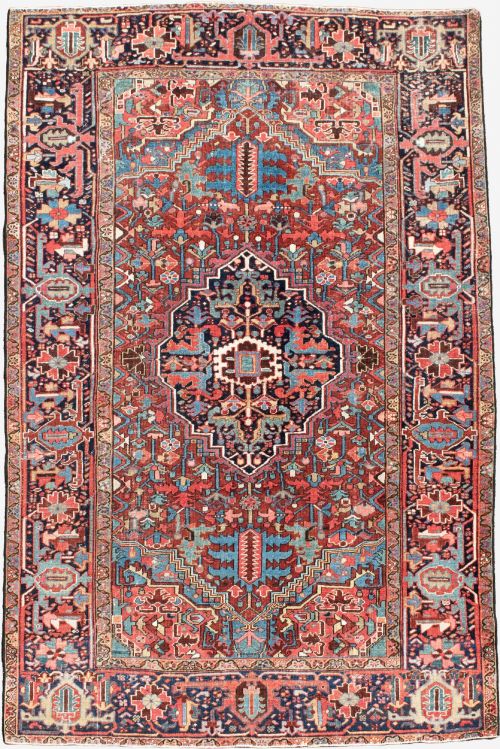
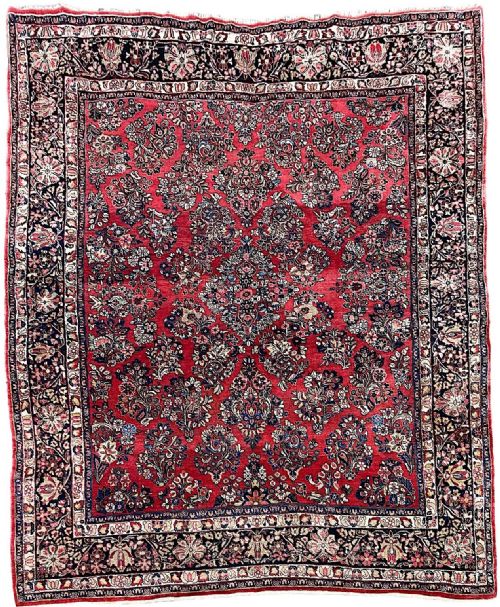
A large living room carpet encompasses historic roomsize floor coverings originating from Persia and Turkey, dating from the late nineteenth century into the early decades of the twentieth century. These textiles include geometric Heriz and Serapi weaves, floral Tabriz and Kirman pieces, and expansive Oushak carpets featuring softer pastel palettes.
The pieces appearing on this page span diverse regional traditions such as Sultanabad, Mahal, Qum, and Bakhtiari, alongside Caucasian patterns and Afghan works. Formats range from substantial roomsize dimensions to expansive country house proportions suited to generous interior spaces.
How they were made
Makers utilised hand-knotted techniques, building pile from wool sometimes combined with cotton foundations and occasional silk highlights. These natural fibres provided durable construction for heavy domestic use across generations.
Dyers employed traditional vegetable and natural colour sources to achieve rich grounds in ivory, pink, and soft pastel shades, establishing complex medallion layouts and overall botanical motifs.
Listings feature nineteenth-century and early twentieth-century roomsize carpets woven in wool, cotton, and silk across Persian and Turkish traditions.
What varies in quality
The standard of a large living room carpet rests on the density of the knotting and the precision of the drawing within the traditional medallion or all-over design. Finer knot counts allow for sharper botanical and geometric details across Tabriz, Kirman, and Qum examples.
Benlian·Maples·Ziegler
The Large Living Room Carpet Glossary
- Medallion
- A central ornamental design motif placed in the middle of the carpet field. This focal element often appears in Heriz and Oushak roomsize weaves.
- Pile
- The upright yarn surface of the carpet formed by individual knots tied to the warp and weft foundation. Pile height varies according to regional workshop practices.
- Warp
- The vertical foundation threads running the entire length of the loom upon which the knots are tied. Cotton or wool serves as the primary material for these structural elements.
- Weft
- The horizontal threads passed across the warp between rows of knots to secure the structure. This technique binds the woven fabric firmly together.
- Heriz
- A style of carpet originating from north-west Persia known for bold geometric medallions and durable construction. These pieces often feature prominent corner spandrels.
Large Living Room Carpet: Frequently Asked Questions
How do I choose a size?
Measure the room floor space carefully to ensure the rug allows furniture legs to sit comfortably upon the field.
Consider leaving a uniform border of exposed wooden flooring around the perimeter of the carpet to frame the piece correctly.
Where were these carpets woven?
These floor coverings were produced across various regional workshops and nomadic communities in Persia and Turkey.
Towns such as Tabriz, Kirman, Oushak, and Heriz developed distinct regional styles utilising local wool and traditional dye methods.
Are these carpets durable for daily use?
Hand-knotted wool construction on sturdy cotton foundations provides substantial resilience for active living spaces.
Traditional roomsize carpets were originally built for heavy domestic environments and continue to withstand regular foot traffic.
How do I identify a Heriz carpet?
Heriz carpets typically present bold geometric central medallions accompanied by large-scale angular botanical motifs.
Their robust knotting and durable structure distinguish them from finer, curvilinear Persian city rugs.