


Large Flatweave Carpet
A large flatweave carpet brings generous scale and floor-hugging texture to a room, drawing on traditions from Anatolia, the Caucasus, and Eastern Europe.
Large Flatweave Carpet
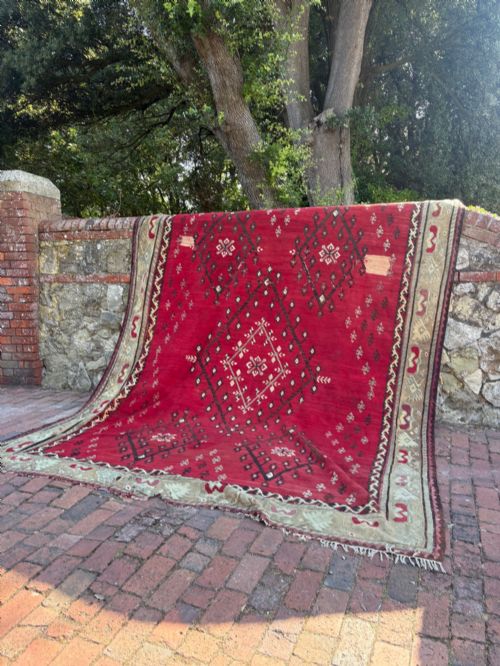
A large flatweave carpet provides a room-sized textile floor covering without the pile depth of knotted carpets, often referred to through terms such as kilim, rug, or specialised regional weaving designations. These pieces originate from diverse traditions spanning the nineteenth century through the early twentieth century, including Turkish, Caucasian, Balkan, and French workshops.
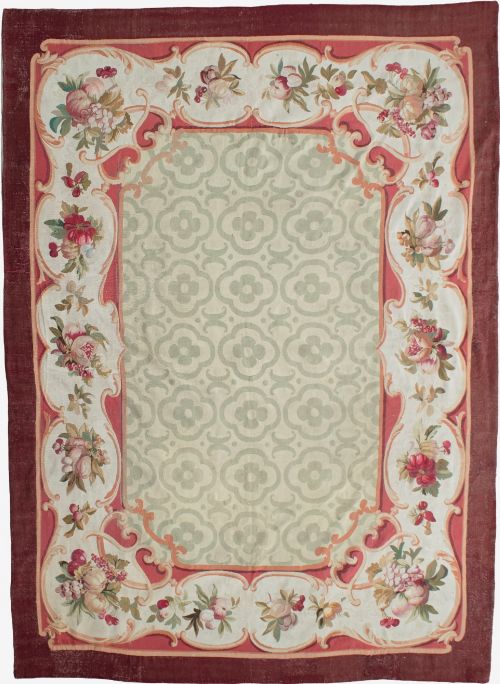
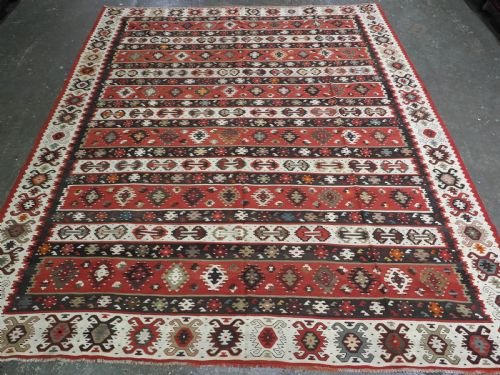
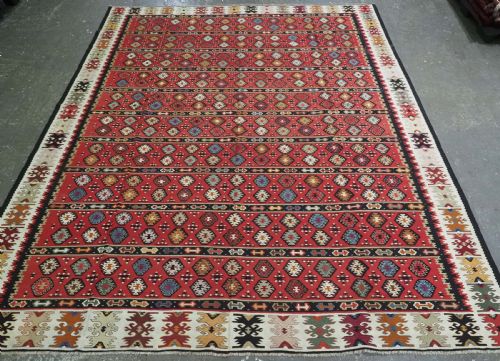
The selections available here emphasise expansive formats suited for substantial spaces, ranging from Bessarabian and Moldovan floral patterns to Anatolian tribal designs and French Aubusson weaves. Buyers encounter various regional structures, from central medallion layouts to banded and repeat patterns.
The form functions primarily as a decorative floor covering or historical textile, utilising wool and cotton foundations and surface weaves. Each piece reflects the distinct aesthetic vocabulary of its weaving origin, whether that involves nomadic tribal geometry or formal European floral arrangements.
Materials and Construction
Construction relies primarily on wool and cotton, utilised either for the structural warp and weft or as the main surface textile. Wool provides resilience and rich dye absorption, while cotton frequently forms a sturdy foundation base in many regional examples.
Techniques range from slit-tapestry weaving in traditional kilims to needlepoint and crewelwork execution seen in European and English pieces. The absence of a pile means the design is built directly into the interlace of warp and weft threads.
Dyes and motifs reflect local traditions of the nineteenth and early twentieth centuries, yielding characteristic palettes from muted pastels to saturated regional tones. The textile structure remains thin and flexible compared to knotted carpets.
The listings span the nineteenth century and the early decades of the twentieth century, focusing exclusively on wool and cotton materials.
Assessing Quality and Execution
Quality rests in the precision of the weave, the clarity of the design geometry, and the integrity of the natural materials. Finer examples display tight interlacings and balanced proportions across room-scale dimensions.
The handling of colour harmony and dye saturation distinguishes standard regional pieces from superior works. Consistency in the flat surface texture and the preservation of original edge finishes contribute significantly to the overall standing of the textile.
The Large Flatweave Carpet Glossary
- Kilim
- An untufted, flat-woven carpet or rug produced in regions of the Near East, Central Asia, and Eastern Europe. This term covers a wide variety of slit-tapestry woven textiles.
- Warp
- The vertical threads stretched on a loom before weaving begins. These parallel elements form the foundational skeleton that supports the weft.
- Weft
- The horizontal threads passed across and through the warp to create the patterned fabric. In flatweaves, the weft yarns entirely cover the warp.
- Medallion
- A large, distinct central ornamental motif placed in the middle of the carpet field. This design element frequently anchors the symmetrical geometry of tribal and village rugs.
- Aubusson
- A French style of woven carpet typically featuring classical floral or architectural motifs. These pieces derive their name from the historic tapestry-weaving town in France.
Large Flatweave Carpet: Frequently Asked Questions
How do I clean a flatweave carpet?
Maintenance requires gentle vacuuming without a rotating brush head to protect the flat surface and delicate edges. Professional textile cleaning is recommended for deeper care to preserve the wool and cotton fibres.
Avoid excessive moisture and harsh chemical treatments, which can damage historic dyes and weaken the woven structure over time.
Can these carpets be placed in high-traffic areas?
Large flatweaves function well in sitting rooms and dining spaces where furniture weight helps keep the textile stable on the floor. Their durable wool construction handles moderate foot traffic effectively.
Using a quality underlay beneath the carpet prevents slipping and reduces friction between the flatweave and the floorboards.
How do I identify the origin of a kilim?
Regional identification relies on observing specific colour palettes, border arrangements, and structural motifs unique to areas such as Anatolia, the Caucasus, or the Balkans. Certain weaving groups employ characteristic geometric symbols or distinctive floral sprays.
Comparing the weave density and material preparation provides further clues regarding whether a piece hails from a nomadic tribal group or a European workshop.
What is the difference between a kilim and a needlepoint carpet?
A kilim is created on a loom by interweaving weft threads through a warp grid to form a flat textile. The design is an integral part of the weaving process itself.
In contrast, needlepoint carpets involve stitching wool or silk yarn by hand through an already constructed canvas mesh grid. This creates a different surface texture and visual weight.