

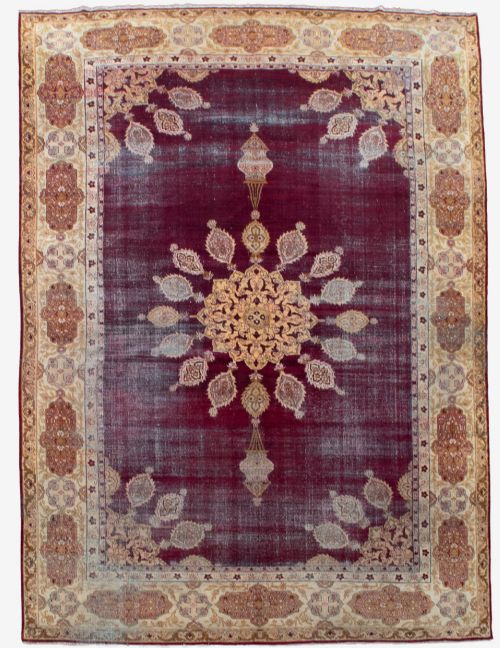
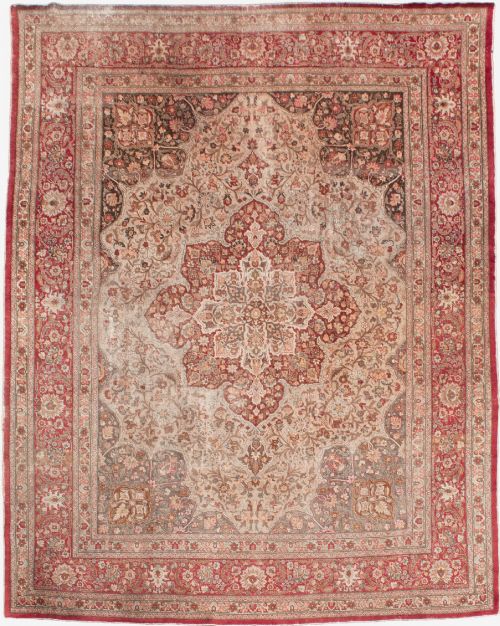


Large Country House Rug
These large country house rug pieces deliver grand scale and storied presence, anchoring a substantial room with woven warmth.
Large Country House Rug
A large country house rug brings substantial proportions and traditional patterns to a major interior space, drawing on centuries of weaving heritage. When searching for a large country house rug, a buyer encounters grand carpets from the late nineteenth and early twentieth centuries, spanning periods from eighteen fifty to nineteen twenty.
The selections on this page centre on expansive formats designed for stately interiors, originating from Persian workshops, Indian looms, and Turkmen tribal traditions. Pieces such as Amritsar, Tabriz, Heriz, Mahal, and Ziegler examples represent the core types available, alongside French Aubusson and Afghan Ersari weaves.
These floor coverings utilise generous dimensions to define principal reception rooms, libraries, and drawing rooms. The designs range from classic all-over floral grounds on ivory fields to bold medallion formats and geometric tribal compositions.
How they were made
The construction of these large carpets relies fundamentally on wool piles knotted onto sturdy cotton foundations. This pairing provides the density and resilience required for high-traffic country house environments while maintaining suppleness underfoot.
Weavers employed traditional hand-knotting techniques across various regional workshops, incorporating natural and early aniline dyes to achieve deep palettes of reds, blues, and ivory grounds. The labour-intensive creation of such monumental scales often occupied multiple artisans over many months.
Large Country House Rug Retail Price Guide 2026
Typical asking prices for large country house rug among the pieces listed under this phrase on Sellingantiques today, from the lower quarter to the upper quarter. They describe what is for sale here now, not the wider market.
The listings on this site span five decades of production between eighteen fifty and nineteen twenty, predominantly utilising wool and cotton materials.
What varies in quality
The distinction between tiers rests upon knot density, the finesse of the drawing, and the integrity of the wool. Finer examples display crisp botanical curves and precise geometric lines, whereas simpler tribal pieces show more rustic, spontaneous execution.
Proportion and pile retention govern the overall impact of the piece within a grand interior. Even wear across the surface reflects the natural ageing of genuine wool, while the depth of the dye saturation determines the enduring richness of the colour.
The Large Country House Rug Glossary
- Mahal
- A type of carpet produced in the Mahallat region of Persia known for larger scale patterns and muted colour palettes. These pieces frequently feature open field designs suitable for expansive rooms.
- Heriz
- A style originating from northwestern Persia characterised by bold geometric medallions and robust structural integrity. They utilise sturdy wool suited to heavy domestic use.
- Amritsar
- A weaving centre in the Punjab region of India that produced large decorative carpets for the western market during the late nineteenth century. These often combine traditional Persian motifs with soft pastel or neutral grounds.
- Aubusson
- A French tapestry weave produced in the town of the same name, featuring neoclassical or rococo floral and architectural motifs. Unlike piled carpets, these are flat-woven textiles.
- Ziegler
- A commercial enterprise that commissioned carpets in Persia using adapted European taste and softer palettes. These pieces balance traditional oriental designs with understated colouration.
Large Country House Rug: Frequently Asked Questions
How do I style a large country house rug?
Position the piece as the central anchor of a primary reception room, ensuring enough floor space remains visible around the perimeter. Allow major furniture groupings to rest fully or partially upon the field to unify the room.
Balance the bold patterns of these large formats with neutral upholstery and substantial architectural surroundings. The generous scale naturally commands the room without requiring competing accessories.
What periods do these carpets cover?
The pieces available date primarily from the late nineteenth century through to the early twentieth century, specifically spanning eighteen fifty to nineteen twenty. This era represents a peak period for large-scale decorative carpet production.
Manufacturing during this timeframe encompassed traditional Persian city workshops, Indian regional looms, and tribal Turkmen output. Each period brings distinct characteristics in dye usage and wool quality.
How do I care for wool carpets?
Maintain the pile through regular gentle vacuuming without a rotating brush roll to prevent fibre distortion. Professional cleaning by specialists in antique textiles preserves the integrity of the wool and cotton foundation.
Protect the piece from prolonged direct sunlight to prevent uneven fading of the natural dyes. Rotating the rug periodically ensures even wear across high-traffic areas.
Where were these carpets woven?
Production locations span traditional Persian centres such as Tabriz, Heriz, and Mahal, alongside Indian workshops in Amritsar. Tribal output from Afghan Ersari weavers also contributes to the available range.
European production is represented by French Aubusson workshops creating flat-woven floor coverings. Each region imparted distinct techniques and regional aesthetic traditions onto the finished textile.