

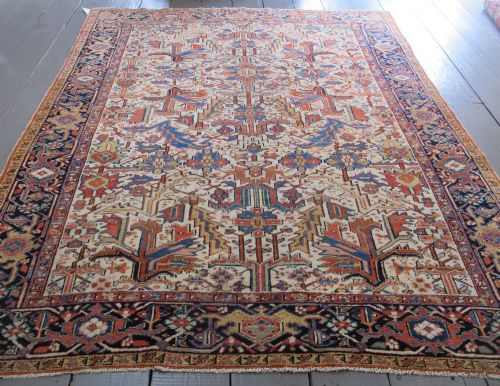
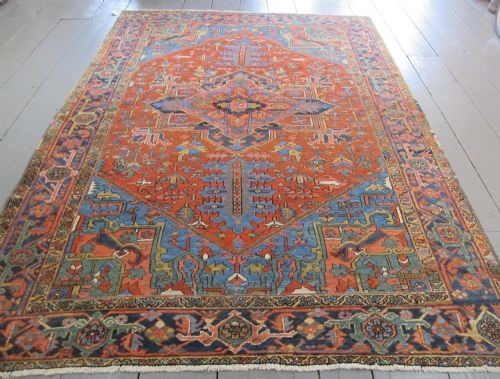
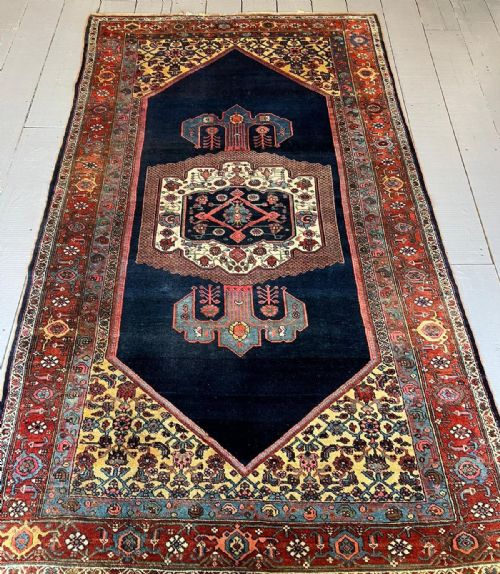


Large Persia Rug
A large antique persia rug brings floor-anchoring scale, village character, and deep botanical dyes to a room.
Large Persia Rug
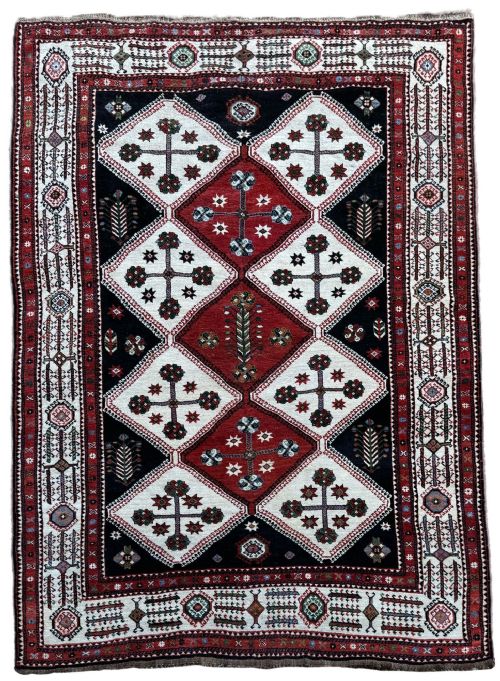
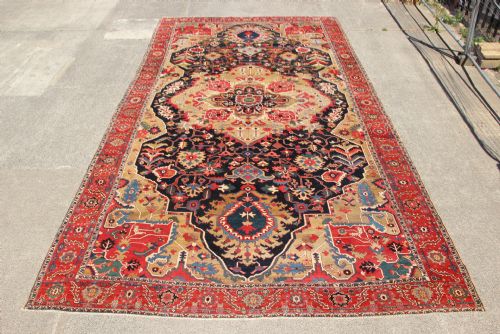
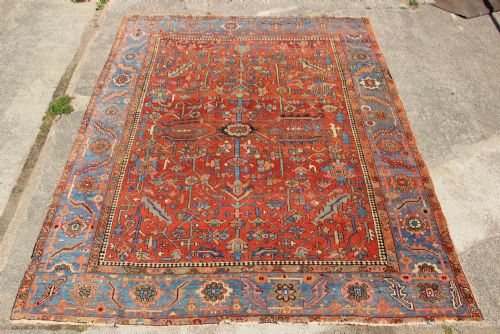
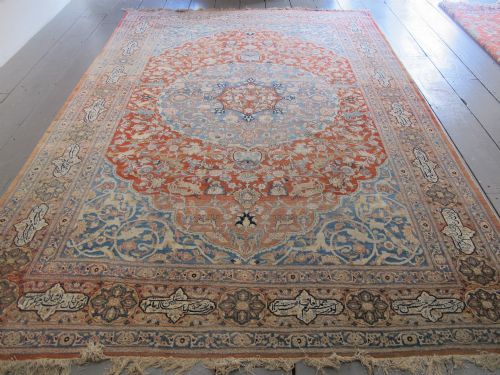
A large antique persia rug spans village floor coverings and city workshop carpets created across the nineteenth and early twentieth centuries. These sizeable room-scale textiles include grand room-size Heriz and Serapi carpets, alongside robust tribal pieces from regional weavers.
Buyers encounter regional names such as Tabriz, Mahal, Bakshiash, and Fereghan. Each centre utilised distinct knotting densities and palette choices, ranging from deep indigo grounds to warm terracotta fields.
How They Were Made
Weavers constructed these large carpets predominantly with hand-knotted wool pile secured onto cotton or wool foundations. Natural dye sources provided the rich red, blue, and gold tones observed across the historic inventory.
Nomadic groups utilised sturdy wool for durability under daily foot traffic, whereas city ateliers incorporated finer wool and occasionally silk highlights to render intricate curvilinear medallion designs.
The listings span multiple nineteenth and twentieth-century Persian origins, featuring wool and cotton materials across diverse regional formats.
What Varies in Quality
Knot density and structural integrity dictate the baseline quality of an antique carpet, separating robust village production from loose utility weaving. Tighter knot counts allowed weavers to articulate complex geometric borders and precise medallion outlines.
The purity and saturation of natural dyestuffs heavily influence visual depth across the pile. Subtle abrash colour shifts resulting from yarn batch changes enhance character, while brittle wool or heavy restoration diminish overall integrity.
Haji Jalili·Benlian
The Large Persia Rug Glossary
- Abrash
- Natural tonal variation within a single field of colour caused by changes in dye batches or wool lots. This subtle striping indicates traditional dyeing methods using natural indigo or madder.
- Medallion
- A large central ornamental design motif placed in the middle of the carpet field. Many Heriz and Serapi carpets feature bold geometric versions of this central ornament.
- Kelleh
- A long, narrow room-size carpet format traditionally utilised alongside larger floor carpets in Persian interiors. These elongated formats fit specific architectural spaces like galleries or large corridors.
- Boteh
- A stylised almond or paisley motif representing a floral shoot or cypress tree, frequently repeated across tribal and village carpets. This ancient symbol appears in various scales from small field repeats to prominent border elements.
- Warp
- The vertical foundation threads running lengthwise through the carpet, onto which the wool knots are tied. Cotton and wool serve as the primary materials for these structural elements.
Large Persia Rug: Frequently Asked Questions
How do I identify a Heriz carpet?
Heriz carpets typically present bold geometric central medallions set against terracotta or brick-red fields, framed by strong turtle borders. The wool quality is famously robust and heavy due to the mountain climate of the region.
Look for large-scale angular drawing rather than curved floral vine-scrolls, as village weavers favored simplified, powerful symmetry.
What is the difference between Serapi and Heriz?
Serapi carpets represent an older, finer, and more open-field iteration of Heriz weaving from the nineteenth century. They feature spacious geometric arrangements with exceptional balance and softer, muted dye palettes.
Standard Heriz pieces from later decades often display denser geometric patterning and stronger, more saturated primary colours across the field.
How should I care for an antique wool carpet?
Protect the textile by placing a quality breathable underlay beneath it to prevent slipping and reduce friction against hard floors. Vacuum gently with suction only, avoiding the rotating brush bars that can pull old wool pile.
Rotate the carpet periodically to ensure even exposure to foot traffic and sunlight. Professional cleaning by a specialist in antique textiles remains essential every few years.
Where were Mahal and Ziegler carpets made?
Mahal carpets were produced in the district around the village of Sultanabad in west-central Persia. They are known for large-scale, all-over floral patterns and relaxed weaves suited for Western room sizes.
Ziegler and Co was a Manchester-based firm operating in Sultanabad that commissioned large carpets with softened palettes specifically for European drawing rooms.