

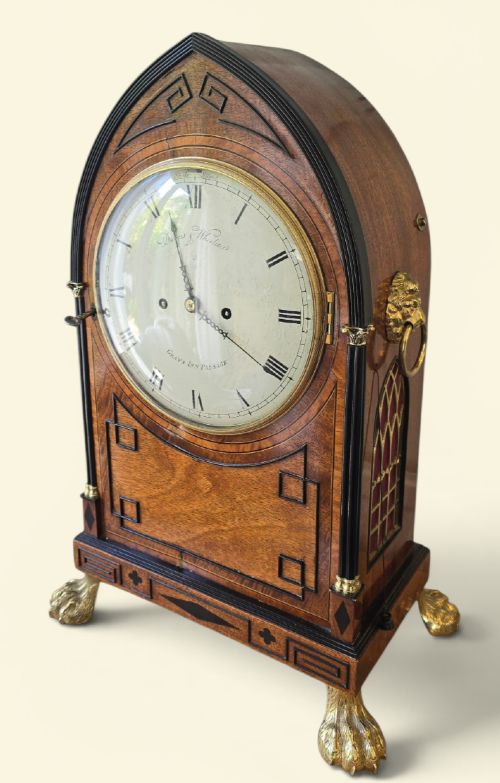


Lancet Top Clock
A lancet top clock brings the distinct pointed architectural silhouette of the Gothic revival into domestic interiors.

Lancet Top Clock
A lancet top clock is defined by its pointed, arch-topped case, mirroring the shape of a medieval lancet window. These pieces function primarily as mantel or bracket clocks, designed to sit steadily on a shelf, table or bracket.
The selections available here span several distinct periods, reaching from the Georgian and Regency eras through the Victorian period and into Edwardian times. Mahogany is the predominant wood encountered, often enriched with brass inlay or delicate stringing, though examples in rosewood and oak also appear.
Most entries function as mantel clocks or bracket clocks, while rarer longcase examples also emerge in the records. These timepieces served both a practical domestic purpose and a decorative role in period reception rooms.
What varies in quality
Quality rests in the precision of the cabinetwork and the execution of the architectural proportions. Crisp inlay work, choice timber grains such as burr mahogany, and robust brass fittings distinguish superior examples from plain variants.
The reputation of the maker also shapes the standing of a piece, with signed dials from notable London workshops representing the higher tiers of craftsmanship. The harmony between the height of the pointed arch and the body of the case determines the visual balance.
Lancet Top Clock Retail Price Guide 2026
Typical asking prices for lancet top clock among the pieces listed under this phrase on Sellingantiques today, from the lower quarter to the upper quarter. They describe what is for sale here now, not the wider market.
Listings demonstrate that mahogany is the dominant wood for lancet top clocks, complemented by occasional examples in rosewood, oak and burr mahogany.
Desbois & Wheeler·Cording of London·Wilkinson Leicester·Ganthony of London·Parkinson & Frodsham
The Lancet Top Clock Glossary
- Lancet top
- A case design featuring a sharply pointed, arched top resembling a Gothic lancet window. This architectural silhouette defines the entire form of the clock.
- Bracket clock
- A portable clock originally designed to sit on a wall bracket or a mantelpiece. Many examples retain the name even when placed directly on a flat surface.
- Fusee
- A conical pulley used in spring-driven clocks to ensure even tension as the mainspring unwinds. This mechanism contributes to accurate timekeeping across the running period.
- Single fusee
- A movement driven by a single fusee chain or cord that powers the timekeeping train only. It represents a simpler mechanical arrangement than striking or chiming variants.
- Stringing
- Thin lines of contrasting wood or material inlaid into the surface of the cabinetwork. This decorative technique highlights the edges and geometry of the case.
Lancet Top Clock: Frequently Asked Questions
Where should I place a lancet top clock?
These clocks suit prominent positions on mantelpieces, sideboards or dedicated wall brackets where the pointed architectural silhouette can be fully appreciated.
Ensure the surface is level to allow the pendulum and movement to operate with steady precision.
How do I wind an antique clock?
Use the appropriate key inserted into the dial winding holes, turning gently until resistance indicates the mainspring is fully tensioned.
Take care not to overwind the movement, as this can strain the internal brass components.
How do I tell Georgian and Edwardian clocks apart?
Georgian examples often feature rich mahogany with precise brass inlay and substantial bracket feet, reflecting the cabinetmaking styles of the early nineteenth century.
Edwardian pieces tend to show lighter mahogany construction, sometimes with simpler stringing and more standardised factory movements.
What is a striking movement?
A striking movement sounds the hours on a bell or gong inside the case, adding an auditory element to the visual display.
These clocks require a separate train of gears and an additional spring or weight specifically to power the strike mechanism.